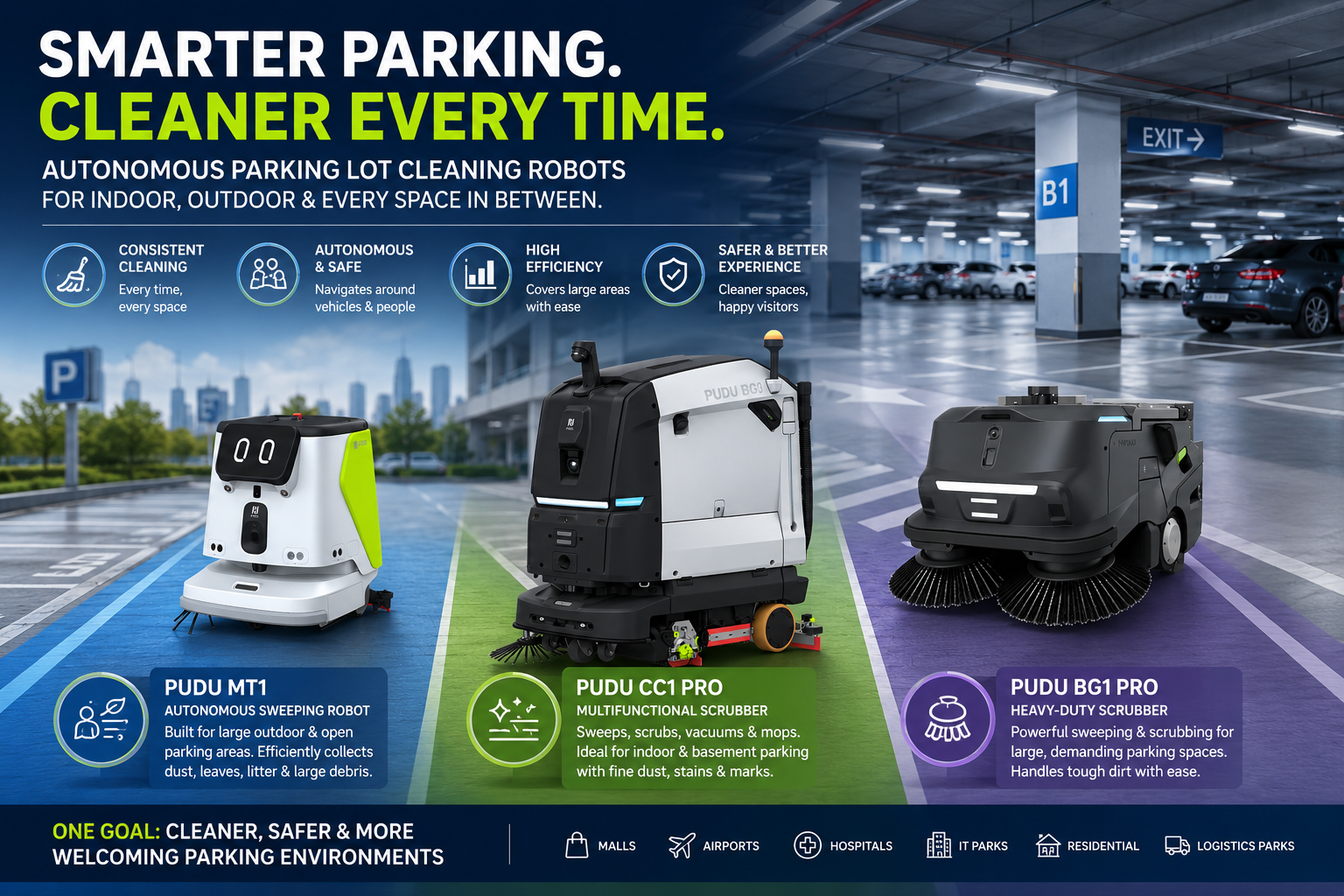
Parking areas are much more than places to park vehicles—they are often the first and last touchpoint visitors have with a commercial property. Whether it’s a shopping mall, airport, hospital, IT park, residential township, or corporate office, a clean and well-maintained parking lot creates a positive first impression while improving safety and the overall visitor experience.
However, maintaining these spaces is becoming increasingly challenging. Continuous vehicle movement, tyre dust, oil stains, litter, construction debris, and seasonal conditions like the Indian monsoon make parking lots one of the most demanding areas to clean. Traditional housekeeping methods often struggle to maintain consistent cleanliness across large parking facilities without requiring significant manpower and operational costs.
This is why parking lot cleaning robots are gaining popularity in modern facility management. Powered by intelligent navigation and parking lot cleaning automation, these autonomous machines can clean large indoor and outdoor parking areas efficiently while safely navigating around vehicles and pedestrians. From basement parking cleaning in commercial buildings to sweeping expansive outdoor parking zones, an autonomous parking cleaning robot helps improve cleaning consistency, operational efficiency, and facility appearance.
In this blog, we’ll explore the unique cleaning challenges faced by Indian parking facilities, why conventional cleaning methods are no longer enough, and how advanced solutions like the PUDU CC1 Pro, PUDU BG1 and PUDU MT1 are transforming commercial parking cleaning with smart automation.
What Are Parking Lot Cleaning Robots?
Parking lot cleaning robots are autonomous cleaning systems designed specifically for maintaining parking areas, basement parking structures, open parking zones, and commercial vehicle spaces. Unlike standard indoor cleaning machines, these robots are built to handle larger areas, rougher environments, vehicle movement, outdoor dust, and industrial-grade dirt accumulation.
Modern parking lot cleaning robots use AI-based navigation, sensors, and intelligent route planning to clean floors independently with minimal human intervention. Depending on the model and application, these robots can perform sweeping, scrubbing, vacuuming, dust control, and debris collection across high-traffic parking facilities.
As commercial infrastructure grows larger and more complex, autonomous parking lot cleaning robots are becoming a practical solution for maintaining cleanliness consistently without depending entirely on manual labor.
How Parking Lot Cleaning Automation Works
Modern parking lot cleaning automation combines AI navigation, intelligent mapping, and autonomous cleaning workflows to maintain large parking facilities efficiently.
AI Navigation
Parking lot robots use technologies such as LiDAR, cameras, and multi-sensor systems to understand their surroundings and move safely through parking areas. These systems allow the robot to detect parked vehicles, pedestrians, pillars, ramps, walls, and temporary obstacles while continuing its cleaning task.
This is especially important in commercial parking environments where layouts are constantly changing due to vehicle movement.
Route Planning
One of the key advantages of autonomous parking lot cleaning robots is their ability to follow structured cleaning routes. The robot maps the parking facility and creates optimized cleaning paths to ensure maximum coverage with minimal overlap.
This helps maintain:
- consistent cleaning schedules
- efficient coverage across large parking floors
- reduced missed spots and uneven cleaning
For multi-level parking facilities, route planning becomes even more important because different floors may have different traffic density and cleaning requirements.
Obstacle Avoidance
Parking lots are dynamic environments. Cars move unpredictably, people walk through active parking lanes, and temporary objects may appear throughout the day.
Parking lot robots use real-time obstacle avoidance systems to:
- slow down near moving vehicles
- navigate around parked cars
- avoid pedestrians and trolleys
- adapt to changing environments safely
This allows robots to continue operating even during active facility hours without causing disruptions.
Autonomous Cleaning Workflows
Once assigned a cleaning route, the robot performs cleaning tasks independently. Depending on the robot type, this may include:
- sweeping loose dust and debris
- scrubbing stains and tyre marks
- vacuuming fine particles
- mopping and drying surfaces
Many advanced parking garage cleaning robots also support automated reporting, allowing facility managers to monitor cleaning coverage, runtime, and performance analytics in real time.
Why Parking Lot Cleaning Is More Challenging Than It Looks
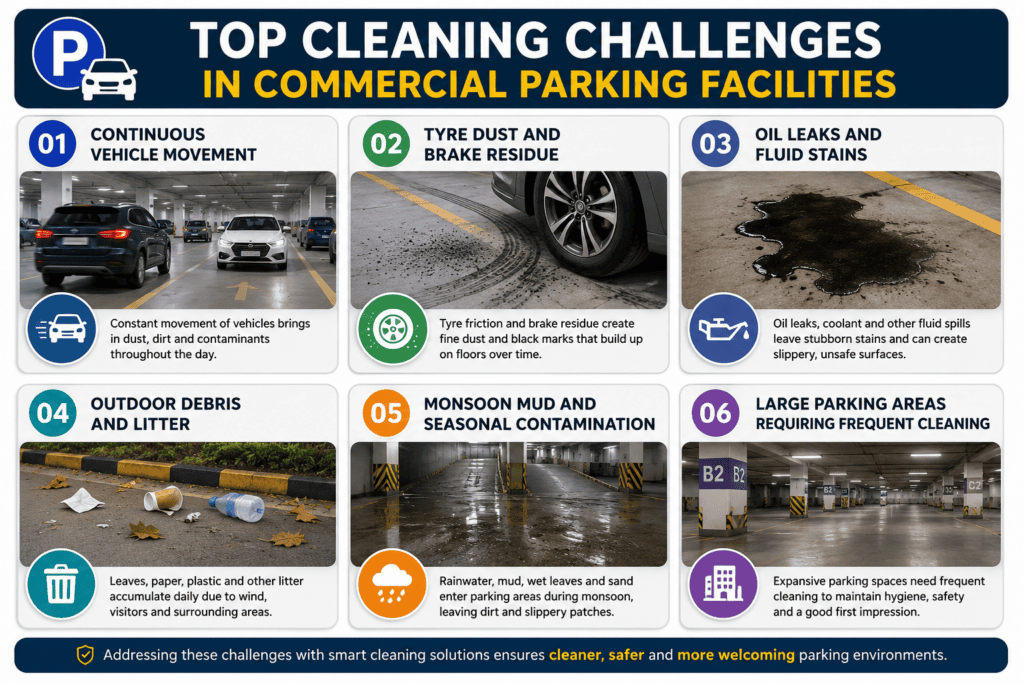 Keeping a parking facility clean is far more complex than maintaining indoor spaces such as offices, hotel lobbies, or retail stores. Unlike controlled indoor environments, parking lots are exposed to continuous vehicle movement, outdoor contaminants, changing weather conditions, and heavy pedestrian traffic. These constantly changing conditions make parking areas one of the most demanding spaces for facility management teams, increasing the need for efficient parking lot cleaning robots that can deliver consistent results.
One of the biggest challenges is the constant movement of vehicles. Every car, motorcycle, delivery van, or service vehicle entering a parking facility carries road dust, sand, mud, and fine particles on its tyres. As vehicles continue to enter and exit throughout the day, freshly cleaned floors quickly become dirty again. This makes it difficult for housekeeping teams to maintain consistently clean parking areas using periodic manual cleaning alone.
Tyre dust and brake residue are another major concern. Every time a vehicle accelerates, brakes, or turns, microscopic rubber particles and brake dust settle onto the floor. Over time, these particles combine with airborne dust to create a visible layer that affects both the appearance and cleanliness of the parking area. In basement parking facilities, where ventilation is limited, these fine particles remain suspended for longer before settling on floors, parked vehicles, and surrounding surfaces.
Oil leaks and automotive fluid stains present additional maintenance challenges. Small leaks of engine oil, coolant, brake fluid, or transmission fluid can quickly create stubborn stains if left unattended. Besides affecting the visual appeal of the parking facility, these spills may also create slippery surfaces that increase the risk of accidents. Removing such contamination requires much more than simple sweeping, making regular scrubbing an essential part of effective commercial parking cleaning.
Parking lots also accumulate a wide variety of debris every day. Outdoor parking areas collect leaves, dust, plastic wrappers, bottles, cigarette butts, and other litter carried by wind or discarded by visitors. Even indoor parking structures experience waste generated by customers, delivery personnel, and maintenance activities. Unlike indoor environments where waste generation is relatively controlled, parking facilities are constantly exposed to contaminants from both inside and outside the property.
Weather conditions further increase cleaning requirements. During the monsoon season, vehicles carry mud, standing water, and wet leaves into parking structures, leaving behind stubborn stains once they dry. During summer months, dry weather and high pollution levels increase airborne dust, which settles continuously on parking floors. Facility managers therefore need flexible cleaning schedules that can adapt to seasonal conditions throughout the year.
The scale of modern parking infrastructure also makes maintenance increasingly challenging. Airports, shopping malls, hospitals, IT parks, residential townships, and logistics parks often have multiple basement levels or extensive outdoor parking areas covering thousands of square metres. Cleaning these spaces manually requires significant manpower, careful planning, and many hours of work, making it difficult to achieve consistent results every day.
Beyond cleanliness, parking maintenance directly influences visitor safety and customer perception. Dust-covered floors reduce the overall appearance of the property, wet or oily surfaces increase the risk of slips and falls, and neglected parking areas create an impression of poor facility management. Since the parking area is often the first point of interaction visitors have with a property, maintaining it to a high standard is essential for enhancing both safety and the overall customer experience.
As these challenges continue to grow, many organisations are turning to parking lot cleaning robots to automate repetitive cleaning tasks, improve consistency, and maintain cleaner parking environments throughout the day.
Parking Lot Cleaning Challenges in Indian Commercial Facilities
Commercial parking facilities in India face a unique combination of environmental and operational challenges that make cleaning more demanding than in many other countries. Rapid urbanisation, increasing vehicle ownership, ongoing infrastructure development, seasonal weather changes, and high pollution levels all contribute to faster dirt accumulation and greater cleaning requirements. These factors have accelerated the adoption of parking lot cleaning robots and parking lot cleaning automation across modern commercial facilities.
Basement Parking Facilities
Basement parking structures are among the most challenging environments to maintain because contaminants accumulate continuously in enclosed spaces. Every vehicle entering the basement brings road dust, tyre residue, moisture, and fine particulate matter onto the floor. Since these areas receive limited natural ventilation, dust remains suspended in the air for longer before settling on floors, parked vehicles, walls, and equipment.
Cleaning is further complicated by structural pillars, narrow driving lanes, ramps, and closely parked vehicles that restrict access for housekeeping teams. As a result, dust often accumulates around corners, pillars, and parking bays where conventional cleaning equipment struggles to reach. Maintaining consistently clean basement parking is particularly important for premium residential communities, commercial office buildings, and shopping malls, where the parking facility forms part of the overall customer experience.
Shopping Mall Parking
Shopping malls experience some of the highest parking turnover rates, especially during weekends, festive seasons, and public holidays. Thousands of vehicles move through these parking facilities every day, bringing road dust, tyre marks, and outdoor debris into both basement and open parking areas.
In addition to vehicle-related contamination, shopping mall parking lots also collect food wrappers, beverage cups, shopping receipts, tissues, and packaging waste left behind by visitors. Because malls operate throughout the day, housekeeping teams often have limited opportunities to perform uninterrupted cleaning, making it difficult to maintain consistently clean floors during peak hours.
Airport Parking
Airport parking facilities operate almost twenty-four hours a day and handle a continuous flow of private vehicles, taxis, buses, rental cars, and commercial transport. These parking areas must maintain high standards of cleanliness because they are an important part of the passenger experience.
Large parking zones, constant vehicle movement, luggage trolley traffic, and limited downtime make manual cleaning both time-consuming and labour-intensive. Maintaining cleanliness across such extensive areas requires structured cleaning operations that minimise disruption while ensuring safe movement for both vehicles and pedestrians.
Hospitals
Hospital parking areas require exceptional standards of cleanliness because they serve patients, visitors, healthcare professionals, ambulances, and emergency vehicles around the clock. Clean parking facilities contribute to safer movement for pedestrians, wheelchairs, stretchers, and patient transport equipment while reinforcing the hospital’s commitment to hygiene and care.
Dust, mud, litter, and fluid spills can quickly affect both safety and appearance. Since hospitals rarely stop operating, cleaning activities must be carried out efficiently without interrupting emergency access or visitor movement.
IT Parks and Commercial Office Complexes
Corporate campuses and IT parks experience concentrated traffic during employee arrival and departure hours, while many facilities continue operating through multiple shifts. Business districts in cities such as Bengaluru, Hyderabad, Pune, Chennai, and Gurugram also experience ongoing infrastructure development, resulting in continuous construction dust settling across parking facilities.
Frequent cleaning is therefore essential to maintain professional-looking parking environments while supporting the expectations of employees, visitors, and corporate tenants.
Residential Communities
Premium residential townships and apartment complexes increasingly consider parking facilities as an extension of their common amenities. Residents expect parking areas to remain clean, organised, and free from excessive dust throughout the year.
Daily vehicle movement, visitor traffic, maintenance work, deliveries, children’s bicycles, and seasonal weather conditions all contribute to continuous floor contamination. During the monsoon season, wet tyres carry mud into basement parking, while outdoor parking areas collect leaves, sand, and rainwater residue that require regular cleaning.
Across all these environments, facility managers face common challenges including urban pollution, construction dust, changing weather, rising labour costs, and increasing expectations for cleanliness. These conditions have significantly increased interest in parking lot cleaning robots, which help commercial facilities maintain consistent cleaning standards while improving operational efficiency.
What Should an Effective Parking Lot Cleaning Solution Deliver?
The challenges of maintaining a modern parking facility cannot be solved simply by increasing cleaning frequency. The cleaning method itself needs to match the nature of the environment. A large basement parking area has very different requirements from an open airport parking lot, while a logistics facility may deal with heavier debris than a premium commercial building.
An effective parking cleaning strategy therefore begins with understanding what needs to be cleaned, how frequently it becomes dirty, and what type of contamination is most common.
For example, a basement parking floor may require regular sweeping and scrubbing to manage fine dust, tyre residue, and occasional stains. An outdoor parking area, on the other hand, may need frequent sweeping to collect leaves, paper, packaging waste, sand, and other larger debris. High-traffic commercial parking areas may require both approaches at different times.
Consistent Coverage Across Large Areas
One of the first requirements is the ability to cover large spaces consistently. Modern malls, airports, IT campuses, hospitals, residential developments, and industrial facilities may have parking areas extending across several thousand square metres and multiple levels.
Cleaning such areas effectively requires more than simply moving a machine from one end of the floor to another. The cleaning process needs to follow planned routes, minimise unnecessary overlap, and reduce the chances of sections being missed.
This is an area where parking lot cleaning automation can improve operational consistency. Once an area has been mapped and cleaning tasks have been configured, autonomous equipment can follow defined routes repeatedly rather than relying entirely on an operator to determine which areas should be covered.
The Right Cleaning Method for the Type of Dirt
Not every parking lot has the same cleaning problem.
Fine dust and dry debris may primarily require sweeping or vacuuming. Floor marks and adhered dirt may require scrubbing. Large outdoor areas may contain leaves, bottles, paper, packaging material, and other debris that requires a more capable sweeping solution.
This distinction is important when selecting parking lot cleaning robots. Facility managers should avoid treating all autonomous cleaning machines as interchangeable. The cleaning mechanism should be matched to the actual conditions of the parking facility.
For this reason, a facility may use a scrubbing-focused robot for its basement levels and a large-area sweeping robot for outdoor parking zones.
Safe Operation Around a Changing Environment
Parking facilities rarely remain static. A lane that is empty in the morning may be filled with vehicles in the afternoon. Pedestrians may cross cleaning routes unexpectedly, trolleys may be temporarily left in pathways, and vehicles may enter or leave parking spaces while cleaning is underway.
An effective autonomous parking cleaning robot therefore needs intelligent navigation and obstacle detection rather than simply following a fixed path.
The ability to detect obstacles and adapt its movement allows the robot to work within changing environments while maintaining its assigned cleaning workflow. This is particularly important in commercial parking facilities where completely closing an area for routine cleaning may not be practical.
Scheduled and Repeatable Cleaning
Parking maintenance is most effective when cleaning is preventive rather than reactive.
Instead of waiting until a parking floor becomes visibly dirty, facility teams can create cleaning schedules based on traffic patterns. High-traffic zones can receive more frequent attention, while lower-traffic sections can be cleaned according to planned intervals.
This makes autonomous cleaning particularly useful for facilities operating for extended hours. Cleaning can be scheduled during quieter periods while additional tasks can be assigned when required.
Visibility Into Cleaning Performance
Another increasingly important requirement is accountability.
Facility managers need to know more than whether a cleaning machine was switched on. They need visibility into where cleaning was performed, whether assigned tasks were completed, and how cleaning resources are being utilised.
Depending on the robotic system and configuration, digital task information and operational data can provide greater visibility into cleaning activity. This supports a more structured approach to facility management than relying entirely on manual supervision.
These requirements explain why parking lot cleaning robots are becoming relevant to large commercial facilities. The objective is not simply to automate movement. It is to create a cleaning system that is repeatable, measurable, scalable, and better suited to continuously changing parking environments.
Choosing the Right Parking Lot Cleaning Robot for Different Parking Environments
There is no single cleaning robot that is ideal for every parking facility. A basement parking area dominated by fine dust and floor marks requires a different cleaning approach from an open parking area where leaves, litter, and larger debris are the primary concerns.
This is why the three focus solutions from Pudu Robotics—PUDU CC1 Pro, PUDU BG1 Pro, and PUDU MT1—serve different roles within parking lot cleaning automation.
Rather than comparing them only through technical specifications, it is more useful to understand the actual parking scenarios in which each robot can contribute.
PUDU CC1 Pro: Multifunctional Cleaning for Indoor and Basement Parking
The PUDU CC1 Pro is particularly relevant for indoor and covered parking facilities where routine floor maintenance involves more than removing loose debris. Its multifunctional cleaning capabilities include sweeping, scrubbing, vacuuming, and dust mopping, allowing one robotic platform to address different day-to-day floor conditions.
Where Can PUDU CC1 Pro Help in a Parking Facility?
Basement parking is one of its most practical applications. Fine road dust and tyre residue continuously enter with vehicles and settle across driving lanes and pedestrian areas. Regular autonomous cleaning can help prevent this contamination from building into a persistent dusty layer.
In corporate and IT park parking facilities, cleaning can be scheduled around traffic patterns. For example, larger cleaning tasks can be performed outside peak arrival and departure periods, while routine maintenance can be planned according to the facility’s operating schedule.
For hospital parking, the combination of structured cleaning and autonomous navigation can support regular maintenance without requiring an operator to manually drive a cleaning machine across the entire parking floor. This can be particularly useful in facilities that remain active around the clock.
In hotels and premium commercial properties, the parking area forms part of the guest experience. Regular floor maintenance helps prevent dusty lanes, visible dirt accumulation, and poorly maintained entrances from undermining the standards maintained elsewhere in the property.
The same principle applies to premium residential parking. Large residential basements may need routine cleaning throughout the week, especially around vehicle lanes, lift lobbies, pedestrian routes, and frequently used sections.
The strength of the PUDU CC1 Pro in these scenarios is therefore not simply that it is autonomous. It combines several cleaning functions within one platform, making it suitable for parking environments where floor conditions vary from fine dust to dirt requiring wet cleaning.
PUDU BG1 Pro: Heavy-Duty Cleaning for Large and Demanding Parking Floors
Some parking facilities require a more intensive cleaning approach. Large commercial basements, airport parking structures, industrial facilities, and logistics environments can experience greater contamination levels, longer cleaning routes, and more demanding floor conditions.
This is where the PUDU BG1 Pro becomes particularly relevant.
The PUDU BG1 Pro combines sweeping and scrubbing capabilities for large-scale floor maintenance. Rather than focusing only on light daily cleaning, it is positioned for facilities where cleaning productivity, floor coverage, and stronger scrubbing performance are important operational requirements.
Where Can PUDU BG1 Pro Help?
In large mall parking basements, extensive circulation lanes can accumulate substantial tyre residue, road dirt, and other contamination due to high vehicle turnover. The PUDU BG1 Pro can support systematic cleaning across these larger floor areas.
For airport parking structures, the challenge is scale. Parking zones may operate for long hours while experiencing constant vehicle movement. A larger autonomous cleaning solution can help facility teams cover extensive areas more systematically.
The robot can also be relevant to industrial and logistics parking environments, where dirt conditions may be more demanding than in premium commercial buildings. Vehicle movement can introduce heavier dust and operational contamination, increasing the need for robust floor cleaning.
Similarly, large commercial campuses and multi-level parking facilities can use the PUDU BG1 Pro where extensive areas need sweeping and scrubbing as part of the same cleaning programme.
The distinction between the PUDU CC1 Pro and PUDU BG1 Pro is therefore largely application-driven. The PUDU CC1 Pro offers versatile multifunctional maintenance for controlled indoor environments, while the PUDU BG1 Pro is better aligned with larger and more demanding floor-cleaning requirements.
PUDU MT1: Autonomous Sweeping for Dust, Litter and Large Open Areas
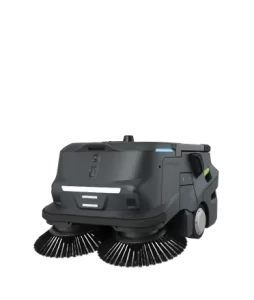
Not every parking cleaning problem requires scrubbing. In many open and semi-open parking environments, the bigger challenge is the continuous accumulation of dry dust, leaves, paper, bottles, wrappers, and other loose debris.
For these conditions, an autonomous sweeping solution such as the PUDU MT1 can be more appropriate.
Where Can PUDU MT1 Help?
Consider an open commercial parking lot next to a busy road. Dust enters continuously, wind carries leaves and packaging waste across the facility, and vehicles redistribute dirt every time they move. Instead of waiting for housekeeping teams to perform periodic manual sweeping, the PUDU MT1 can support scheduled autonomous sweeping across designated areas.
Construction-adjacent commercial properties are another relevant Indian application. Buildings located near roadwork, metro construction, new developments, or industrial zones can experience repeated dust deposition. Even after an area has been cleaned, a new layer may begin forming within hours. Regular sweeping becomes important for preventing excessive accumulation.
In airport and transportation parking areas, large open spaces may collect considerable amounts of loose debris. Autonomous sweeping can help maintain these extensive areas more consistently without requiring a manually driven sweeper to cover every route.
Logistics parks and industrial campuses present similar requirements. Packaging waste, dust, leaves, and other loose debris can accumulate around vehicle circulation and parking areas. A large-area autonomous sweeping robot can take over repetitive sweeping routes while housekeeping personnel handle specialised tasks.
The PUDU MT1 can also support large residential townships and mixed-use developments with extensive common areas and semi-open parking spaces where dry debris is a bigger concern than intensive floor scrubbing.
This illustrates why choosing the right parking lot cleaning robot should begin with the type of contamination rather than simply the size of the facility.
Which Parking Lot Cleaning Robot Fits Which Environment?
| Parking environment or challenge | Suitable solution | Primary cleaning role |
|---|---|---|
| Indoor basement parking | PUDU CC1 Pro | Routine multifunctional floor cleaning |
| Premium residential parking | PUDU CC1 Pro | Sweeping, scrubbing, vacuuming and maintenance |
| Hospital or hotel parking | PUDU CC1 Pro | Regular indoor floor maintenance |
| Large commercial basement | PUDU BG1 Pro | Large-area sweeping and scrubbing |
| Airport parking structures | PUDU BG1 Pro | Higher-capacity floor cleaning |
| Industrial parking floors | PUDU BG1 Pro | More demanding sweeping and scrubbing |
| Open parking areas | PUDU MT1 | Dry sweeping and debris collection |
| Dust-heavy parking zones | PUDU MT1 | Frequent autonomous sweeping |
| Logistics and industrial campuses | PUDU MT1 | Dust and loose-debris management |
| Mixed indoor + outdoor facility | Combination | Different robots for different cleaning zones |
For larger properties, the answer may not be choosing one robot over another. A mixed-use commercial facility could use the PUDU MT1 for open and semi-open dust-heavy areas, the PUDU CC1 Pro for routine basement maintenance, and the PUDU BG1 Pro where larger floor areas require more intensive sweeping and scrubbing.
What to Consider Before Deploying Parking Lot Cleaning Robots?
Selecting a parking lot cleaning robot should begin with an assessment of the facility rather than a comparison of product specifications alone. Two parking areas of similar size may require completely different cleaning strategies depending on whether they are indoor, outdoor, dust-heavy, wet, crowded, or exposed to industrial contamination.
Before deploying autonomous cleaning, facility managers should evaluate several practical factors.
Understand the Dominant Cleaning Problem
The first question should be: What are we actually trying to remove?
If fine dust, routine floor dirt, and regular wet cleaning are the primary concerns, a multifunctional solution such as the PUDU CC1 Pro may be appropriate.
If the facility has extensive floor areas requiring sweeping and scrubbing under more demanding conditions, the PUDU BG1 Pro may be better suited.
Where loose dust, litter, leaves, and dry debris dominate, the sweeping capabilities of the PUDU MT1 may offer a more appropriate approach.
Selecting a robot based only on floor area without understanding the contamination profile can result in an inefficient deployment.
Evaluate the Parking Layout
Pillars, ramps, narrow lanes, parking bays, speed breakers, pedestrian routes, charging stations, entry barriers, and other structural elements can influence autonomous operation.
The facility should therefore be evaluated to identify suitable cleaning zones and determine where robotic cleaning can deliver the greatest benefit.
This is particularly important in older basement parking structures that may have tighter circulation areas compared with newly developed commercial properties.
Study Traffic Patterns
Understanding when and where vehicles move is equally important.
Instead of operating the robot during the busiest period simply because autonomous operation is possible, cleaning schedules should be designed around the natural rhythm of the facility.
For example, corporate parking may offer larger cleaning windows after employees leave, while malls may provide better opportunities before opening or after closing. Hospitals and airports require more carefully distributed schedules because traffic continues throughout the day.
Consider Indoor and Outdoor Conditions Separately
A large property may require more than one cleaning approach.
An indoor basement may require scrubbing and vacuuming, while an adjacent open parking lot primarily requires sweeping and debris collection. Treating both environments as a single cleaning application may compromise efficiency.
This is why combining PUDU CC1 Pro, PUDU BG1 Pro, and PUDU MT1 according to individual cleaning zones can be more effective than trying to use one machine for every part of a mixed facility.
Plan for Human and Robot Collaboration
Robotic cleaning should form part of the wider housekeeping strategy.
Certain tasks will continue to require people, particularly detailed cleaning, inaccessible corners, waste-bin management, immediate spill response, and other unpredictable activities.
The objective should therefore be to identify repetitive, high-area cleaning tasks that can be automated and allow housekeeping personnel to focus their time where human intervention adds greater value.
Building a Smarter Parking Cleaning Strategy with Pudu Robotics
The growing complexity of parking infrastructure is changing how facility managers approach cleaning. Instead of relying exclusively on periodic manual cleaning, facilities can combine trained housekeeping teams with autonomous technology to create a more responsive and scalable maintenance programme.
Pudu Robotics offers different autonomous cleaning solutions that can address different parts of this requirement.
The PUDU CC1 Pro is suited to multifunctional cleaning in indoor and basement environments where sweeping, scrubbing, vacuuming, and dust mopping may all be required as part of routine floor maintenance.
The PUDU BG1 Pro addresses larger and more demanding floor-cleaning applications where sweeping and scrubbing performance, coverage, and operational capacity are key considerations.
The PUDU MT1, meanwhile, focuses on autonomous sweeping and debris collection, making it relevant where dry dust and loose waste represent the primary cleaning challenge.
The key is not simply selecting the most capable robot. It is selecting the right parking lot cleaning robot for the right environment.
For a large mixed-use property, this could mean using one type of robot for basement maintenance and another for larger dust-heavy or open areas. Such a zone-based approach helps facilities match cleaning technology to actual floor conditions and operational requirements.
As the authorised deployment and support partner, Autofina Robotics can help Indian businesses evaluate their parking environment, identify appropriate robotic cleaning applications, conduct demonstrations, and support deployment of Pudu Robotics solutions according to site requirements.
Frequently Asked Questions About Parking Lot Cleaning Robots
-
What are parking lot cleaning robots?
Parking lot cleaning robots are autonomous cleaning machines designed to perform tasks such as sweeping, scrubbing, vacuuming, dust mopping, or debris collection with reduced dependence on manual machine operation. They use navigation and sensing technologies to move through mapped cleaning areas and execute assigned tasks.
-
Can cleaning robots work in basement parking?
Yes. The suitability depends on the layout, floor conditions, cleaning requirements, and robot selected. For example, the PUDU CC1 Pro can support multifunctional cleaning in suitable indoor and basement parking environments, while the PUDU BG1 Pro can address larger and more demanding floor-cleaning applications.
-
Which robot is suitable for dust-heavy parking areas?
Where dry dust and loose debris are the primary challenges, an autonomous sweeper such as the PUDU MT1 may be appropriate. The final selection should consider floor conditions, debris type, layout, traffic, and operational requirements.
-
Can parking lot cleaning robots operate around vehicles?
Autonomous cleaning robots use sensing and navigation technologies to detect and respond to obstacles. However, deployment should always be planned according to the specific parking environment, traffic conditions, site assessment, and applicable operating procedures.
-
Do parking cleaning robots completely replace housekeeping staff?
No. Parking lot cleaning automation is most effective when used alongside housekeeping teams. Robots can automate repetitive large-area cleaning, while staff remain important for detailed cleaning, inaccessible spaces, waste management, spill response, and other tasks requiring human judgement.
-
Can one robot clean both indoor and outdoor parking areas?
It depends on the robot, environmental conditions, and cleaning requirement. Indoor basement cleaning and large-area dry sweeping involve different challenges, which is why facilities should select equipment according to each cleaning zone rather than assuming one machine will be optimal everywhere.
-
Which Pudu Robotics cleaning robot should a facility choose?
The choice depends on the application. The PUDU CC1 Pro is suited to versatile indoor floor maintenance, the PUDU BG1 Pro addresses larger and more demanding sweeping and scrubbing applications, and the PUDU MT1 focuses on autonomous sweeping and loose-debris collection. A site assessment is the best way to determine the appropriate solution.
Conclusion: The Future of Parking Lot Cleaning Is More Autonomous
Parking facilities are becoming larger, busier, and more important to the overall experience of commercial properties. In India, dust, pollution, construction activity, monsoon conditions, high vehicle density, and extended operating hours make maintaining these spaces particularly demanding.
Parking lot cleaning robots provide facility teams with a practical way to automate repetitive large-area cleaning while improving consistency and making better use of housekeeping resources. The key is to match the cleaning technology with the actual conditions of the facility.
The PUDU CC1 Pro provides multifunctional cleaning for suitable indoor and basement environments, the PUDU BG1 Pro supports larger and more demanding sweeping and scrubbing requirements, and the PUDU MT1 addresses autonomous sweeping and debris management.
Together, these solutions from Pudu Robotics enable facilities to move toward a more structured, scalable, and intelligent approach to commercial parking cleaning.
For Indian airports, malls, hospitals, corporate campuses, residential developments, logistics facilities, and other large properties, parking cleaning automation is ultimately about more than deploying robots- it is about creating cleaner, safer, and better-managed facilities from the moment a visitor arrives.
Request a Live Demo
Tell us about your facility and cleaning challenges. We provide Pan India support and installations. Our team will propose routes, coverage estimates, and ROI.
Email: [email protected]
Phone: +91 98192 22944 | +91 98238 30979