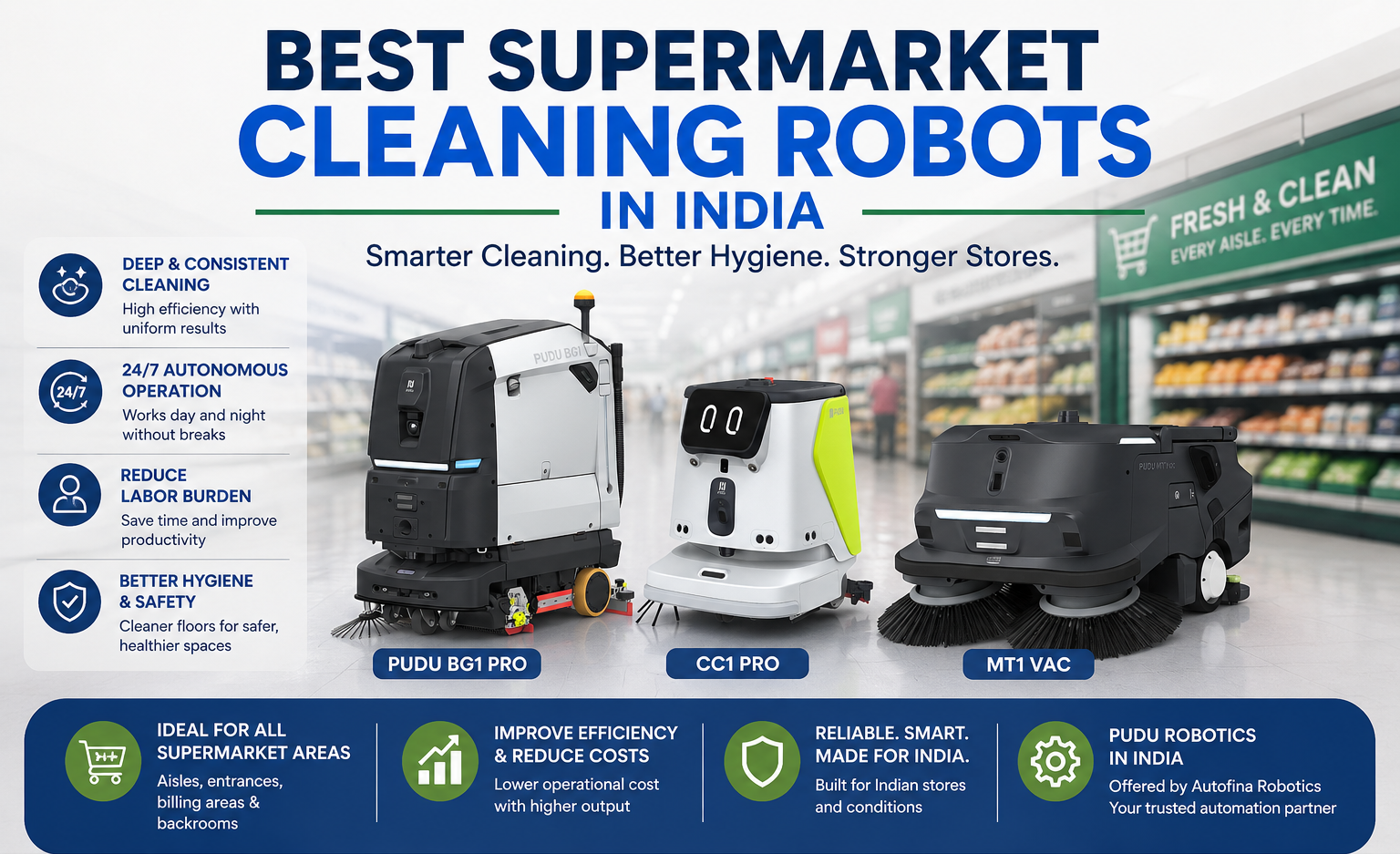
Keeping a supermarket clean is very different from cleaning an office, warehouse or other commercial facility. Supermarket floors remain active for long hours while customers, shopping trolleys, stocking teams and employees continuously move through the same spaces.
In India, the challenge is greater because supermarkets may deal with outdoor dust, loose packaging debris, food and beverage spills, produce waste, muddy footprints during the monsoon and heavy customer traffic, often within the same day. Cleaning also has to continue without unnecessarily disrupting shoppers or store operations.
This is where supermarket cleaning robots in India can support modern retail housekeeping. Instead of relying entirely on employees to repeatedly cover large floor areas, autonomous cleaning robots can handle suitable routine sweeping, vacuuming, mopping and scrubbing tasks. Pudu Robotics’ retail cleaning solutions are specifically designed around challenges such as long operating hours, high cleaning frequency, narrow and crowded spaces and inconsistent cleaning requirements across different retail zones.
However, there is no single robot that is ideal for every supermarket. The right solution depends on the store size, floor type, aisle width, type of dirt, customer traffic and cleaning frequency.
Different Supermarket Zones Need Different Cleaning Approaches
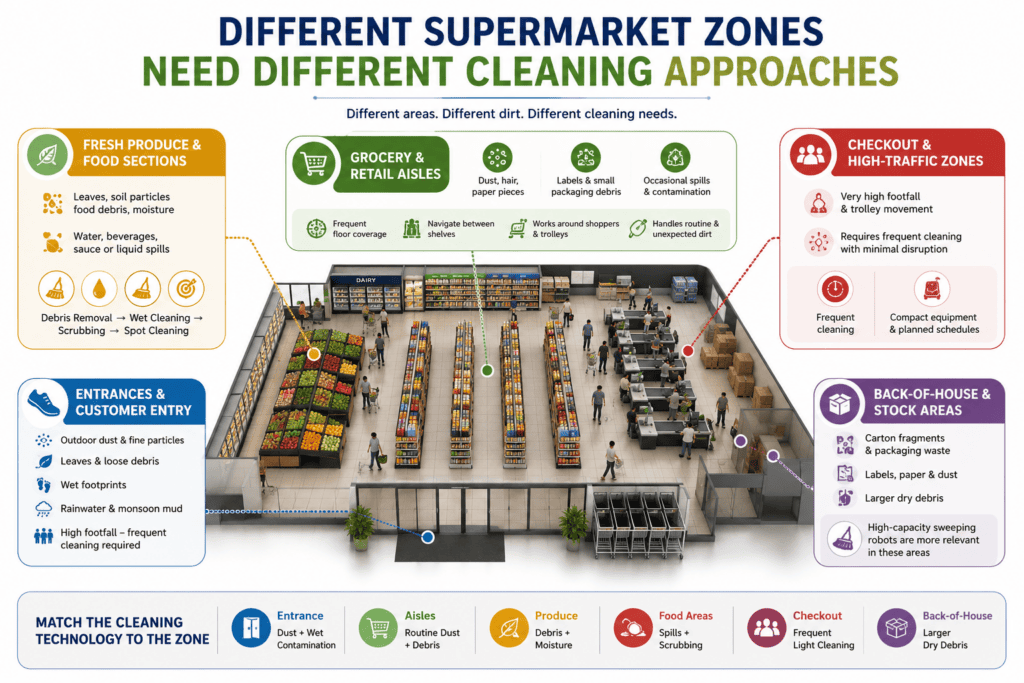
A supermarket should not be treated as one uniform cleaning area. The type and frequency of contamination can change significantly between the entrance, grocery aisles, fresh-food sections, checkout counters and back-of-house areas.
Understanding these zones is therefore important before selecting supermarket cleaning robots in India.
Entrances and Customer Entry Areas
Entrances are among the most demanding areas because outdoor contamination is continuously carried inside through footwear and shopping trolley wheels.
Common cleaning requirements include:
- outdoor dust and fine particles;
- leaves and loose debris;
- wet footprints;
- rainwater and monsoon mud; and
- frequent cleaning during high-footfall periods.
During dry weather, sweeping and vacuuming may be the priority. During the monsoon, wet cleaning and scrubbing become considerably more important.
Grocery and Retail Aisles
Main aisles generally require frequent, consistent floor cleaning rather than occasional intensive cleaning.
Typical contamination includes dust, hair, paper pieces, labels and small packaging debris. Occasional food or beverage spills may also occur.
Cleaning equipment used here should therefore be suitable for:
- repetitive daily floor coverage;
- navigating between shelving;
- operating around shoppers and trolleys; and
- handling both routine dirt and unexpected contamination.
Compact autonomous floor cleaning robots for supermarkets are particularly relevant in these areas because aisle width and customer movement can limit the practicality of larger cleaning machines.
Fresh Produce and Food Sections
Fresh produce sections create a different cleaning challenge. Leaves, soil particles, food debris and moisture can all reach the floor.
Food, dairy and beverage sections can additionally experience water, beverage, sauce or other liquid spills.
These areas may therefore require a combination of:
Debris Removal → Wet Cleaning → Scrubbing → Spot Cleaning
This is where an all-in-one robotic cleaner becomes particularly useful because the cleaning requirement can change within a relatively small area.
Checkout and High-Traffic Zones
Checkout areas experience concentrated customer and trolley traffic, particularly during evenings, weekends and festive shopping periods.
The priority here is not necessarily heavy-duty cleaning. Instead, supermarkets need frequent cleaning with minimal interference with customers.
Compact equipment and carefully planned cleaning schedules are therefore more appropriate than large machines designed primarily for open spaces.
Back-of-House and Stock Areas
Stockrooms, receiving areas and back-of-house corridors generally experience less customer traffic but may accumulate:
- carton fragments;
- packaging material;
- labels and paper;
- dust; and
- larger dry debris.
For larger supermarkets and hypermarkets, high-capacity sweeping robots can become more relevant in these areas than compact scrubbers designed for customer-facing aisles.
The key is to match the cleaning technology to the zone:
Entrance → Dust + Wet Contamination
Aisles → Routine Dust + Debris
Produce → Debris + Moisture
Food Areas → Spills + Scrubbing
Checkout → Frequent Light Cleaning
Back-of-House → Larger Dry Debris
Where Cleaning Robots Fit into Supermarket Operations
The purpose of supermarket cleaning automation is not to remove people from the cleaning process. It is to reduce the amount of repetitive floor cleaning that housekeeping teams need to perform manually.
In a traditional cleaning model, employees may repeatedly sweep, mop or scrub the same aisles throughout a shift. In a large supermarket, this consumes considerable time that could otherwise be used for tasks where manual attention is still essential.
Supermarket cleaning robots create a more practical division of work.
What Cleaning Robots Can Handle
Depending on the robot and floor conditions, automated equipment can support tasks such as:
- scheduled floor cleaning;
- sweeping and debris collection;
- vacuuming fine dust;
- dust mopping;
- floor scrubbing;
- repeated coverage of large areas; and
- targeted cleaning of suitable dirty areas.
This is particularly valuable for large supermarkets where the same floor zones need to be cleaned repeatedly throughout long operating hours.
Where People Remain Essential
Housekeeping personnel continue to handle tasks that require greater flexibility or immediate human judgement, including:
- shelves and displays;
- washrooms;
- stairs;
- difficult corners;
- waste collection;
- cleaning under inaccessible fixtures;
- urgent hazards; and
- unusual or complex spills.
A more effective supermarket cleaning model therefore looks like this:
Robots → Repetitive Floor Coverage
People → Detailed, Difficult and Exception-Based Cleaning
This approach can also help supermarket managers standardise routine cleaning. Instead of floor coverage depending entirely on when staff become available, suitable areas can be assigned scheduled robotic cleaning tasks.
For retailers evaluating robotic cleaning solutions for supermarkets, this distinction is important. Automation should be introduced where the task is repetitive, measurable and suitable for autonomous operation—not simply wherever manual cleaning currently exists.
PUDU MT1 Vac — Best for Dust, Fine Debris and Routine Dry Cleaning
Not every supermarket floor needs frequent wet scrubbing. In many stores, particularly across grocery aisles and general merchandise sections, the everyday challenge is dust, hair, crumbs and other small dry debris.
This is where PUDU MT1 Vac can complement an all-round cleaning robot such as CC1 Pro. It is designed around autonomous vacuuming and sweeping, making it particularly relevant for routine dry-floor maintenance.
Where PUDU MT1 Vac Fits in a Supermarket
MT1 Vac can be considered for areas such as:
- grocery and packaged-food aisles;
- general merchandise sections;
- checkout circulation areas;
- dry back-of-house corridors;
- entrance areas during dry weather; and
- stores where fine dust is a recurring problem.
This is especially relevant in Indian supermarkets, where dust entering through doors, footwear and trolley wheels can gradually spread across large sections of the store.
Why Vacuuming Matters in Retail
Sweeping can collect visible debris, but supermarkets can also accumulate fine dust and lightweight particles that benefit from vacuum-based cleaning.
Regular autonomous vacuuming can help maintain these areas without requiring housekeeping staff to repeatedly cover the same routes manually.
For supermarkets evaluating multiple commercial cleaning robots in India, MT1 Vac therefore has a clearly defined role:
PUDU MT1 Vac → Routine dry cleaning and fine-particle removal
It is most useful where the primary problem is dust and dry debris rather than sticky contamination requiring intensive scrubbing.
Best suited for: Grocery aisles | Dry retail floors | Fine dust | Hair and crumbs | Routine vacuuming
PUDU MT1 Max — Best for Large Supermarkets, Hypermarkets and Heavy Debris
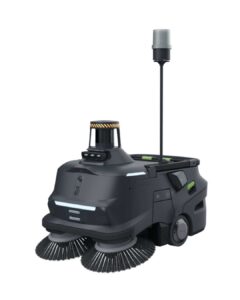
As supermarket size increases, the cleaning requirement changes. A hypermarket may contain broad circulation areas, large grocery sections, receiving zones and extensive back-of-house spaces that require considerably more floor coverage.
In these environments, PUDU MT1 Max is better positioned for large-scale autonomous sweeping.
Where MT1 Max Becomes Useful
The robot is particularly relevant for:
- hypermarkets;
- wholesale-format retail stores;
- large back-of-house areas;
- receiving and staging zones;
- wide circulation spaces; and
- areas with significant quantities of dry debris.
Instead of focusing primarily on small spills or detailed wet cleaning, MT1 Max addresses a different supermarket requirement: covering larger areas and collecting dry waste efficiently.
Handling More Than Fine Dust
Large retail environments can accumulate packaging fragments, paper, leaves and other debris that would be inefficient to collect manually across thousands of square metres.
For example, receiving and stock-handling areas may experience contamination very different from customer-facing grocery aisles.
This creates an important distinction between the two MT1 solutions:
MT1 Vac focuses more strongly on vacuuming and routine dry-floor cleaning, while MT1 Max is better suited to large-area sweeping and more demanding debris collection.
For supermarket operators, choosing between them should therefore depend on the contamination profile rather than simply store size.
Best Fit Within the Supermarket
MT1 Max makes the most sense when there are large, relatively open areas requiring repeated sweeping. It may be less appropriate as the primary cleaner for narrow, congested grocery aisles where a smaller multifunctional robot could provide greater flexibility.
Best suited for: Hypermarkets | Large open floors | Receiving zones | Back-of-house areas | High-volume dry debris
PUDU BG1 Pro — Heavy-Duty Cleaning for Large Supermarket Floors
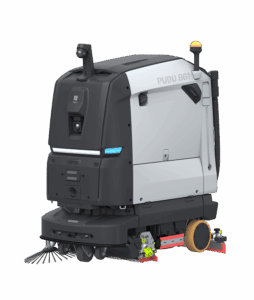
Some supermarket environments require more than routine sweeping or light floor maintenance.
Large-format supermarkets and hypermarkets can have expansive floors exposed to continuous trolley traffic, high footfall and persistent dirt. In such environments, the cleaning requirement shifts towards high-productivity floor scrubbing.
This is where PUDU BG1 Pro becomes relevant.
Where PUDU BG1 Pro Fits
BG1 Pro is better considered for larger and more open supermarket environments such as:
- hypermarket main floors;
- large entrance and circulation zones;
- broad checkout areas;
- wide retail corridors;
- heavily trafficked floor sections; and
- large areas requiring regular scrubbing.
Rather than positioning BG1 Pro as the answer to every supermarket cleaning requirement, it is more useful to view it as a large-area floor-cleaning solution.
A compact robot may be preferable between narrower shelving arrangements, while BG1 Pro can handle suitable high-volume floor areas where greater cleaning productivity is required.
Useful for Stores with Large Scrubbing Requirements
Consider the difference between a neighbourhood supermarket and a large hypermarket.
The smaller store may prioritise compact navigation and multifunction cleaning. A hypermarket, however, may have substantial floor area that needs to be scrubbed repeatedly.
For these facilities, cleaning productivity becomes increasingly important.
This makes PUDU BG1 Pro particularly relevant when supermarkets need to automate large-scale floor scrubbing rather than only dust and debris collection.
A Complementary Role in Large Stores
Large retail facilities do not necessarily need to choose one cleaning technology.
A more practical robotic cleaning strategy could assign different machines according to the environment:
CC1 Pro → Mixed everyday supermarket cleaning
MT1 Vac → Fine dust and dry cleaning
MT1 Max → Large-area sweeping and debris
BG1 Pro → Large-area intensive floor cleaning
This allows each robot to work where its cleaning capability is most useful.
Best suited for: Large supermarkets | Hypermarkets | Wide floor areas | High footfall | Large-scale scrubbing
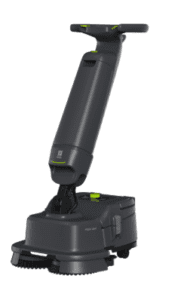
Which PUDU Cleaning Robot Is Best for Which Type of Supermarket?
Choosing the right supermarket cleaning robots in India should start with the store environment rather than the robot itself. Floor area, aisle width, customer traffic, type of contamination and cleaning frequency all influence which solution is most suitable.
Small and Medium-Sized Supermarkets
Smaller supermarkets usually have tighter aisles, frequent customer movement and a combination of dust, small debris and occasional wet contamination.
For these stores, PUDU CC1 Pro is generally the most practical all-round option because multiple cleaning functions can be handled by one autonomous platform.
Recommended: PUDU CC1 Pro
Primary needs: Sweeping, vacuuming, dust mopping and scrubbing
PUDU SH1 can supplement autonomous cleaning where direct operator control is more practical.
Large Supermarkets
Large supermarkets have greater floor coverage and often contain more clearly separated cleaning zones. A single robot may therefore not be the most efficient approach.
A suitable combination could include:
- PUDU CC1 Pro for mixed cleaning across customer-facing areas
- PUDU MT1 Vac for routine dry cleaning and fine particles
- PUDU SH1 for targeted manually controlled cleaning
The actual combination should depend on the store’s layout and daily contamination pattern.
Hypermarkets and Large-Format Retail
Hypermarkets create a different challenge because of their large floor area, wide circulation zones, extensive product categories and back-of-house operations.
These facilities can benefit from task-specific automation:
- PUDU MT1 Max for large-area sweeping and debris collection
- PUDU BG1 Pro for suitable large areas requiring intensive floor cleaning
- PUDU CC1 Pro for mixed cleaning in customer-facing zones
- PUDU MT1 Vac where routine vacuuming and dry cleaning are priorities
- PUDU SH1 for areas requiring manual control
Rather than asking, “Which is the best cleaning robot?”, large retailers should ask, “Which cleaning task should each robot handle?”
How to Choose a Supermarket Cleaning Robot in India
The right robot is not necessarily the largest or most powerful model. It should match the supermarket’s actual cleaning workload.
Before selecting an autonomous cleaning robot for supermarkets, retailers should assess a few important factors.
Store Size and Cleaning Area
Start by calculating the actual cleanable floor area rather than the supermarket’s total built-up area.
Shelves, counters, displays, storage racks and fixed equipment reduce the space that a robot can physically clean.
A compact supermarket may benefit more from a versatile robot such as PUDU CC1 Pro, while large hypermarkets can justify higher-capacity or specialised machines such as PUDU MT1 Max and PUDU BG1 Pro.
Aisle Width and Layout
Supermarkets contain considerably more obstacles than an empty commercial floor.
Consider:
- aisle widths;
- checkout counters;
- promotional islands;
- trolley parking;
- pillars;
- shelving arrangements; and
- frequently changing displays.
The selected robot must be suitable for the actual navigable environment, not simply the floor area on a layout drawing.
Type of Dirt
This is one of the most important selection criteria.
If the primary challenge is fine dust, vacuuming capability becomes important. If the store regularly encounters food and liquid contamination, scrubbing becomes more relevant. If large quantities of packaging fragments or other dry debris are present, sweeping capacity may become the priority.
A useful selection logic is:
Fine dust → MT1 Vac
Mixed wet + dry cleaning → CC1 Pro
Large-area dry debris → MT1 Max
Large-area intensive floor cleaning → BG1 Pro
Targeted manual cleaning → SH1
Peak and Off-Peak Cleaning
Retailers should also determine when the robot will operate.
Some cleaning tasks can be scheduled before opening or after closing, when floors are comparatively unobstructed. Other tasks may need to continue during operating hours.
This distinction affects robot selection, route planning and cleaning schedules.
Service and Deployment Support
Robot specifications alone do not determine whether a deployment will succeed.
Retailers should also consider mapping, commissioning, staff training, maintenance, consumables, technical support and optimisation after deployment.
For commercial robotic cleaning, the goal should be a workable cleaning process, not simply the installation of a machine.
How Multiple Cleaning Robots Can Work Together in a Hypermarket
For a smaller supermarket, one multifunctional robot may cover a substantial portion of routine floor-cleaning requirements.
A large hypermarket is different.
Instead of expecting one machine to perform every task, retailers can divide the facility into cleaning zones and assign equipment according to the workload.
For example:
Customer-facing aisles
PUDU CC1 Pro handles routine mixed floor cleaning.
Dust-prone dry zones
PUDU MT1 Vac supports repeated vacuuming and dry cleaning.
Large open and back-of-house areas
PUDU MT1 Max handles suitable large-area sweeping and debris collection.
Large floors requiring intensive cleaning
PUDU BG1 Pro provides higher-capacity floor-cleaning support.
Difficult or targeted areas
Housekeeping personnel can use PUDU SH1 where direct manual control is more appropriate.
This creates a more structured model:
Zone → Cleaning Requirement → Appropriate Robot → Scheduled Task
The benefit is not simply having more robots. It is matching cleaning capacity to the actual conditions of each part of the supermarket.
This can be particularly useful for Indian hypermarkets operating for long hours, where customer-facing areas, entrances, stockrooms and receiving zones may all need different cleaning methods within the same shift.
Suggested Infographic: One Supermarket, Five Cleaning Solutions
This would be one of the strongest infographics for the blog.
Use an illustrated supermarket floor divided into five zones, with minimal text:
Main Aisles → CC1 Pro
Mixed Cleaning
Dry Grocery Areas → MT1 Vac
Dust & Vacuuming
Large / Back-of-House Areas → MT1 Max
Sweeping & Debris
Large Open Floors → BG1 Pro
Intensive Floor Cleaning
Targeted Areas → SH1
Manual Cleaning
Use the actual product images around the supermarket illustration with thin connector lines pointing to their respective zones.
Autofina Robotics and Pudu Robotics for Supermarket Cleaning Automation in India
Introducing cleaning robots into a supermarket involves more than selecting a product from a specification sheet. The robot needs to be matched to the store’s layout, floor conditions, traffic patterns and cleaning workload.
Autofina Robotics works with Pudu Robotics solutions to support commercial cleaning automation in India, including applications across supermarkets, hypermarkets and other large retail environments.
As an official pan-India distributor for Pudu Robotics, Autofina Robotics can support businesses in evaluating which robotic cleaning solution is appropriate for their facility.
For supermarket projects, this can include understanding the cleaning requirement, identifying suitable robot models, planning deployment and supporting implementation and after-sales requirements.
The objective should not be to automate every cleaning activity. A more effective approach is to identify repetitive and suitable floor-cleaning tasks that can be automated, while allowing housekeeping teams to concentrate on areas requiring human attention.
Conclusion
The best supermarket cleaning robots in India will differ from one store to another because supermarket cleaning itself is not a single task.
A compact supermarket dealing with everyday dust and occasional spills may primarily need a multifunctional solution such as PUDU CC1 Pro. A large supermarket with persistent fine dust may benefit from PUDU MT1 Vac, while hypermarkets with extensive floor areas can use PUDU MT1 Max and PUDU BG1 Pro for more specialised large-area cleaning. PUDU SH1 fills the remaining gap where direct human control is still the more practical approach.
The most effective strategy is therefore not:
“Replace manual cleaning with robots.”
It is:
Understand the Floor → Identify Repetitive Cleaning Tasks → Match the Right Robot → Automate Suitable Areas → Keep People Focused on Higher-Attention Tasks
For Indian supermarkets facing long operating hours, high customer traffic, dust, seasonal monsoon contamination and increasing expectations around cleanliness, this combination of robotic cleaning and human housekeeping provides a more structured approach to maintaining retail floors.