



Best Commercial Cleaning Robot in India (2026): Why CC1 Pro Leads the Market
Cleaning in India has reached a breaking point. High footfall, constant dust, monsoon mess, and manpower instability make manual cleaning unreliable at scale. What worked for small spaces no longer works for malls, hospitals, IT parks, or large commercial campuses. Today, facilities don’t just need floors that look clean once—they need them to stay clean, hour after hour. This is why the rise of the commercial cleaning robot in India is not a trend—it is a necessity. Robot cleaning is no longer futuristic; it is the new operational standard.
Table of Contents
How to Choose the Best Commercial Cleaning Robot in India?
If you want real results in Indian facilities, you must define “best” in operational terms—not brochure terms. That is why a commercial cleaning robot in India must win on five criteria: cleaning outcome, repeatability, safety, manageability, and serviceability. Here’s a simple checklist for you to help you choose the best commercial cleaning robot in India objectively:
1) Cleaning Performance: Does it actually clean or just look impressive?
A top-tier robot must scrub stubborn stains, remove sticky spills, and lift ingrained grime—not just glide over surfaces. Indian facilities deal with oily food court patches, muddy footprints, and blackened entrance tracks daily.
It must also vacuum fine dust, hair, and lightweight debris instead of pushing them around. With Indian cities regularly recording high particulate levels, dust resettles constantly—especially near entrances and open corridors.
Drying quality matters just as much. A “best” robot leaves floors visibly dry, reducing slip risk and maintaining a premium look during live operations. Edge and wall-follow cleaning ensure corners, skirting lines, and pillar bases don’t get ignored—the exact spots customers notice first.
2) Consistency and Coverage: Can it maintain standards all day?
Manual cleaning varies by shift and worker. A good robot removes that uncertainty by following repeatable paths and delivering the same result every time.
Zone-based scheduling is critical. Facilities need different cleaning frequencies for entrances, corridors, food zones, and lobbies. A strong system lets you assign time slots per zone—before opening, during peak hours, and post-close.
For large spaces, floor size matters more than floor count. Many Indian sites prefer one robot delivering flawless consistency on a priority floor rather than struggling with multi-floor logistics.
3) Safety and Navigation: Can it operate confidently in live environments?
Indian facilities are dynamic—people cross unpredictably, carts stop suddenly, and corridors stay busy. The robot must detect obstacles in real time and react instantly.
Smart speed control, short stopping distance, and audible alerts protect both visitors and staff. These features allow the robot to operate safely during business hours instead of being restricted to night shifts.
Narrow corridors and high-traffic choke points are the real test. If the robot struggles here, it won’t be usable where cleaning is needed most.
4) Operations and Manageability: Can your team actually run it?
Frequent layout changes—temporary stalls, festive décor, barricades—are common in India. The robot should allow quick remapping without expert intervention.
Role-based access prevents chaos. Operators run the robot, supervisors manage zones, and admins review performance. This structure fits Indian vendor-managed housekeeping models well.
Clear reports show where the robot cleaned, when, for how long, and what it missed. This replaces verbal assurance with proof—critical in hospitals, IT parks, and audit-driven environments.
5) Serviceability in India: The factor most buyers ignore
Many robots perform well during demos but fail months later due to poor service support. Consumables like pads, squeegees, and filters must be easily available locally.
Daily maintenance should be simple enough for on-ground staff. If upkeep feels complicated, adoption drops fast.
Strong local support, quick spare availability, and fast downtime resolution matter more than any spec sheet. Especially for those evaluating a floor cleaning robot for hospitals in India, uptime and service response are non-negotiable.
Types of Commercial Cleaning Robots in India (And Which One Actually Fits Indian Facilities)
India’s facilities have changed faster than manual cleaning can keep up. Footfall has exploded, dust keeps resettling, and monsoon weeks turn entrances into nonstop mess zones. That is why robot cleaning is no longer “innovation”—it is the new operating model, especially when you want predictable hygiene across large spaces. If you are evaluating a commercial cleaning robot in India, start by understanding the three main segments below and what each one is truly designed to handle.
1) Scrubber-Dryer Robots: The Most Relevant Category for Large, Live Facilities
Scrubber-dryer robots wash the floor the way a commercial scrubber does: they scrub, lift dirt, and leave the surface dry. This category is the closest replacement for the daily “mop + machine scrub” routine—without the shift-to-shift variability.
Where they fit best in India
- Malls and retail chains: Entrances, corridors, food courts, anchor-area commons. These zones get dirty repeatedly through the day. A scrubber-dryer can run scheduled loops and keep floors “always clean,” not “cleaned once.” This is why a cleaning robot for malls in India typically falls into this segment.
- Hospitals: OPD corridors, lobbies, waiting areas, non-critical pathways. Hospitals need consistent outcomes and controlled operations, not subjective cleaning quality.
- Airports and transit-linked commercial zones: Passenger volumes create constant track-in dirt and spills. For context, AAI reported FY 2023–24 domestic passenger traffic of 30.6 crore (306 million) and international traffic growth as well—this scale directly translates into high cleaning load in terminals and connected areas.
- IT parks and corporate campuses: Predictable schedules plus high brand expectations in lobbies and common areas.
- Warehouses and large back-of-house areas: Especially where floors collect dust and tire marks and need regular scrub cycles.
Why this segment tends to “win” in India
- Indian cities see persistent particulate pollution; under NCAP tracking, 78 of 85 cities assessed had PM10 levels above national standards—dust simply keeps coming back.
- A scrubber-dryer robot addresses both perception and safety because it cleans and dries. This matters during monsoon periods when wet floors become a daily risk.
2) Vacuum-Only Robots: Useful for Light Debris, Weak for Real Commercial Mess
Vacuum-only robots focus on dry debris pickup—dust, hair, crumbs, paper bits. They can work well in controlled environments where spills are rare and floors do not need scrubbing.
When they work in India
- Low-mess office zones with carpet or dry flooring
- Controlled corridors where you mainly fight dust and lint
- After-hours maintenance where the main goal is to reduce visible dry debris
3) Sweeper Robots: Strong for Dust-Heavy Large Areas, Often a Pre-Step to Scrubbing
Sweeper robots are built to collect dry dust and larger debris across big open areas. They are especially useful when your facility generates continuous dry particulate—common in industrial estates, loading areas, and large halls.
When you should consider a robot sweeper in India
- Warehouses, factories (non-cleanroom), logistics zones
- Large parking-linked corridors where dust and sand drift in
- Big open areas that accumulate paper scraps and dry debris throughout the day
When sweeping alone is not enough
Sweeping improves baseline cleanliness, but it does not remove sticky stains or restore floor finish. Many Indian sites use sweeping as a first pass and then run a scrubber-dryer cycle to achieve the “premium clean” that customers and auditors expect.
The practical takeaway
If your site struggles with heavy dust first, sweepers help. If your site struggles with stains, spills, or visible patchiness, you need scrub + dry capability as the core.
Introducing PUDU CC1 Pro
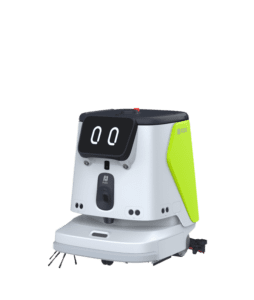
PUDU CC1 Pro is an autonomous commercial floor cleaning robot built for real Indian facilities—where high footfall, dust, spills, and continuous operations make manual cleaning unreliable. It fits seamlessly into large, performance-driven environments such as malls, hospitals, airports, IT parks, and warehouses, where management needs floors to stay clean all day, not just after one round of mopping. Designed as a true commercial cleaning robot in India, CC1 Pro replaces inconsistent human routines with predictable, safe, and repeatable automation. It gets shortlisted quickly because it solves the four biggest problems Indian facilities face every day:
The 4 Core Functions That Make CC1 Pro Operationally Superior
Scrub + Lift + Deep Clean
CC1 Pro mechanically scrubs the floor to remove sticky spills, grime, and embedded dirt—especially common in food courts, entrances, and high-traffic corridors. This makes it ideal as an autonomous scrubber dryer robot for Indian conditions where dry dust mixes with wet mess daily.
Vacuum + Debris Collection
It vacuums fine dust, hair, paper bits, and loose debris instead of spreading them around. This matters in Indian cities where airborne particulate levels remain high and dust keeps resettling, especially in open and semi-open commercial spaces.
Dry + Safe Floor Finish
CC1 Pro leaves floors visibly dry after each run, reducing slip risk and keeping the surface presentable during business hours. This is critical for a floor cleaning robot for hospitals in India, where safety and hygiene perception matter as much as actual cleanliness.
Autonomous Navigation + Smart Coverage
It navigates live environments safely, avoids people and obstacles, follows walls, and cleans edges—areas humans often miss. This makes it ideal as a cleaning robot for malls in India, where cleaning must happen around customers, not after closing.
Why PUDU CC1 Pro Is the Best Commercial Cleaning Robot in India (Core Reasons)
India has reached the point where “more manpower” no longer fixes cleaning at scale. Dust keeps returning, footfall keeps rising, and monsoon weeks keep turning entrances into daily mess zones. That is exactly why robot cleaning is becoming the new standard. If you want a commercial cleaning robot in India that delivers measurable outcomes (not just a good demo), CC1 Pro stands out on the fundamentals: performance, safety, manageability, and uptime.
1) Built for Indian footfall, dust, and daily abuse
Indian facilities run “live” for long hours. Airports, malls, and IT parks see continuous movement, not quiet windows for deep cleaning. AAI’s FY 2023–24 annual report notes 30.6 crore domestic passengers and 22% growth in international passengers—that scale translates directly into heavy cleaning load in terminals and connected commercial zones.
CC1 Pro fits this reality because it supports continuous cleaning cycles without fatigue. It also removes shift-to-shift variance. Your floor finish stops depending on which worker showed up or how closely a supervisor monitored the route.
2) Scrub + vacuum + dry results that look “premium”
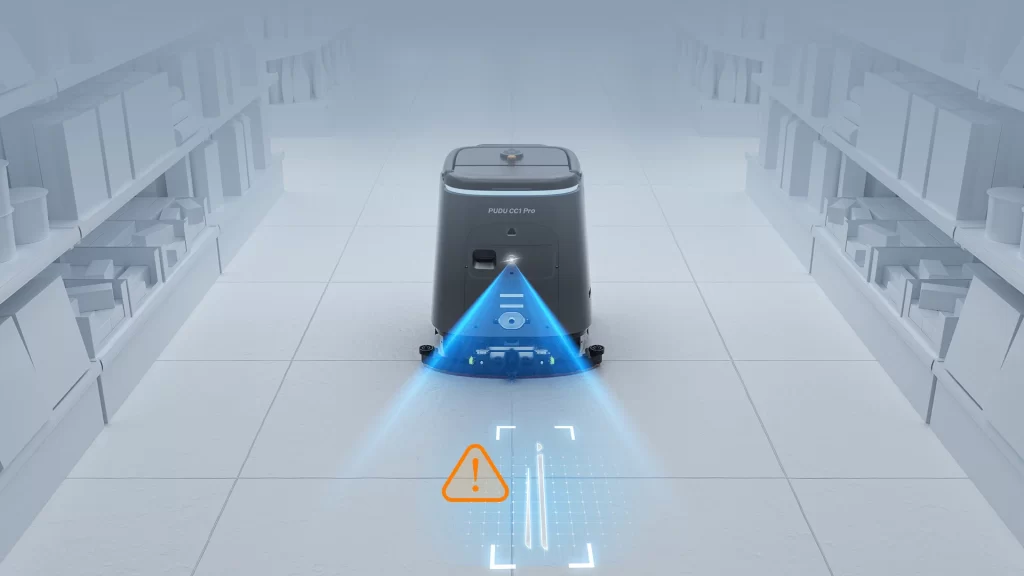
Most facilities do not lose points on effort. They lose points on appearance. Visitors judge hygiene instantly, especially at entrances, lift lobbies, corridors, and reception zones. CC1 Pro delivers the “premium” outcome because it does not just move dirt around. It scrubs to break grime, picks up debris, and leaves the surface dry.
That dry finish matters in India because wet patches create both safety risk and reputation risk. This is also why CC1 Pro’s positioning as an autonomous scrubber dryer robot is commercially important: it helps you maintain shine and safety at the same time.
3) Predictable coverage with zone-based scheduling
Manual cleaning usually runs as a routine (“morning round,” “evening round”). Real facilities need timed cycles. CC1 Pro supports zone-based scheduling so you can define cleaning by time and business intensity:
- pre-opening refresh for high-visibility areas
- peak-hour buffer runs for entrances/corridors
- post-close deeper cycles for larger coverage
This approach reduces “cleaning gaps”—those predictable windows when your facility looks dirty and complaints rise.
4) Safer navigation in live environments
Indian sites are dynamic. People change direction suddenly. Trolleys stop without warning. Wheelchairs and beds move through corridors. A robot that cannot operate safely during business hours becomes a night-shift-only machine, which limits value.
CC1 Pro’s core advantage is that it designs for live operation. It uses people-first cues and navigates around moving obstacles so you can keep cleaning while your facility runs at full speed.
5) Operational control: reporting, accountability, and standardization
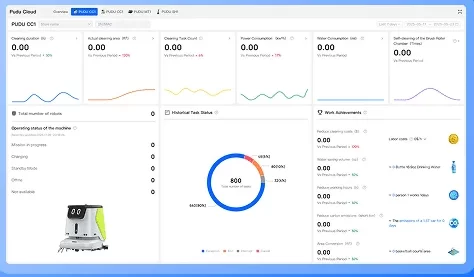
Large facilities now demand proof, not verbal confirmation. This is especially true for hospitals and audit-sensitive environments. CC1 Pro supports logs and reporting so supervisors and management can verify:
- where it cleaned
- when it cleaned
- how long it ran
- what exceptions occurred
That reporting standardizes cleaning across shifts and vendors. It also supports environments that need evidence-driven housekeeping discipline. NABH’s Hospital Accreditation Standards (6th Edition, January 2025) reinforce structured quality and safety expectations, which increases pressure on consistent operational controls.
6) Lower dependency on labor availability
Manpower availability remains a real constraint across Indian commercial operations. When attendance drops or teams rotate, cleaning quality becomes inconsistent. CC1 Pro stabilizes baseline cleaning even when staffing is short or uneven.
It also uses humans where they add the most value: detailing and hygiene-critical tasks. Teams can focus on restrooms, corners, glass, high-touch disinfection, and spot-cleaning, instead of spending the full shift on repetitive floor runs.
7) Strong ROI logic for commercial sites
CC1 Pro’s ROI does not rely on “replacing people” alone. It improves the economics through operational leak reduction:
- fewer repeat-cleaning cycles for the same zones
- lower supervision intensity (less constant monitoring)
- higher uptime and scheduled consistency
- fewer complaints and faster issue closure
The second-order ROI matters too. Better floor presentation improves customer trust, reduces negative feedback, and protects brand perception—especially in premium retail and hospitality environments.
Where PUDU CC1 Pro Delivers the Biggest Impact in India (Use Cases by Facility Type)
India has moved past the phase where manual cleaning can “catch up later.” Footfall spikes, dust resettles quickly, and monsoon weeks turn entrances into continuous mess zones. That is why robot cleaning is no longer optional—it is the new operating standard for large facilities. Below are practical, India-first use cases that show where CC1 Pro fits best as a commercial cleaning robot in India, with clear zones, schedules, and outcome expectations.
Malls and Retail Chains: Keep floors “always clean” through live footfall
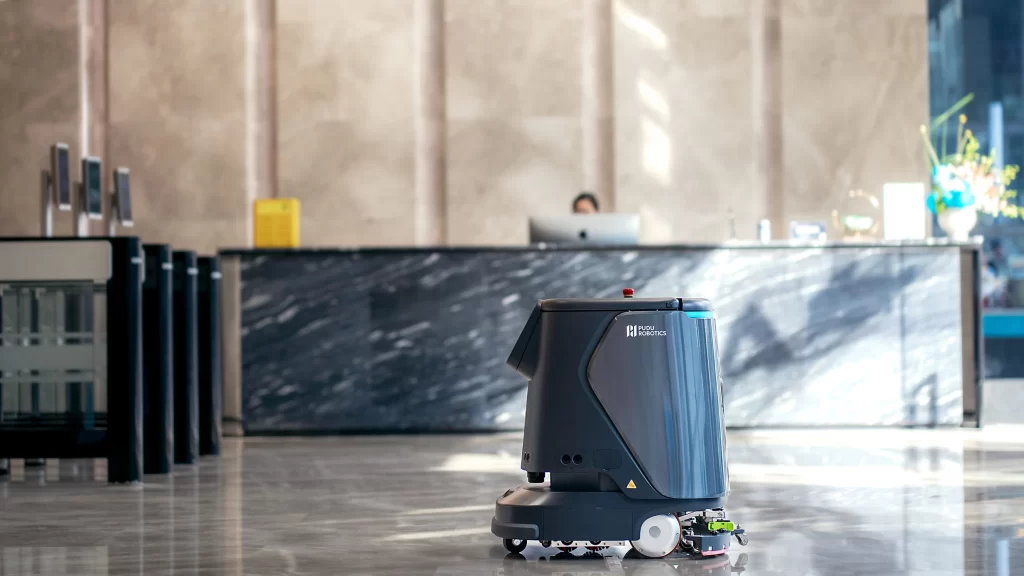
Best zones: entrances, food courts, corridors, lift lobbies, anchor-store commons.
Malls lose cleanliness within minutes during peak hours. Footwear brings in dust and grit, and food courts add spills and sticky patches. CC1 Pro helps you keep presentation consistent because it runs repeat cycles without fatigue. As a cleaning robot for malls in India, it supports two critical modes: peak-hour safety runs (light, frequent cleaning) and off-peak deep cycles (thorough scrub and dry).
How to schedule it well:
- Pre-opening: full visibility-zone clean (entrances + main corridors)
- Peak hours: short loops around food court and entry corridors
- Post-close: deeper runs across larger common areas
Hospitals and Clinics: Standardize hygiene outcomes without shift-to-shift variation
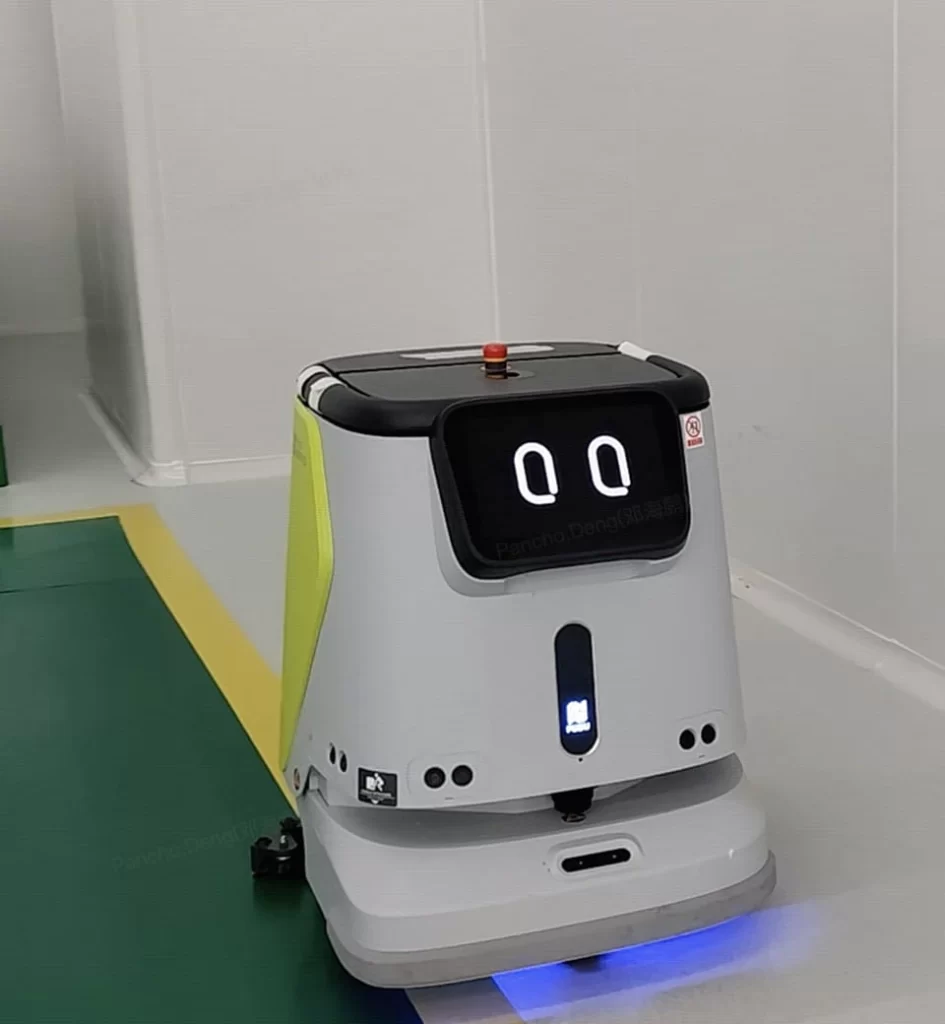
Best zones: corridors, OPD common areas, waiting lounges, non-critical pathways.
Hospitals cannot rely on subjective cleaning quality. One missed patch in a corridor affects perception immediately, and repeated wet mopping can raise slip risk. CC1 Pro improves consistency because it repeats the same cleaning standard every run and reduces dependence on who is on duty.
Where it adds the most value:
- High-traffic OPD zones that get dirty repeatedly
- Waiting areas where cleanliness equals trust
- Corridors where safe drying matters as much as scrubbing
This is exactly why many teams evaluate CC1 Pro as a floor cleaning robot for hospitals in India—because predictable outcomes matter more than occasional deep cleaning.
Hotels and Banquet Halls: Protect premium presentation and recover faster after events
Best zones: lobby and reception shine zones, banquet pre-function areas, post-event corridors, back-of-house routes.
Hotels win or lose impressions in the first 10 seconds. Floors must look dry, polished, and consistent, especially in lobbies and near lifts. Banquet halls face a different challenge: sudden post-event debris, spills, and high-volume movement. CC1 Pro supports quick recovery runs so your team stops spending hours re-cleaning the same high-traffic paths.
Ideal operating pattern:
- Daytime: light cycles in lobby/common areas
- Post-event: targeted runs where debris and spills concentrate
- Late night: deeper runs across continuous floor sections
IT Parks and Corporate Campuses: Run predictable schedules and maintain “always-ready” common areas
Best zones: lobby floors, long corridors, cafeteria approaches, elevator zones, large continuous basements and common areas.
Corporate facilities need consistency, not dramatic deep cleans that happen only once. CC1 Pro fits well because IT parks usually allow structured schedules and night operations. It helps you maintain a stable baseline clean while your staff focuses on detailing, pantry areas, and washrooms.
How facilities typically use it:
- Early morning: high-visibility zones
- Midday: cafeteria and corridor buffer runs
- Night: larger coverage runs with minimal interruptions
Warehouses and Factories (Non-cleanroom): Cover large areas and control dust across shifts
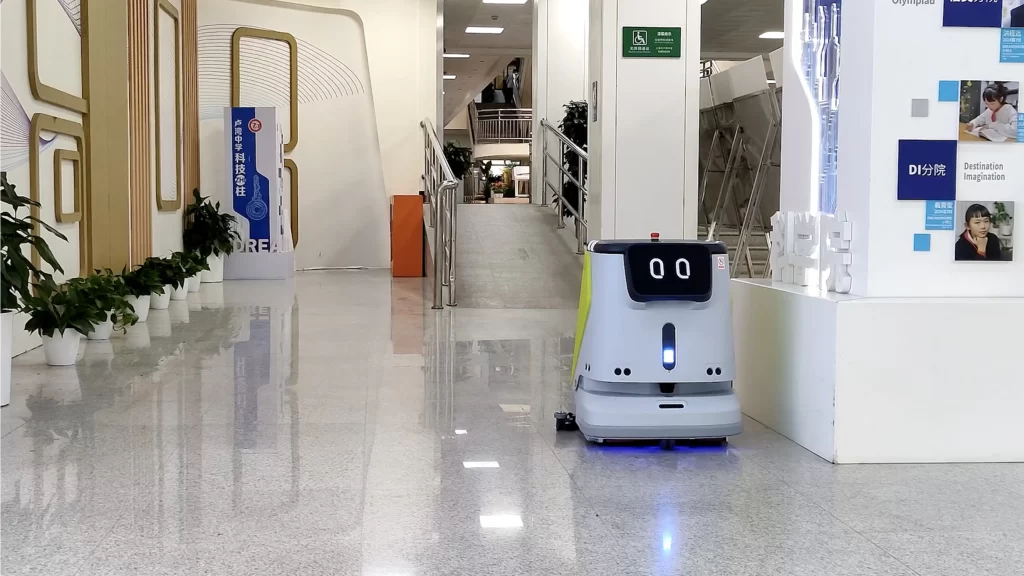
Best zones: wide aisles, packing zones, dispatch routes, staging areas, high-dust corridors.
Warehouses and industrial spaces accumulate dry dust and tire-mark grime quickly. Manual cleaning teams often struggle to cover large areas daily without cutting corners. CC1 Pro helps you maintain routine coverage and reduces re-cleaning caused by inconsistent human execution. As an autonomous scrubber dryer robot, it also supports safer floors by leaving surfaces cleaner and drier after each run.
Practical deployment approach:
- Run shift-aligned schedules (between peak movement windows)
- Focus on primary aisles and staging lanes first
- Expand coverage once routines stabilize
PUDU CC1 Pro vs Generic Cleaning Robots (What Actually Changes in Real Facilities)
| Criteria | CC1 Pro (Advanced Scrubber-Dryer Robot) | Generic Cleaning Robots |
|---|---|---|
| Best for (facility type) | Malls, hospitals, hotels, airports, IT parks, large campuses | Small offices, low-traffic zones, back rooms |
| Cleaning modes (scrub / vacuum / dry) | Scrubs, vacuums, and dries in one continuous cycle | Usually vacuum-only or sweep-only |
| Handling Indian dirt (dust + spills + sticky grime) | Designed for mixed Indian mess: dust, mud, food spills | Works mainly on dry dust and light debris |
| Navigation maturity | Fully autonomous with dynamic obstacle avoidance | Basic navigation or fixed-path movement |
| Live environment operation | Can operate safely around people | Often restricted to empty or low-traffic areas |
| Zone-based scheduling | Yes – time-based, area-based, and repeatable | Limited or none |
| Reporting & logs | Full proof-of-work: where, when, how long | No reporting or very basic usage logs |
| Edge and wall-follow cleaning | Yes – covers corners and boundaries | Often misses edges and corners |
| Dry floor finish | Leaves floor visibly dry and safe | May leave moisture or residue |
| Maintenance complexity | Designed for daily staff handling | Simple, but limited capability |
| Indian serviceability | Structured service, training, consumables | Inconsistent or unclear |
| Outcome consistency | High and repeatable | Varies run to run |
| Total cost of ownership logic | Saves via uptime, fewer complaints, less rework | Cheap upfront, limited operational value |
Conclusion
The shift to robotic cleaning in India is no longer about experimentation—it is about operational survival. Facilities today need consistent hygiene, safer floors, and predictable performance, not manual routines that break under pressure. CC1 Pro delivers exactly that, making it the most practical commercial cleaning robot in India for real-world, high-footfall environments. With PUDU’s global robotics expertise and Autofina Robotics as the official distributor bringing CC1 Pro to India, businesses now get not just advanced technology, but local deployment, training, service, and long-term support. This partnership ensures that Indian facilities don’t just adopt robot cleaning—they adopt it the right way. And that is what makes this shift truly powerful.