Best Hospital Delivery Robot in India: PUDU Flashbot Max
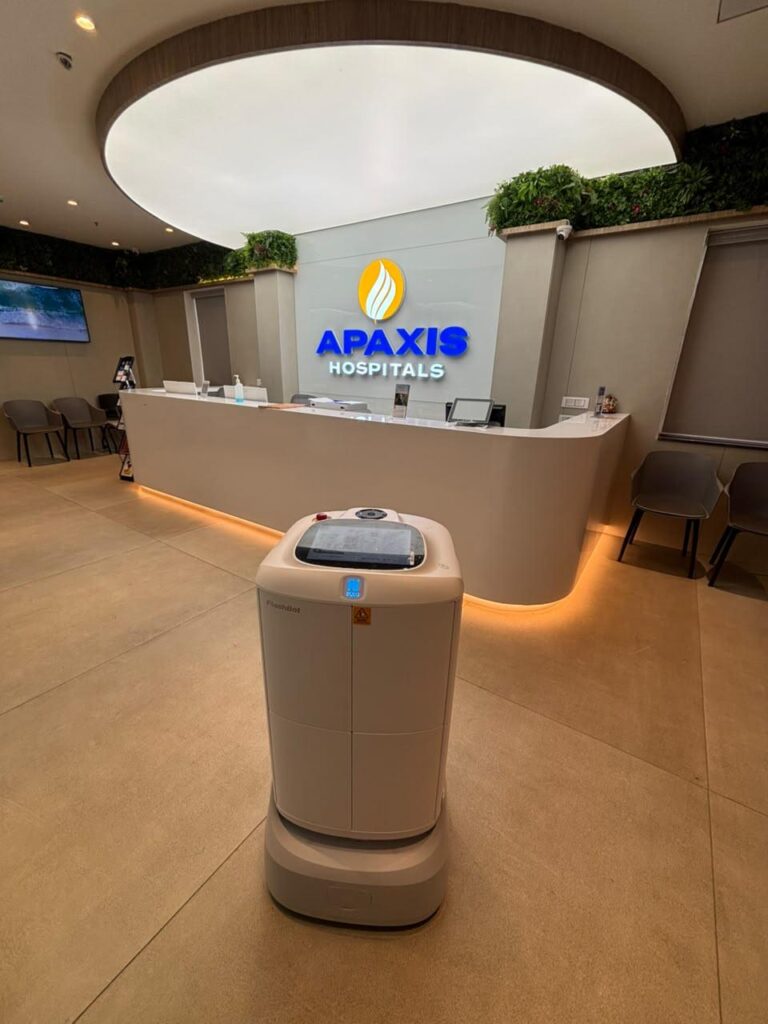
A hospital delivery robot in India is becoming increasingly relevant as hospitals look for practical ways to reduce repetitive internal transportation and give healthcare staff more time for patient care. In large multi-floor hospitals, a significant amount of everyday work involves moving medicines, pharmaceutical supplies, reports, medical consumables and other items between pharmacies, wards, departments and patient rooms.
These movements may appear routine, but they happen repeatedly throughout every shift.
A medicine prepared at the pharmacy may need to reach a ward several floors above. A required pharmaceutical item may have to be taken to a patient room. A department may urgently need a small medical supply. Each task can involve walking through long corridors, waiting for elevators, travelling between floors, locating the correct ward and then returning to the original department.
Traditionally, many such activities are carried out by nurses, ward attendants, pharmacy personnel or other hospital staff. As hospitals grow larger and patient volumes increase, however, this approach can consume considerable staff time. The existing hospital logistics model therefore creates an important question:
Should trained healthcare professionals be spending their time transporting items around the hospital when their skills are needed for patient care?
A nurse’s primary responsibility is to care for patients- not to function as an intra-hospital courier.
This does not mean hospitals can eliminate people from their operations. Healthcare will always depend on skilled doctors, nurses, pharmacists, technicians and support teams. The opportunity is instead to automate repetitive transportation activities that do not necessarily require clinical expertise.
This is where autonomous hospital delivery robots can play an important role.
Robots such as PUDU FlashBot Max are designed to move items autonomously through indoor environments while navigating around people and obstacles. When properly integrated with hospital infrastructure, the robot can also travel between floors using elevators and deliver items to predefined wards, departments or rooms.
For Indian hospitals- particularly large multi-specialty facilities operating across several floors- this creates the possibility of building a much more structured internal logistics system.
Instead of:
Pharmacy → Staff Collection → Elevator → Ward → Delivery → Staff Return
the workflow can increasingly become:
Pharmacy → FlashBot Max → Elevator → Ward/Room → Delivery Notification → Next Task
The objective is simple: allow technology to handle repetitive transportation so hospital employees can spend more time where human skills matter most.
Why Hospital Delivery Robots in India Are Becoming Important for Intra-Hospital Logistics
Hospital logistics has become considerably more complex as healthcare facilities expand in size, specialization and service capacity. A modern hospital is not simply a collection of patient rooms. It is a highly interconnected environment consisting of pharmacies, ICUs, operating theatres, diagnostic departments, laboratories, nursing stations, emergency departments, outpatient areas, administrative sections and specialized wards.
All these areas depend on a continuous movement of materials. Medicines must reach wards. Supplies must reach departments. Pharmaceutical items must be delivered when requested. Reports and documents may need to move between locations. Urgent requirements can arise at any time of the day or night. The larger the hospital becomes, the more complicated this internal movement becomes.
1. Multi-Floor Hospitals Create Repetitive Vertical Movement
One particularly important challenge in Indian hospitals is vertical transportation. Hospitals located in major cities frequently operate in multi-storey buildings where different functions may be distributed across several floors. A central pharmacy may be located on one floor while ICUs, general wards, private rooms, operating theatres and specialty departments occupy others.
This means a seemingly simple delivery may involve: Pickup point → corridor → elevator → another floor → corridor → destination. The employee must then often make the same journey back. When this happens dozens or hundreds of times across a working day, internal logistics can consume substantial manpower.
A hospital delivery robot in India becomes much more valuable when it can operate not only on one floor but across the entire building. That is why elevator integration is a critical element of hospital robotics. A properly deployed FlashBot Max can be integrated with an elevator-control system so that it can complete cross-floor transportation tasks without requiring an employee to accompany it throughout the journey.
2. Pharmacy-to-Ward Delivery Is a Major Opportunity
Hospital pharmacies are among the departments that can benefit most from structured internal logistics. Medicines and pharmaceutical supplies may be requested from inpatient wards, ICUs, specialty departments, operating areas, nursing stations and patient rooms. In a conventional workflow, a member of the hospital staff may need to collect the item personally.
Consider a simple example. A patient on the sixth floor requires medicine from a pharmacy located on a lower floor. The traditional workflow might be: The medicine request reaches the pharmacy. The medicine is prepared. A nurse, attendant or other employee is assigned to collect it. The employee walks to the pharmacy. The employee waits for the order if necessary. The medicine is collected. The employee waits for the elevator. The employee travels to the appropriate floor. The medicine is delivered. The employee returns to the ward or original duty location.
The transportation itself adds no clinical value, yet it consumes employee time. Using a hospital delivery robot changes the allocation of work. Once the medicine has been verified and securely loaded, the robot can undertake the physical transportation while the hospital employee remains available for higher-value responsibilities.
3. The Hidden Cost Is Not Just Distance
The cost of manual hospital logistics is often misunderstood. It is not simply the number of metres an employee walks. Every delivery may also involve waiting for elevators, interruptions from other hospital traffic, coordinating with receiving departments, waiting for items to be prepared, travelling back after delivery, navigating crowded corridors and leaving another task temporarily unattended.
When these small delays are multiplied across multiple departments, floors and shifts, they can become a meaningful operational burden. The original hospital logistics material also highlights the fact that routine transportation has traditionally been handled by nurses, support staff, ward attendants and logistics employees, which reduces the amount of time available for direct patient responsibilities.
4. Rising Patient Volumes Increase Internal Movement
As patient volumes increase, logistics activity rises with them. More patients generally mean more medicine requests, pharmacy deliveries, diagnostic requirements, supplies, reports, departmental coordination and time-sensitive movement between wards.
This creates an important scalability problem. A hospital can continue adding employees to perform transportation tasks, but that approach remains heavily dependent on manpower and shift availability.
Automation provides another option. Routine, predictable and repeatable transportation can be assigned to robots, while employees concentrate on activities that require decision-making, communication, clinical knowledge and direct interaction with patients.
5. Hospitals Operate 24/7
Another major difference between hospitals and conventional commercial facilities is operating time. A hospital does not stop functioning at 6 PM. Emergency departments, inpatient wards, ICUs and pharmacy operations may require support throughout the night, on weekends and on public holidays. Logistics therefore has to remain available across shifts.
Autonomous robots can support this requirement because their operating model is not tied to conventional employee working hours. With proper task management, battery management and automatic charging, a robot can support repeated deliveries throughout the operating day.
This makes hospital robotics particularly relevant for facilities looking to build more consistent internal services across different shifts.
6. Staff Shortages Make Better Workforce Utilization Essential
Indian hospitals also need to consider how skilled manpower is used. Employing more nurses simply to compensate for repetitive transportation is not an efficient long-term strategy.
Nurses should ideally spend their working hours on activities such as patient monitoring, medication administration, clinical documentation, coordination with doctors, patient communication, treatment support, responding to changes in patient condition and helping patients and families understand their care.
Walking repeatedly between a pharmacy and a ward does not require the same level of clinical expertise. This distinction is important. Hospital automation is not about replacing nurses. It is about preventing hospitals from using nurses for tasks that do not require nursing skills.
A well-designed robotic logistics workflow therefore supports employees rather than attempting to replace them.
What Is a Hospital Delivery Robot and How Does It Work?
A hospital delivery robot is an autonomous mobile robot designed to transport items between predefined locations inside a healthcare facility without requiring a person to manually push, guide or accompany it throughout the journey. Unlike a conventional trolley, a delivery robot has its own navigation, sensing, computing and task-management capabilities.
A robot such as PUDU FlashBot Max can be configured to travel between hospital departments while detecting obstacles and navigating through changing indoor environments. Depending on the infrastructure and deployment configuration, a hospital delivery robot can connect different operational locations such as: Pharmacy → Nursing Station, Pharmacy → Ward, Pharmacy → Patient Room, Department → Department and Central Supply Area → Ward.
The purpose is not simply to move an object from one location to another. The real value comes from creating an automated delivery workflow.
1. How a Hospital Delivery Robot Receives a Task
A delivery normally begins when an employee creates or assigns a transportation task. For example, the pharmacy may have a medicine or pharmaceutical item ready for a particular ward. The destination is selected and the required material is placed inside the robot.
For secure or patient-specific deliveries, enclosed compartments are particularly useful because they prevent items from remaining openly exposed during transportation. Once the task has been initiated, the robot calculates or follows the appropriate route to its destination.
2. Autonomous Navigation Through Hospital Corridors
Hospitals are highly dynamic environments. A robot cannot assume that the corridor it travelled through five minutes ago will remain empty. During operation it may encounter doctors and nurses, patients, visitors, wheelchairs, stretchers, housekeeping carts, medical equipment and other moving obstacles.
The robot therefore uses onboard navigation and perception systems to understand its surroundings and modify its movement where necessary. FlashBot Max combines technologies including VSLAM and LiDAR-based navigation, allowing it to navigate indoor environments while detecting obstacles.
This is essential because a hospital robot must operate in spaces designed primarily for people—not in isolated industrial robot zones.
3. Cross-Floor Navigation Through Elevator Integration
Navigation becomes significantly more useful when the robot can move beyond a single floor. Consider a pharmacy on the ground or first floor and a ward located on the seventh floor.
Without elevator integration, an employee would still need to move the robot between floors manually. That would undermine a major part of the automation benefit.
With a properly designed elevator integration, the workflow can become: Robot approaches elevator → Elevator is called → Robot enters elevator → Required floor is requested → Elevator reaches destination floor → Robot exits → Robot continues to the ward or room.
The existing hospital logistics material identifies elevator integration as one of the key technologies that enables hospital delivery robots to perform cross-floor transportation independently. This is particularly important for the Indian market because many large hospitals operate vertically rather than across a single large floor plate.
4. Secure Delivery at the Destination
When FlashBot Max reaches the destination, the recipient can be notified that the delivery has arrived. Its enclosed compartment design is especially relevant for hospital environments because medicines and sensitive materials do not need to travel on exposed trays.
Depending on the configured workflow, access can also be controlled through supported verification methods. This creates a more structured process: Load → Secure → Transport → Notify → Authenticate → Collect.
For hospital pharmacies, this is considerably more useful than simply sending an open cart through a corridor.
5. Telephone Integration Can Extend the Workflow
Hospital delivery automation can also be connected with the facility’s communication infrastructure. For example, where the necessary telephone or IP-PBX integration has been configured, the system can notify a ward or patient room when the robot reaches its destination.
The sequence can therefore become: Medicine loaded at pharmacy → Robot travels → Elevator journey → Robot reaches room/ward → Telephone notification → Recipient collects medicine.
This type of integration turns FlashBot Max from an independently moving machine into part of a broader hospital workflow.
6. Automatic Charging and Continuous Availability
Once a delivery is completed, the robot can either receive another task or return to its charging point according to its operating configuration and battery condition. Automatic charging is important because the objective of hospital logistics automation is to reduce routine human intervention.
Employees should not have to constantly move the robot manually, plug it in after every delivery, guide it between floors or supervise every journey. A properly configured system should allow the robot to handle much of its routine movement independently.
7. A Hospital Delivery Robot Is Part of a System
Ultimately, the robot itself is only one component. Successful deployment requires several parts to work together: FlashBot Max + Hospital Mapping and Navigation + Wi-Fi / Network Infrastructure + Elevator Integration + Telephone or Notification System + Operational Workflow + Staff Training.
When these elements are planned correctly, a hospital delivery robot in India can become part of a practical intra-hospital logistics system rather than simply being a standalone robotic device.
That difference becomes much clearer when looking at a real deployment—such as the multi-floor PUDU FlashBot Max implementation at Apaxis Hospital in Chennai, where pharmacy logistics, elevator control, telephone integration and patient-facing functions were brought together within the hospital environment.
FlashBot Max at Apaxis Hospital, Chennai: A 30-Day Operational Case Study
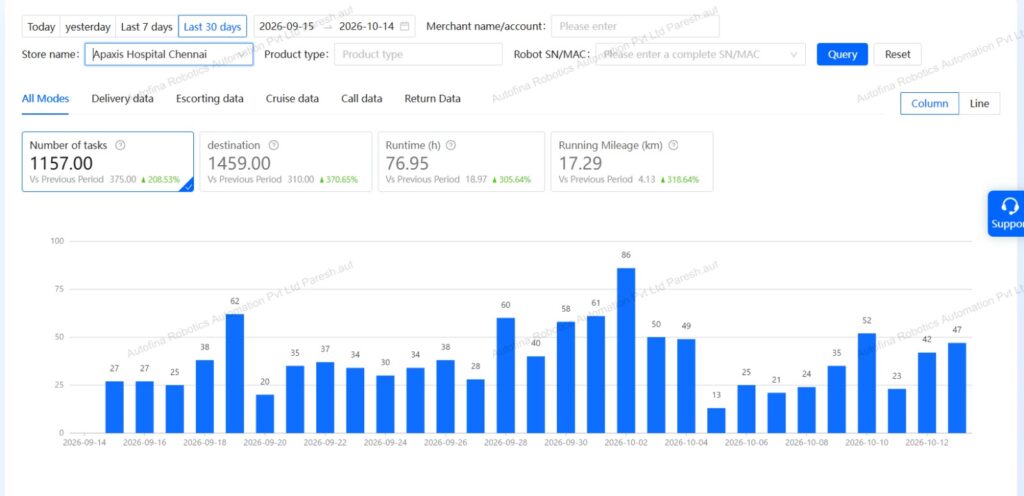
PUDU FlashBot Max was deployed at Apaxis Hospital, Chennai, as identified in the deployment context provided. Its operational dashboard for the selected period, 15 September 2026 to 14 October 2026, records 1,157.00 tasks, a destination count of 1,459.00, 76.95 hours of runtime and 17.29 kilometres of running mileage.
The report provides an overview of robot activity, comparisons with the previous reporting period and daily task counts. It shows the “All Modes” view, so the figures represent combined activity across the reporting modes rather than a delivery-only breakdown.
Reporting Scope
| Report field | Information shown |
|---|---|
| Store name | Apaxis Hospital Chennai |
| Selected reporting option | Last 30 days |
| Start date | 2026-09-15 |
| End date | 2026-10-14 |
| Selected reporting tab | All Modes |
| Selected metric | Number of tasks |
| Merchant name/account | No value entered |
| Product type | No product selected |
| Robot SN/MAC | No robot selected |
The screenshot does not display a selected robot serial number, MAC address or product type. Therefore, the identification of the deployment as FlashBot Max comes from the accompanying deployment context, rather than a visible model or serial-number field in the report.
Overall Operational Performance
The dashboard presents four headline metrics:
| Metric | Selected-period figure | Previous-period figure | Increase displayed |
|---|---|---|---|
| Number of tasks | 1157.00 | 375.00 | 208.53% |
| destination | 1459.00 | 310.00 | 370.65% |
| Runtime (h) | 76.95 | 18.97 | 305.64% |
| Running Mileage (km) | 17.29 | 4.13 | 318.64% |
The previous-period comparison is labelled “Vs Previous Period.” Its date range is not shown.
Task Volume
The dashboard records 1,157.00 tasks during the selected reporting period, compared with 375.00 in the previous period. The displayed increase is 208.53%.
The metric is labelled “Number of tasks.” The screenshot does not separately identify successful, failed, cancelled or interrupted tasks. Accordingly, this figure is the reported task count, without presenting it as a verified count of successfully completed deliveries.
Destination Activity
The dashboard’s “destination” metric is 1,459.00, compared with 310.00 in the previous period. The displayed increase is 370.65%.
No definition or destination-level breakdown is visible. The figure therefore cannot be described as the number of unique rooms, departments, delivery recipients or successfully completed stops.
Runtime
The reported runtime is 76.95 hours, compared with 18.97 hours in the previous period. The displayed increase is 305.64%.
This is the aggregate runtime shown by the dashboard. The screenshot does not provide individual task durations, daily runtime, charging time, idle time, waiting time or a definition explaining which operating states contribute to runtime.
Running Mileage
The reported running mileage is 17.29 kilometres, compared with 4.13 kilometres in the previous period. The displayed increase is 318.64%.
The screenshot does not show distance by task, route, destination, department or floor.
Daily Task Timeline
Every visible daily task count is transcribed below.
| Date | Reported task count |
|---|---|
| 15 September 2026 | 27 |
| 16 September 2026 | 27 |
| 17 September 2026 | 25 |
| 18 September 2026 | 38 |
| 19 September 2026 | 62 |
| 20 September 2026 | 20 |
| 21 September 2026 | 35 |
| 22 September 2026 | 37 |
| 23 September 2026 | 34 |
| 24 September 2026 | 30 |
| 25 September 2026 | 34 |
| 26 September 2026 | 38 |
| 27 September 2026 | 28 |
| 28 September 2026 | 60 |
| 29 September 2026 | 40 |
| 30 September 2026 | 58 |
| 1 October 2026 | 61 |
| 2 October 2026 | 86 |
| 3 October 2026 | 50 |
| 4 October 2026 | 49 |
| 5 October 2026 | 13 |
| 6 October 2026 | 25 |
| 7 October 2026 | 21 |
| 8 October 2026 | 24 |
| 9 October 2026 | 35 |
| 10 October 2026 | 52 |
| 11 October 2026 | 23 |
| 12 October 2026 | 42 |
| 13 October 2026 | 47 |
Although the selected reporting range ends on 14 October 2026, no separate daily task count for that date is visible in the supplied screenshot. No value has been assigned to that date.
Notable Activity Milestones
The highest visible daily task count is 86, on 2 October 2026. The lowest visible daily task count is 13, on 5 October 2026.
Other visible activity peaks include 62 tasks on 19 September, 60 on 28 September, 58 on 30 September, 61 on 1 October and 52 on 10 October.
These are observations from the visible daily figures. The screenshot does not include a separate leaderboard, robot ranking or milestone-award section.
Task Types and Hospital Use
The dashboard provides the following reporting tabs:
| Reporting tab | What is visible in this screenshot |
|---|---|
| All Modes | Selected; aggregate metrics and daily task counts displayed |
| Delivery data | Tab visible; detailed data not displayed |
| Escorting data | Tab visible; detailed data not displayed |
| Cruise data | Tab visible; detailed data not displayed |
| Call data | Tab visible; detailed data not displayed |
| Return Data | Tab visible; detailed data not displayed |
These tabs identify the reporting categories available in the interface. Their presence does not establish that every category was used during this deployment.
The screenshot documents robot activity at the hospital, but it does not identify the materials transported or the specific workflows performed. It contains no visible breakdown of medicine deliveries, specimen transport, document movement, food deliveries, patient-room service or other hospital applications.
Likewise, it does not show origin and destination names, room numbers, departments, floor movements, elevator usage, telephone notifications or compartment-access events. Those details cannot be included as confirmed features of this deployment based on this screenshot alone.
What the Report Establishes
The report documents hospital robot activity across the selected period through task volume, destination activity, runtime and travel distance. Each headline metric shows an increase against the dashboard’s previous-period figure:
- Number of tasks: 1157.00, with a displayed increase of 208.53%.
- Destination count: 1459.00, with a displayed increase of 370.65%.
- Runtime: 76.95 hours, with a displayed increase of 305.64%.
- Running mileage: 17.29 kilometres, with a displayed increase of 318.64%.
Daily task activity varied, including a visible peak of 86 tasks on 2 October 2026.
These figures support a case study of the deployment’s recorded operational activity. The screenshot does not establish delivery success rate, task turnaround time, staff time saved, labour savings, financial return, service availability or improvements in hospital outcomes.
Case Study Conclusion
For the selected period of 15 September to 14 October 2026, the dashboard for Apaxis Hospital Chennai reports 1,157.00 tasks, 1,459.00 destinations, 76.95 runtime hours and 17.29 kilometres of running mileage. All four metrics show increases against the previous-period values displayed.
The report provides measurable evidence of robot activity at the hospital. A more detailed account of what the robot transported, how long individual tasks took and how each hospital workflow operated would require the corresponding detailed reports; those particulars are not visible in the supplied screenshot.
Why FlashBot Max Is Suitable as a Hospital Delivery Robot in India
Choosing a hospital delivery robot in India requires more than looking at whether the robot can simply move from one point to another. Hospitals are complex environments with crowded corridors, multiple floors, restricted areas, sensitive materials and workflows that continue throughout the day and night.
A hospital robot therefore needs to support secure transport, autonomous navigation, elevator movement, controlled access and reliable operation without creating additional work for staff. This is where PUDU FlashBot Max becomes particularly relevant.
FlashBot Max is designed for autonomous indoor delivery in multi-floor environments. Its enclosed compartment design, autonomous navigation, elevator-integration capability and access-control options make it suitable for hospital applications where medicines, pharmaceutical materials, reports and other lightweight items need to move safely between departments.
1. Enclosed Compartments for Secure Hospital Deliveries
One of the most important differences between hospital logistics and general service delivery is the nature of the material being transported. A hospital may need to move patient-specific medicines, pharmaceutical items, medical consumables, documents and reports, supplies required by wards, small diagnostic materials where hospital SOPs permit, and other sensitive or controlled items.
These materials should not necessarily be transported on an exposed tray. FlashBot Max uses enclosed delivery compartments, allowing items to remain contained during movement through public hospital areas.
This is especially important when the robot travels through reception areas, waiting zones, common corridors, elevator lobbies, inpatient floors and other spaces accessible to patients and visitors. The enclosed design helps create a more controlled delivery process from loading point to destination.
2. Adjustable Compartments for Different Delivery Requirements
Hospital requirements vary throughout the day. One trip may involve a small medicine package, while another may involve several separate deliveries to different locations.
FlashBot Max supports configurable compartment arrangements, allowing the internal storage space to be adapted for different delivery requirements. This can help hospitals organize deliveries by ward, room, department, delivery task or receiving staff member.
Instead of assigning an employee to make several individual trips, the robot can potentially carry multiple appropriately configured deliveries during one operational cycle. For a busy pharmacy, this creates an opportunity to improve the utilization of every trip.
3. Controlled Access Helps Protect Sensitive Deliveries
Security is particularly important in pharmaceutical and hospital logistics. The receiving process should ensure that an item is collected by the correct person rather than simply being left unattended.
FlashBot Max supports controlled compartment-access options such as password-based, phone-number-based and NFC-supported verification, depending on the configured deployment.
A hospital can therefore design a workflow in which: Pharmacy staff load the item → Compartment remains closed during transport → Robot reaches the destination → Authorized receiver verifies access → Correct compartment opens → Item is collected.
This provides a more structured process than placing medication on an open trolley and manually transporting it through the hospital.
4. Dual Navigation for Dynamic Hospital Environments
Hospital corridors are constantly changing. Patients may suddenly cross the robot’s route. Stretchers can temporarily block passages. Visitors may stop in hallways. Wheelchairs, housekeeping trolleys and medical equipment may also be present.
FlashBot Max uses autonomous navigation technology including VSLAM and LiDAR-based navigation to understand its surroundings and move through indoor environments.
The objective is not simply to follow a fixed line on the floor. The robot needs to continuously detect its operating environment and respond to obstacles while proceeding toward its assigned destination. For an Indian hospital with significant staff and visitor movement, this capability is essential.
5. Elevator Integration Enables True Multi-Floor Automation
A delivery robot that operates on only one floor has limited value in a large hospital. FlashBot Max can be integrated with compatible elevator infrastructure, allowing it to perform cross-floor transportation without requiring a person to accompany it during each delivery.
This is one of the most important features for multi-storey Indian hospitals. For example: Pharmacy – Ground Floor → FlashBot Max receives delivery task → Robot reaches elevator → Elevator interaction is triggered → Robot enters elevator → Required floor is accessed → Robot exits and continues to the ward.
The original hospital automation material similarly identifies elevator integration as the technology that expands robotic logistics from individual floors to hospital-wide operations.
6. Automatic Charging Reduces Routine Intervention
Automation becomes less useful if hospital personnel must constantly monitor battery levels and manually connect the robot to a charger. FlashBot Max supports automatic charging.
After completing tasks, the robot can return to its charging station based on its configured operating logic and battery requirement. This helps create a more autonomous operating cycle: Task → Delivery → Next Task → Low Battery → Charging → Return to Service.
For hospitals operating across multiple shifts, this reduces another small but repetitive responsibility for employees.
7. One Robot Can Support Multiple Hospital Workflows
FlashBot Max does not have to be restricted to a single fixed route. Within the limits of its payload, compartment configuration and hospital SOPs, it can support several lightweight internal delivery workflows.
The same robot may potentially serve: Pharmacy → Ward, Pharmacy → Patient Room, Department → Department, Central Supply → Nursing Station and Administrative Department → Ward.
This flexibility is important because logistics demand changes during different periods of the day. For a hospital considering a hospital delivery robot in India, the value therefore comes not from one isolated feature but from the combination of secure storage, autonomous movement, multi-floor capability and workflow integration.
FlashBot Max Technical Specifications for Hospital Deployment
PUDU FlashBot Max: Technical Specifications and Hospital Delivery Features
FlashBot Max combines enclosed compartments, autonomous navigation and building-system integration for internal deliveries. The specifications and features below help hospitals assess its fit for pharmacy, ward and departmental transport.
| Specification | Published Details |
|---|---|
| Model | PUDU FlashBot Max |
| Robot dimensions | 538 × 534 × 1,052 mm |
| Robot weight | 60 kg |
| Payload per layer | 10 kg per layer. Confirm the total permitted load for the supplied configuration. |
| Compartment arrangement | 2–4 adjustable compartments |
| Single compartment dimensions | 187 × 410 × 280 mm |
| Double compartment dimensions | 380 × 410 × 280 mm |
| Navigation | VSLAM + LiDAR SLAM |
| Cruising speed | 0.5–1.2 m/s, adjustable |
| Published runtime | 9 hours; actual runtime varies with operating conditions |
| Published charging time | Approximately 4 hours |
| Body materials | ABS and aviation-grade aluminium alloy |
| Path clearance | Confirm during site assessment. Published documents list differing minimums of 60 cm and 70 cm. |
| Feature | Hospital Application and Deployment Requirement |
|---|---|
| Enclosed, configurable compartments | Organise packaged items for different destinations. Loading, separation and release procedures remain part of the hospital workflow. |
| Controlled compartment access | Password, phone-number or NFC verification options; configure and test the selected method. |
| Multi-sensor obstacle detection | Supports navigation around obstacles. Validate routes under normal hospital traffic. |
| Elevator integration | Cloud or hardware-based options for compatible elevators; requires building-specific integration. |
| Multi-floor mapping | Supports deployment across floors, with each route and destination verified before operation. |
| Automatic charging | Supports planned delivery and charging schedules across shifts. |
| Remote monitoring | PUDU Management Platform and Pudu Link support location and operating-status monitoring. |
| Multi-robot scheduling | Supports coordinated operation; confirm fleet compatibility and traffic configuration. |
| Hospital telephone notifications | Arrival calls can form part of the deployment where compatible telephone or IP-PBX integration is installed and tested. |
Deployment note: Confirm specifications, accessories and integration scope for the supplied model. Minimum passage width is not a recommended shared hospital-corridor width. Medicines, specimens and temperature-sensitive items require approved packaging and hospital handling procedures; enclosed compartments alone do not provide refrigeration or sterility.
Sources: PUDU FlashBot Max brochure · PUDU model comparison sheet · PUDU hospital delivery guide
Why Robot Dimensions Matter in Hospitals
Hospital corridors are shared spaces. The robot must move alongside patients, healthcare staff, wheelchairs, stretchers, supply carts, and visitors. The physical footprint therefore matters.
FlashBot Max has a relatively compact body designed for indoor delivery environments. A smaller footprint can be advantageous when navigating corridors, elevator entrances and other constrained hospital spaces.
However, every hospital should conduct an actual route survey before deployment. This should include checking narrowest corridor width, elevator door width, available turning radius, doorway clearances, floor transitions, ramps, obstacles, high-traffic areas, and charging-station location.
Specifications should support deployment planning, not replace it.
Payload Should Be Matched to the Correct Use Case
FlashBot Max should not be positioned as a heavy material-handling robot. Its strength is secure, lightweight and structured delivery.
This makes it more appropriate for items such as medicines, pharmaceutical packages, reports, diagnostic documents, small medical consumables, patient-specific items, and selected departmental supplies.
This distinction is important for the blog. The previous version discussed heavy linen, waste and bulk warehouse logistics. Those applications should not be a central part of a FlashBot Max-focused article.
The product should instead be positioned around secure, frequent, high-value lightweight hospital deliveries.
Runtime Must Be Evaluated Against Actual Delivery Volume
A stated robot runtime is useful, but hospitals should evaluate battery performance based on real operational conditions.
Runtime will depend on factors such as number of trips, distance travelled, elevator usage, waiting time, robot speed, payload, congestion, and frequency of task assignment.
The correct approach is therefore to measure actual hospital delivery demand and then design charging and task schedules around it.
Automatic charging can help ensure that charging becomes part of the robot’s operating routine rather than an additional responsibility for employees.
How FlashBot Max Automates Pharmacy-to-Ward Delivery
Pharmacy logistics is one of the strongest applications for a hospital delivery robot in India because medicines need to move throughout a hospital continuously.
In a multi-storey facility, the pharmacy may receive requests from numerous wards and departments throughout every shift. Some are planned. Others are urgent. The challenge is not necessarily preparing the medicine. The challenge is physically moving the prepared medicine from the pharmacy to the correct location quickly and consistently.
FlashBot Max can help separate these two responsibilities. The pharmacist continues to handle the professional pharmaceutical work. The robot handles the repetitive physical transportation.
1. Medicine Request Reaches the Pharmacy
The workflow begins when a ward, department or authorized hospital employee generates a requirement for medicine or another pharmaceutical item.
Depending on the hospital, the request may originate through the hospital information system, pharmacy software, a nursing station, a phone request, an internal workflow platform, or another approved hospital process.
The pharmacy then prepares and verifies the required medicine. Automation should not change the hospital’s responsibility for correct medicine verification. The robot takes over primarily after the medicine has been prepared for transportation.
2. Medicine Is Loaded Into FlashBot Max
The prepared item is placed inside the appropriate FlashBot Max compartment. Because the storage space is enclosed, the medicine does not have to remain exposed while the robot travels through hospital corridors and public areas.
Where several deliveries are being prepared, different compartments can be assigned according to the hospital’s workflow. For example: Compartment 1 → Ward A; Compartment 2 → Ward B; Compartment 3 → Patient Room; Compartment 4 → Department C.
This can allow a single journey to support more than one delivery requirement when route planning and hospital SOPs permit.
3. Destination Is Assigned
The operator selects the appropriate destination. This may be a ward, nursing station, department, designated delivery point, or configured patient-room location. The robot then begins the assigned task.
4. FlashBot Max Navigates Through the Hospital
Once dispatched, FlashBot Max travels autonomously through the mapped environment. It uses its onboard navigation systems to move toward the destination while detecting people and obstacles along the route.
The robot may need to navigate around hospital visitors, nurses, doctors, wheelchairs, housekeeping equipment, medical carts, and temporarily blocked areas.
This autonomous navigation removes the need for a person to push or escort the delivery trolley throughout the journey.
5. The Robot Communicates With the Elevator
If the destination is on another floor, elevator integration becomes the key link in the workflow. A properly integrated system allows the robot to coordinate with the elevator infrastructure.
The process can be represented as: Robot reaches elevator lobby → Lift request is initiated → Lift arrives → FlashBot Max enters → Required floor is accessed → Doors open at destination floor → Robot exits → Autonomous navigation continues.
This eliminates one of the biggest limitations of conventional single-floor robotic delivery.
6. FlashBot Max Reaches the Ward or Patient Room
After exiting the elevator, the robot continues along its mapped route to the configured delivery point. This may be outside a patient room, nursing station, ward, department, or other approved receiving location.
The exact stop point should be planned during deployment so that the robot does not interfere with clinical movement or emergency access.
7. Telephone or Digital Notification Alerts the Receiver
This is where hospital-specific integration can make the workflow much more useful. When telephone control is integrated with the hospital’s communication infrastructure, the receiving ward or patient room can be notified when the robot arrives.
For example: FlashBot Max reaches Room 604 → Telephone notification is triggered → Room / staff receives arrival information → Authorized person approaches robot → Required compartment is accessed.
This reduces the need for pharmacy personnel to separately call the receiving department for every delivery. The exact telephone workflow depends on the hospital’s PBX, SIP, network and integration configuration.
8. Authorized Recipient Collects the Medicine
At the destination, access can be controlled using the configured verification method. Once verified, the appropriate compartment can be opened and the medicine collected. This creates a controlled handover rather than an unattended delivery.
9. FlashBot Max Continues to the Next Task
After successful collection, the robot can proceed to another delivery, another pickup location, its standby point, or the charging station.
The result is a pharmacy logistics cycle with much less dependency on staff walking between floors. The existing hospital logistics material emphasizes that automated pharmacy delivery can reduce staff travel, improve delivery consistency and create better visibility into medication movement.
Here’s how FlashBot Max is Deployment at Apaxis Hospital, Chennai
A practical example of a hospital delivery robot in India can be seen in the FlashBot Max deployment at Apaxis Hospital in Chennai. The deployment demonstrates why hospital robotics should be understood as more than simply placing an autonomous robot inside a building. For effective hospital automation, the robot must work with the surrounding infrastructure.
At Apaxis Hospital, the FlashBot Max application combines Autonomous Robot Navigation + Johnson Elevator Integration + Telephone Control + Pharmacy and Hospital Logistics + Patient-Facing Information.
The result is a robot that can support both internal logistics and selected patient-facing functions in a seven-floor hospital environment.
1. The Hospital Environment: Seven Floors of Internal Movement
Apaxis Hospital operates across seven floors. A multi-floor hospital immediately creates a logistics challenge. If a medicine is required on an upper floor while the pharmacy is located elsewhere in the building, someone must physically move that item through: Pharmacy → Corridor → Elevator → Destination Floor → Ward/Patient Room.
The same pattern may repeat numerous times throughout the day. Without automation, each cross-floor delivery may require a hospital employee to leave his or her existing location and perform the transportation manually. The FlashBot Max deployment was designed to automate part of this repetitive movement.
2. Pharmacy-to-Ward and Patient-Room Delivery
One of the robot’s primary applications at the hospital is transporting pharmaceutical items from the pharmacy to wards and patient rooms.
The basic workflow is: Medicine / pharmaceutical item prepared → Item loaded into FlashBot Max → Delivery destination selected → Robot travels autonomously → Elevator used when required → Robot reaches ward or patient room → Receiver is notified → Item is collected.
This is precisely the type of repetitive logistics activity that can consume hospital employee time without requiring clinical expertise. By assigning the physical transportation to the robot, staff can remain focused on their primary responsibilities.
3. Johnson Elevator Integration Enables Cross-Floor Automation
One of the most important parts of the Apaxis deployment is integration with the hospital’s Johnson make elevators. For a seven-floor hospital, the robot would have limited value if employees had to manually place it inside the elevator and select the appropriate floor.
The elevator integration allows the robot to communicate with the lift system as part of the automated delivery workflow.
Conceptually, the process works as: FlashBot Max approaches the elevator → Elevator request is communicated → Lift arrives → Robot enters automatically → Destination floor is requested → Robot travels between floors → Doors open at the required floor → Robot exits and continues independently.
This turns the robot from a single-floor delivery tool into a multi-floor hospital logistics system. It also demonstrates an important lesson for hospitals evaluating robotics: The robot and the elevator should not be treated as two independent systems. For true hospital-wide automation, they need to work together.
4. Telephone Control Completes the Delivery Workflow
Another important part of the Apaxis Hospital deployment is telephone integration. Reaching the room is only part of the delivery process. Someone also needs to know that the robot has arrived. Telephone control helps connect the autonomous delivery process with the hospital’s existing communication workflow.
For example: FlashBot Max reaches the destination room → Telephone notification is generated → Recipient knows the robot has arrived → Required medicine or item can be collected.
This is especially useful when the robot is delivering directly to a ward or patient-room area rather than simply stopping at a central logistics station. The specific implementation depends on the hospital’s telephone and PBX architecture, so similar deployments should always be assessed individually.
5. FlashBot Max Also Supports Patient Greeting and Information
The deployment at Apaxis Hospital is not restricted only to material transportation. FlashBot Max is also used for selected patient-facing activities. When patients or visitors arrive, the robot can greet them and provide information relating to the hospital and the surgeries or services available there. This creates two distinct roles for the same robotic platform.
Back-of-House Role: The robot supports operational tasks such as pharmaceutical delivery, pharmacy-to-ward logistics, patient-room deliveries, cross-floor transportation, and repetitive internal movement.
Front-of-House Role: The robot can also support patient greeting, visitor engagement, hospital information, and information about relevant hospital services and procedures.
This dual use is particularly interesting for hospitals because robot utilization does not necessarily have to be limited to logistics alone. During appropriate periods, the same robotic platform can support both operational efficiency and the patient experience.
6. What the Chennai Deployment Demonstrates
The Apaxis Hospital example highlights a broader point about hospital logistics automation in India. Effective automation requires several technologies to work together.
It is not simply Hospital + Robot. It is Hospital Workflow + FlashBot Max + Navigation + Elevator Control + Telephone Integration + Network Infrastructure + Operational SOP.
When these elements are properly integrated, a hospital delivery robot can become part of the hospital’s day-to-day operational infrastructure rather than remaining a demonstration technology. The Chennai deployment also illustrates why multi-floor logistics should be evaluated as an end-to-end workflow.
A robot may be capable of moving autonomously, but real value is created when it can: collect → navigate → use the elevator → reach the correct floor → notify the receiver → complete the delivery → move to the next task.
For Indian hospitals considering automation, this integrated approach is far more important than evaluating the robot only on individual technical specifications.
A Nurse’s Job Is to Care for Patients, Not Manage Intra-Hospital Logistics
There is a simple principle that hospitals should consider when evaluating automation: A nurse’s job is to take care of a patient, not to perform intra-hospital logistics.
Nurses are trained to perform responsibilities that require clinical knowledge, judgement and direct interaction with patients. Their time is valuable because it is needed for activities such as monitoring patient condition, administering medication, responding to clinical changes, assisting doctors, communicating with patients and families, maintaining clinical documentation, coordinating treatment, supporting recovery, and maintaining patient safety.
Walking several floors to collect a medicine does not require the same level of professional expertise. Yet repetitive logistics activities can still become part of a nurse’s working day when hospitals do not have a dedicated or automated internal transport system. The source material for this article highlights exactly this operational issue: hospital staff can spend significant time transporting medicines and supplies between pharmacies, wards, ICUs and other departments, reducing the time available for direct patient care.
1. Automation Should Support Healthcare Workers, Not Replace Them
This distinction is important. Hospital robotics should not be positioned as Robot versus nurse. It should be positioned as Robot handles repetitive transport + Nurse handles patient care.
There are some things a robot simply cannot replace. It cannot make clinical decisions. It cannot reassure an anxious patient the way a nurse can, notice subtle changes in a patient’s condition, or have a meaningful conversation with a worried family member. Those responsibilities need empathy, experience and human judgement.
But carrying a medicine package from one floor to another is different. That is a repetitive logistics task, and it is exactly the kind of work where automation can help. By taking care of routine transport, robots can free healthcare staff to spend more of their time where it matters most—with patients.
2. Better Utilization of Skilled Hospital Staff
Consider two uses of the same 20 minutes.
Scenario A: A nurse spends 20 minutes walking to a pharmacy, waiting for a medicine, waiting for the elevator, and returning to the ward.
Scenario B: FlashBot Max performs the transportation while the nurse spends those 20 minutes monitoring patients, completing documentation, coordinating with physicians, answering patient questions, or preparing for the next clinical activity.
The second scenario uses human expertise more effectively. This is why the business case for a hospital delivery robot in India should not be evaluated only on robot price. Hospitals should also consider the value of the employee time that can be redirected toward patient-focused responsibilities.
3. Supporting Staff During Busy Shifts
The benefit may become even more visible during morning medication rounds, evening shifts, night shifts, periods of high occupancy, weekends, emergency situations, and times when support staff availability is limited.
Instead of adding another repetitive physical task to an already busy shift, routine transportation can be assigned to a robotic system. The goal is not fewer people caring for patients. The goal is more of people’s working time being used for patient care.
Why Elevator and Telephone Integration Are Critical for Hospital Automation
A robot moving autonomously through one corridor is useful. But a robot that can communicate with hospital infrastructure is far more valuable.
For large hospitals, two integrations can significantly expand the usefulness of FlashBot Max: Elevator control and telephone/notification control.
1. Elevator Integration Converts Single-Floor Automation Into Hospital-Wide Automation
Consider a seven-floor hospital. If a robot operates only on one floor, separate manual intervention is still required whenever an item must be moved vertically. That creates a break in the automation.
Someone must meet the robot, call the elevator, place or accompany the robot inside, select the floor, and remove it at the destination.
In that scenario, the hospital has automated only part of the journey. Elevator integration removes much of this dependency. The source material describes this capability as one of the most important elements of cross-floor robotic logistics because it allows robots to call elevators, enter independently, reach the required floor and continue toward the destination. For Indian hospitals built vertically, this capability can fundamentally change the scale of the deployment.
2. The Elevator Must Be Evaluated Before Deployment
However, elevator integration should never be assumed. Hospitals use lifts from different manufacturers and generations, with different controllers, communication interfaces, access-control systems, safety configurations, and building-management integrations.
Before deployment, the integration team should evaluate elevator manufacturer, model/controller, available interface, communication method, lift access permissions, safety requirements, floor selection process, robot entry and exit clearance, and emergency behavior.
The integration method must be approved and tested for that specific elevator environment.
3. Johnson Elevator Integration at Apaxis Hospital
At Apaxis Hospital in Chennai, the FlashBot Max deployment includes interaction with Johnson make elevators. This enables the robot to move between the hospital’s seven floors as part of its automated delivery tasks. The importance of this implementation is not that every Johnson elevator can automatically connect to FlashBot Max without engineering work.
The important point is that a real Indian hospital deployment successfully incorporated elevator control into the robot workflow. This demonstrated the practical value of integrating the building infrastructure rather than limiting the robot to individual floors.
4. Telephone Integration Solves the “Robot Has Arrived” Problem
Reaching the destination is only part of a delivery. The receiving person must also know that the robot is there. Without a notification mechanism, the robot could arrive at a patient room or ward and still require manual coordination. Telephone integration can help automate this stage.
Conceptually: Robot arrives at destination → Integrated system initiates notification → Ward / room telephone receives the call → Recipient is informed of the delivery → Item can be collected.
This creates a more complete end-to-end workflow.
5. Hospital PBX Infrastructure Matters
Telephone integration depends heavily on the hospital’s existing communication system. Depending on the facility, this may involve IP-PBX, SIP extensions, analog telephone infrastructure, dedicated extensions, gateways, network VLANs, or other communication equipment.
Hospitals should therefore involve their IT and telephone-system teams during deployment. The robot cannot be evaluated independently from the communication infrastructure it must interact with.
6. Infrastructure Integration Is the Real Differentiator
For a multi-floor hospital, the complete automation stack may look like: FlashBot Max → Hospital Wi-Fi / Network → Elevator Interface → Telephone / PBX System → Ward / Room → Delivery Confirmation.
That is why hospital robotics should be treated as an infrastructure project rather than simply a product purchase.
How Indian Hospitals Can Measure the ROI of a Hospital Delivery Robot
The return on investment from a hospital delivery robot in India should not be measured only by asking: “How much does the robot cost?”
A better question is: “How much repetitive transportation does the hospital perform today, and what resources are being used to perform it?”
Hospital logistics generates many hidden operational costs. These can be measured.
1. Start With the Number of Delivery Trips
Record how many internal trips are performed daily for the selected use case. For example: routine pharmacy deliveries, urgent pharmacy deliveries, ward collection trips, patient-room delivery trips, and interdepartmental trips.
Hospitals should measure actual activity rather than estimate from memory wherever possible.
2. Calculate Average Time Per Trip
The average delivery time should include walking to pickup point, waiting for the item, elevator waiting, elevator travel, walking to destination, handover, and return journey.
A trip that appears to take five minutes based only on distance may actually consume 15 or 20 minutes after waiting and return movement are included.
3. Estimate Daily Staff Time Used for Logistics
A simple starting calculation is: Daily Logistics Time = Number of Trips × Average Minutes Per Trip.
For example, if a particular workflow requires 40 trips per day × 15 minutes, that equals 600 minutes = 10 staff-hours per day.
This does not automatically mean all ten hours can be eliminated through robotics. Some human interaction will still remain. But the calculation reveals the scale of the transportation workload and provides a baseline for automation.
4. Measure Before and After Deployment
Useful performance indicators include number of robot deliveries per day, number of successful deliveries, average delivery time, kilometres travelled, robot utilization, deliveries per shift, charging time, failed or interrupted tasks, staff time avoided, pharmacy response time, and receiver waiting time.
Hospitals can then compare these against the manual baseline.
5. Consider Staff Reallocation, Not Only Staff Reduction
A strong ROI model should not assume that every hour saved results in an employee being removed. That is often not the purpose. The value may come from redeploying staff time toward patient support, higher pharmacy throughput, clinical coordination, documentation, care quality, department responsiveness, and other productive work.
In healthcare, time returned to patient care can itself be a meaningful operational benefit.
6. Consider 24/7 Logistics Requirements
Hospitals should also evaluate whether robots can reduce pressure during night shifts, weekends, low-staff periods, and high-demand periods.
The value of automation may be greater during these times because manual logistics capacity is often more constrained.
7. Avoid Unrealistic ROI Claims
There is no single payback period that applies to every hospital.
ROI depends on hospital size, number of floors, delivery volume, route distances, staff costs, robot utilization, number of shifts, infrastructure integration costs, charging requirements, and maintenance/support arrangements.
Hospitals should therefore build ROI calculations from their own operational data. That approach is more credible than relying on generic percentage savings.
Why Autofina Robotics and PUDU Robotics for Hospital Automation in India
Implementing a hospital robot requires more than supplying hardware. The success of a deployment depends on how well the robot is integrated into the hospital’s actual environment and workflow. This is particularly important when the application includes several floors, elevator communication, telephone integration, secure deliveries, patient-room destinations, different departments, and continuous operation.
Autofina Robotics, working with PUDU Robotics, supports Indian organizations with the deployment and integration of robotic automation solutions. For FlashBot Max hospital applications, this can include several stages.
1. Hospital Workflow Assessment
Before deployment, the existing process needs to be understood. This includes identifying current delivery routes, staff involved, frequency of deliveries, operating hours, target departments, destination floors, delivery volumes, and key bottlenecks.
The robot should then be deployed around a genuine operational need rather than around a generic demonstration.
2. Site Survey and Route Planning
The hospital environment is assessed for corridors, intersections, doors, elevator lobbies, destination areas, network coverage, floor transitions, and charging-point suitability.
This helps determine whether the proposed workflow is practical.
3. Mapping and Robot Deployment
FlashBot Max must understand the environment in which it operates. Mapping and destination configuration establish the routes required for routine deliveries. Common points may include pharmacy, nursing stations, wards, patient-room zones, reception, departments, and charging station.
4. Elevator Integration
For multi-floor hospitals, elevator integration becomes a core implementation activity. Technical coordination may involve the hospital engineering team, elevator manufacturer or service provider, robot integration team, and hospital IT team.
The purpose is to create a safe and reliable cross-floor workflow.
5. Telephone and Communication Integration
Where automated room or ward notification is required, the hospital’s communication infrastructure must also be evaluated. This can require coordination with the hospital’s IT team, PBX vendor, telephone-system provider, and network administrators.
6. Testing and Commissioning
A hospital deployment should be tested under realistic conditions. Testing may include pharmacy pickup, normal corridor movement, elevator calling, elevator entry, floor selection, elevator exit, destination arrival, telephone notification, compartment access, return journey, automatic charging, and exception handling.
7. Staff Training
Hospital teams should understand how to create tasks, how to load compartments, how recipients collect items, what to do during an interrupted task, how to clean the robot, basic operating procedures, and when to contact technical support.
Automation works best when employees understand the system and see how it fits into their existing responsibilities.
8. Support After Deployment
A robotic system operating inside a hospital is an operational asset. Ongoing technical support, workflow refinement and maintenance are therefore important for long-term utilization. The aim should not simply be to install the robot. It should be to make the robot a reliable part of the hospital’s daily operations.
Conclusion
A modern hospital depends on thousands of small movements every day.
Medicines must reach wards.
Pharmaceutical items must reach patient rooms.
Supplies must move between departments.
Urgent requirements must be delivered across different floors.
These tasks are necessary. But they do not always require skilled healthcare professionals to physically perform the transportation. That distinction is at the heart of the business case for a hospital delivery robot in India.
A nurse’s job is to take care of a patient, not to spend valuable clinical time repeatedly travelling between the pharmacy and hospital wards. FlashBot Max provides hospitals with a way to separate clinical responsibility from repetitive physical logistics.
Through autonomous navigation, enclosed compartments, controlled access, elevator integration, telephone connectivity and automatic charging, the robot can become part of a structured multi-floor delivery workflow. The deployment at Apaxis Hospital in Chennai shows what this can look like in an actual Indian hospital setting. In the seven-floor facility, FlashBot Max supports the movement of pharmaceutical items from the pharmacy toward wards and patient-room areas. Integration with Johnson elevators enables cross-floor travel, while telephone control supports notification at delivery destinations. The robot also supports selected patient-facing activities such as greeting visitors and providing information about the hospital and its surgical services.
The larger lesson goes beyond one hospital. The future of hospital automation is not simply about putting robots into healthcare buildings. It is about connecting robots with the systems hospitals already depend on:
Pharmacy + Robot + Elevator + Telephone + Network + Hospital Workflow
When those elements work together, repetitive logistics can increasingly be managed by automation while doctors, nurses, pharmacists and other healthcare professionals concentrate on work that requires human expertise.
For Indian hospitals facing increasing patient volumes, multi-floor logistics demands and pressure to make better use of skilled manpower, PUDU FlashBot Max represents a practical step toward a more connected, efficient and patient-focused hospital environment.
Let robots handle the repetitive movement. Let healthcare professionals focus on healthcare.
Tell us about your facility and cleaning challenges. We provide Pan India support and installations. Our team at Autofina Robotics will propose routes, coverage estimates, and ROI.
Email: [email protected]
Phone: +91 98192 22944