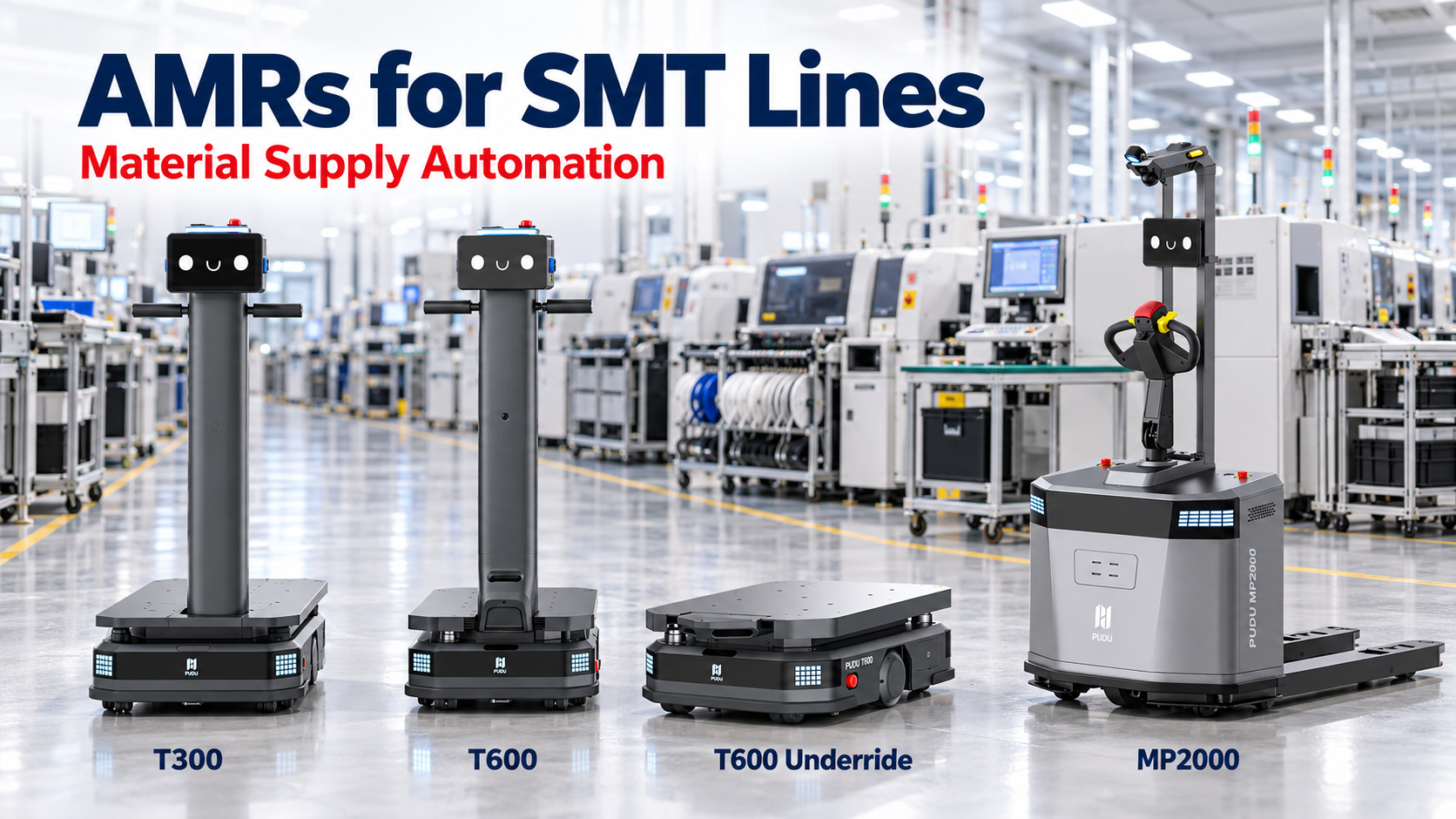
An SMT production line depends on a reliable supply of component reels, solder paste, bare PCBs and prepared kits. When those materials arrive late, production teams compensate through urgent requests, additional walking and larger line-side buffers. Across multiple lines and shifts, these workarounds become a recurring operational cost. AMRs for SMT lines help manufacturers automate the material movements connecting stores, preparation areas, production and return locations.
These applications show why evaluating AMRs for SMT lines requires more than comparing robot payloads. Manufacturers must consider the materials and carriers, request frequency, receiving interfaces, integration requirements and exceptions that affect the complete delivery cycle.
Autofina Robotics, working with Pudu Robotics, helps Indian manufacturers evaluate these requirements around their actual material flow. The objective is to develop a deployment scope that can be tested against delivery performance, operator transport time, material-related interruptions and the demands of future expansion.
This guide examines where AMRs for SMT lines fit, what PUDU’s applications demonstrate, and how to plan a project around measurable manufacturing requirements.
Key Takeaways
- AMRs for SMT lines automate recurring material transport between stores, preparation areas, production stations and return locations.
- The application extends beyond component replenishment. Prepared kits, PCB carriers, fixtures, unused materials and empty carriers can create suitable transport requirements.
- Robot selection follows the load and receiving interface. A protected kit rack, wheeled trolley, roller-transfer station and pallet each require a different handling arrangement.
- Reliable supply depends on the complete workflow. Material readiness, task priorities, loading, unloading and receipt confirmation influence delivery performance.
- PUDU offers several configurations relevant to electronics manufacturing, including T300, T300 Roller, PuduBot 2, T600 and MP2000.
- Published manufacturing case studies provide reference evidence. Each proposed deployment still needs representative-load testing and measurable acceptance criteria.
- Autofina Robotics helps manufacturers connect their material-flow requirements with an application-specific assessment and deployment scope.
What is an AMR in Electronics Manufacturing?
An Autonomous Mobile Robot, or AMR, transports materials between configured locations using onboard navigation, sensors and control software. It localises within a mapped environment and manages movement according to the available route, obstacles and operating rules.
In electronics manufacturing, an AMR provides a transport link between processes. Depending on its configuration, it can carry protected containers, move compatible racks or trolleys, transfer loads through roller interfaces, or transport pallets.
AMRs for SMT lines connect material preparation with the production locations that need those materials. Their work can include delivering a verified kit, replenishing suitable component containers, moving fixtures or collecting empty carriers.
How an AMR Fits into the Manufacturing Process
The robot operates within a wider workflow:
- Materials are prepared and released for movement.
- An operator, schedule or connected system creates a transport request.
- The robot collects the load through the configured loading arrangement.
- It travels to the designated receiving point.
- An operator or compatible transfer system unloads the material.
- The workflow records completion and, where required, material acceptance.
The exact level of automation depends on the carrier, receiving equipment and system integration. Autonomous travel does not automatically provide automatic loading, component verification or machine feeding.
How AMRs Help SMT Lines
AMRs for SMT lines automate recurring material movements between stores, preparation areas, production and return locations. They provide transport capacity for tasks that otherwise depend on material handlers being available when production needs a delivery.
The strongest applications combine frequent movements, defined pickup and receiving points, and suitable carriers. Selecting the robot requires assessing the complete load and handoff, including protection, loading access, route clearance and unloading.
Delivering Prepared Kits and Replenishment Materials
Prepared kits must reach production before the next job starts, while replenishment materials must arrive within the running line’s required window.
AMRs can transport verified kits and protected containers from preparation to designated receiving points. Requests can be scheduled, operator-triggered or connected to production systems, depending on the supplied configuration.
This helps organise deliveries around production demand. The workflow still needs clear priorities, material identification and receipt confirmation.
Moving Pallets, Trolleys and Production-Support Loads
Different stages of material supply require different handling arrangements.
Compatible palletised stock can move into preparation or staging areas, while suitable racks and trolleys can carry prepared materials towards production. Fixtures and other production-support loads may also create recurring routes between departments.
These applications should be assessed separately: pallet access, trolley behaviour and fixture restraint present different requirements.
Transferring Loads Between Equipped Stations
Where standardised containers move repeatedly between compatible stations, a roller configuration can support an equipment-linked handoff.
The application requires matching transfer geometry, station-ready signals and confirmation that unloading is complete. This allows the transport project to address handling at the receiving interface as well as travel between locations.
Collecting Returns and Empty Carriers
Changeovers create outgoing loads alongside incoming demand. Unused materials and empty carriers need timely collection to keep receiving positions and staging areas available.
AMRs for SMT lines can include these return movements in the operating workflow. Delivery and collection may share a mission where carrier capacity, segregation and production timing permit. Returned-material status remains governed by the plant’s quality and inventory processes.
Match the Material Route to the Transport Arrangement
| Material route | Typical load | Configuration to assess | Main requirement |
|---|---|---|---|
| Stores to preparation | Compatible palletised materials | MP2000 | Pallet compatibility and loaded manoeuvring space |
| Preparation to SMT | Verified kits in protected carriers | T300 with suitable carrier | Load restraint, identification and receiving handoff |
| Trolley-based supply | Compatible wheeled carriers | Engineered towing or lifting arrangement | Coupling or carrier interface and loaded movement |
| Station-to-station transfer | Standardised containers | T300 Roller | Transfer geometry and equipment signals |
| Testing and inspection | Samples or suitable small containers | PuduBot 2 | Tray loading, protection and operator interaction |
| Heavier carrier movement | Consolidated loads | T600 or T600 Underride | Carrier compatibility and loaded clearance |
| Return collection | Unused materials and empty carriers | Configuration matched to the load | Segregation, material status and destination |
These are candidate applications, subject to configuration and site validation.
Connect Automation with Measurable Results
The operational value should be evaluated through delivery timing, manual transport workload and the clearance of outgoing materials. Where integration supports task records, timestamps and exceptions can also help identify where delays occur.
Autofina Robotics can help identify a priority route and define the carrier, robot configuration, interfaces and trial criteria around that requirement. The first application should address a measurable constraint under actual loads, normal traffic and busy delivery conditions.
Evaluating AMRs for SMT lines? Share your route layout, carrier dimensions and shift demand with Autofina Robotics to scope a material-flow assessment.
| Application | Potential operational contribution | Measure to evaluate |
|---|---|---|
| Prepared-kit delivery | More consistent dispatch to production | Kits received within the required window |
| Replenishment | Dedicated capacity for recurring requests | Request-to-receipt time during peak demand |
| Fixture transport | Reduced manual movement between areas | Operator transport time and completed deliveries |
| Return collection | More timely clearance of outgoing loads | Return dwell time and staging occupancy |
| Recorded delivery events | Better visibility of delays and exceptions | Record completeness and unresolved tasks |
These measures turn the discussion about AMRs for SMT lines into a project that manufacturing leadership can evaluate.
Where SMT Material Supply Gets Delayed
Material arriving late at an SMT line does not necessarily mean the transport stage caused the delay. Preparation, release, dispatch, travel and receipt can each affect the result. Before selecting AMRs for SMT lines, the assessment should establish where time is lost and which part of the process automation can improve.
Kits Are Ready, but Transport Is Unavailable
Material handlers may be replenishing another line, collecting returns or serving a distant location when a kit becomes ready. If several requests arrive together, dispatch queues build. Production teams then escalate requests or collect materials themselves.
The useful baseline is the time between material release and pickup. This separates transport availability from preparation performance.
Urgent Requests Displace Scheduled Work
An urgent delivery can interrupt a planned route. Repeated exceptions can make the remaining queue difficult to manage. The proposed operating rules should establish:
- Which requests qualify as urgent.
- How priority changes affect existing tasks.
- Who handles an unresolved request.
- How delayed scheduled deliveries remain visible.
AMRs for SMT lines need these rules to operate as a dependable supply resource.
Changeovers Generate Movement in Both Directions
The next kit must arrive while previous-job materials and empty carriers leave the production area. Without coordinated collection, outgoing loads can occupy receiving positions or staging space. This adds handling work and can delay the next delivery.
Changeover analysis should therefore include delivery and return demand together.
Receiving Points Cannot Accept the Load
A robot may arrive on time but wait because the unloading position is occupied, an operator is unavailable or receiving equipment is not ready. This extends the mission and reduces capacity for subsequent work. Loading and unloading time, staging capacity and destination availability must therefore be included in the application design.
Material Identity or Status Is Unclear
A transport request may lack a usable destination, carrier identifier or confirmation that the material is ready. Automating the journey cannot resolve incomplete release information. The workflow needs clear request fields and ownership of material status.
Measure the Delay Before Sizing the Fleet
| Measure | What it reveals |
|---|---|
| Preparation and release time | Whether materials are ready when required |
| Dispatch waiting | Whether transport capacity matches demand |
| Travel time | The route’s contribution to delivery time |
| Receiving wait and unloading | Whether the handoff constrains capacity |
| On-time receipt rate | Performance against the production window |
| Operator transport and follow-up time | Manual workload supporting the current process |
| Return dwell time | Whether reverse logistics clears the line |
| Material-related interruptions | The production consequence of supply failures |
For Autofina and the plant team, this baseline identifies where AMRs for SMT lines can address a defined operating problem.
Which PUDU Robots Suit SMT Material Handling?
Selecting AMRs for SMT lines starts with the material, its carrier and the receiving interface. A prepared-kit rack, fixture trolley, small sample container and pallet create different requirements for loading, navigation and unloading.
PUDU’s product range provides several configurations to assess. The objective is to select the arrangement that supports the route’s demand and handoff with an appropriate level of integration.
PUDU T300: Prepared Kits, Fixtures and Compatible Carriers

T300 is relevant to recurring transport involving prepared kits, protected containers, fixtures and compatible material carriers.
The application should define how the load is retained, how operators access it and what confirms completion at the receiving point. Rack, lifting and towing arrangements require separate assessment because their carrier interfaces and loaded movement differ.
Suitable applications to investigate include:
- Prepared-kit movement from preparation to production.
- Delivery of protected material containers.
- Fixture transport between approved locations.
- Movement of compatible racks or wheeled carriers using the appropriate configuration.
PUDU’s Ennoconn case provides a documented reference for T300 across SMT supply and wider EMS production logistics.
PUDU T300 Roller: Transfers Between Equipped Stations
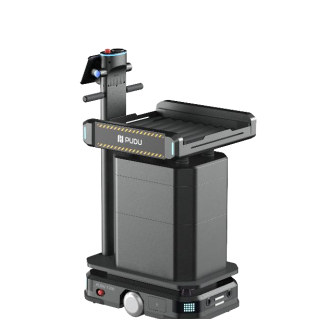
T300 Roller is relevant where standardised containers must transfer between the robot and compatible equipment.
For these applications, the transfer interface becomes a central part of the project. The assessment should establish:
- Container dimensions, weight and underside.
- Transfer height and direction.
- Load retention during travel.
- Station-ready and transfer-complete signals.
- Response to an occupied station or incomplete transfer.
For manufacturers evaluating AMRs for SMT lines, this configuration can support a more automated handoff where the equipment and control interfaces are engineered accordingly.
PuduBot 2: Selected Small-Material Deliveries
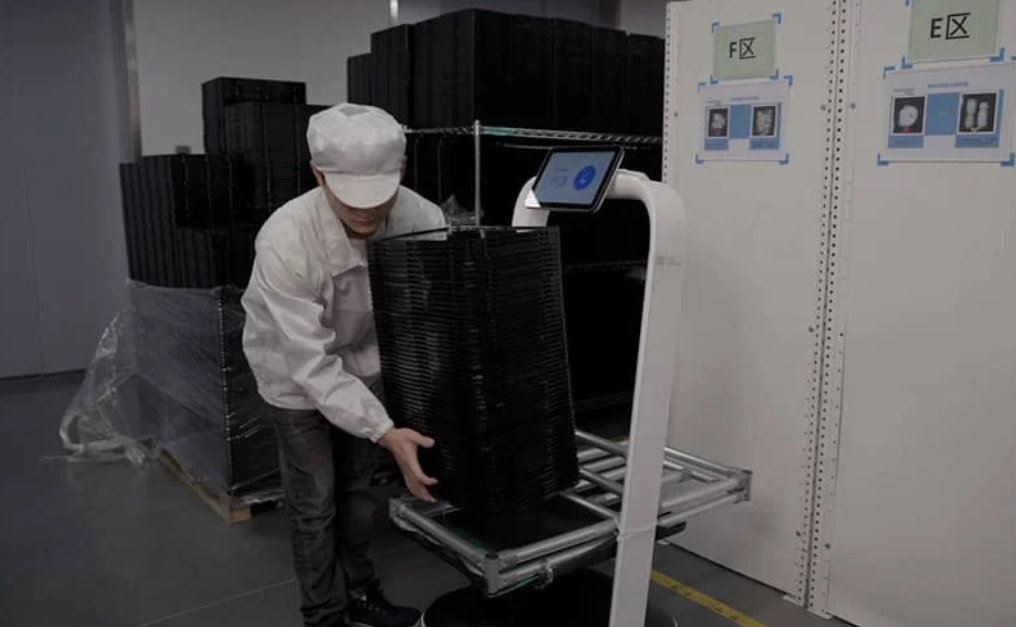
PuduBot 2 can be assessed for samples and suitable small containers where tray-based transport matches the task.
Tray geometry, individual loading limits, material protection and operator access must be checked. Its suitability should follow the actual manufacturing application rather than appearance or nominal total capacity alone.
Potential routes include sample movement, selected replenishment tasks and collection of suitable return containers.
PUDU T600 and T600 Underride: Heavier Carrier Requirements
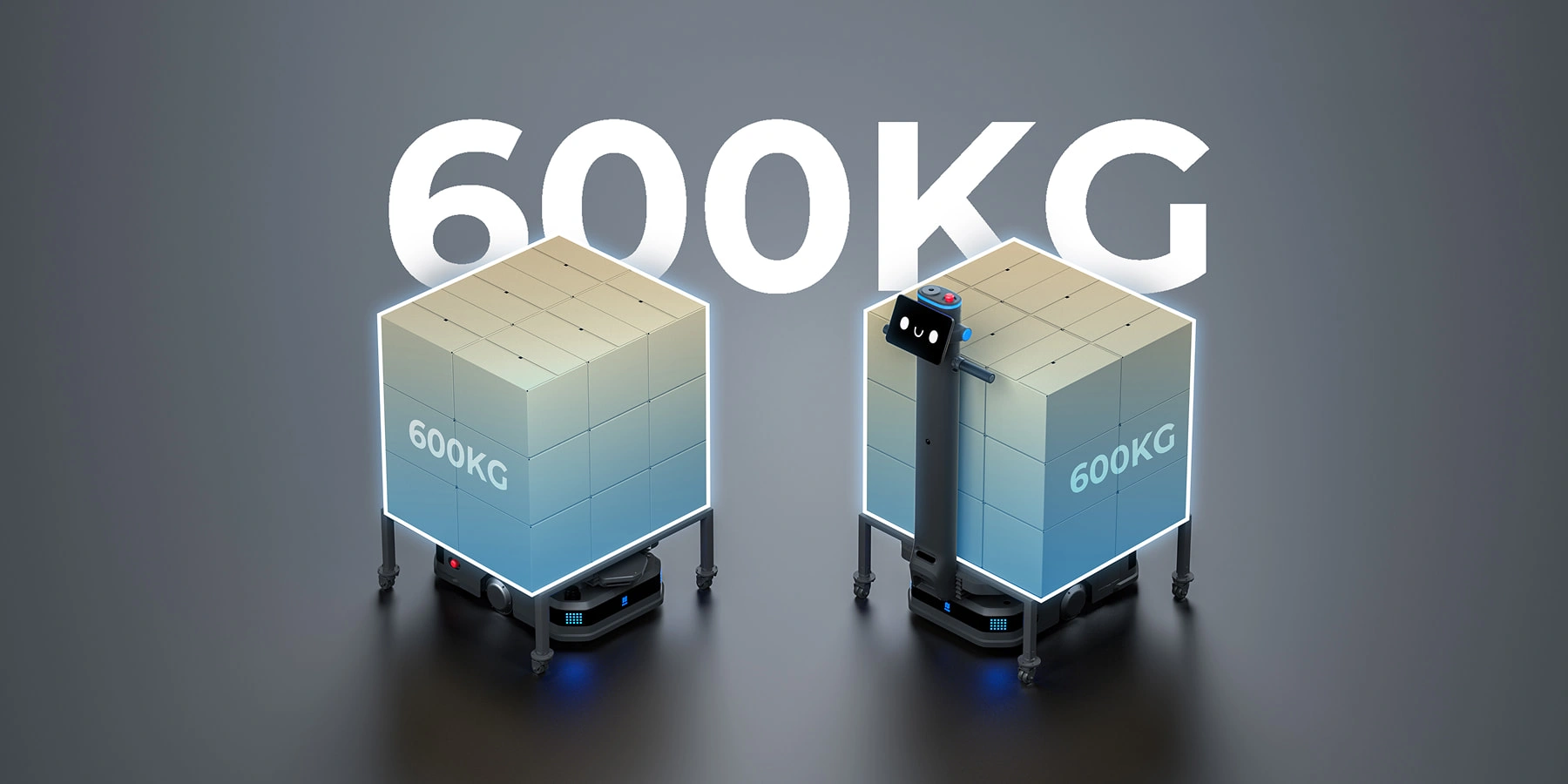
T600 configurations can enter the assessment where consolidated loads or compatible under-carrier handling require a different platform.
The selection depends on carrier geometry, load distribution, pickup and release arrangements, and loaded route clearance.
These configurations should be evaluated against the plant’s actual carrier rather than treated as direct substitutes for every T300 application.
PUDU MP2000: Upstream Pallet Transport
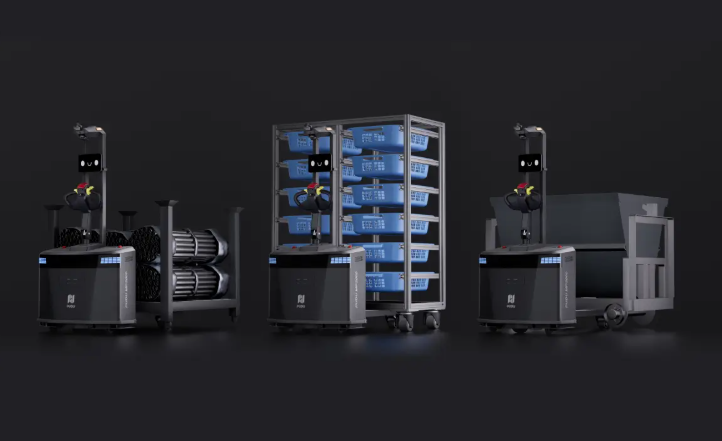
PUDU MP2000 is relevant where compatible pallets move between storage, preparation and staging areas.
This upstream task differs from delivering small containers beside an SMT line. Some plants may justify both pallet automation and line-side transport; others may have a stronger first project in only one stage.
Pallet construction, fork access, load stability and manoeuvring space must be validated. Compare the Complete Transport Arrangement
| Configuration | Application to investigate | Main selection requirement |
|---|---|---|
| T300 with appropriate carrier | Kits, protected containers and fixtures | Carrier suitability and receiving handoff |
| T300 towing or lifting arrangement | Compatible trolleys and carriers | Engineered coupling or pickup interface |
| T300 Roller | Standardised station transfers | Mechanical and control compatibility |
| PuduBot 2 | Selected small-material deliveries | Tray loading, protection and interaction |
| T600 / T600 Underride | Heavier compatible carrier movement | Carrier interface and loaded clearance |
| MP2000 | Upstream pallet movement | Pallet compatibility and manoeuvring space |
The final selection of AMRs for SMT lines should be documented alongside the carrier, integration, commissioning and acceptance scope.
How an AMR Delivery Workflow Operates
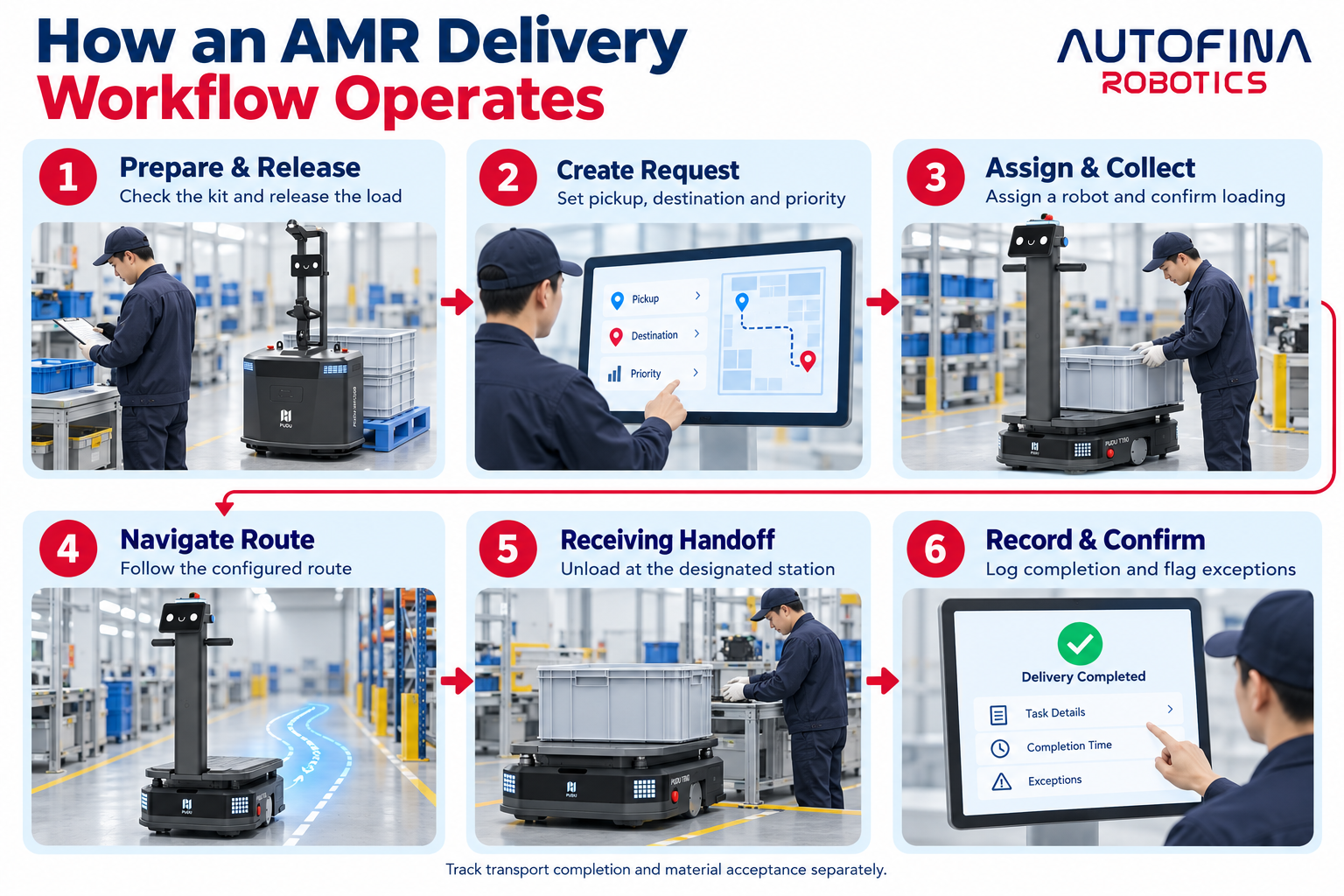
An AMR delivery begins before the robot starts moving and ends after the load reaches its receiving position.
For a dependable application, each stage needs a defined owner, trigger and completion condition.
Step 1: Prepare and Release the Material
Stores or preparation personnel confirm that the load is ready for movement.
Depending on the plant’s process, this may involve checking the kit identifier, quantity, production order, carrier condition and material-release status. The transport task should receive the information needed to identify the load and destination.
Step 2: Create the Transport Request
A request may originate from an operator interface, call button, schedule or connected production system.
The available method depends on the supplied configuration and integration scope. Where several request sources are used, duplicate requests and task ownership need clear handling.
Useful task information can include:
| Field | Purpose |
|---|---|
| Task ID | Identifies the transport request |
| Pickup location | Defines the collection point |
| Destination | Defines the receiving point |
| Carrier or kit ID | Links transport with the load |
| Required delivery time | Establishes the service window |
| Priority | Supports dispatch decisions |
| Task status | Shows progress or exceptions |
Step 3: Assign and Collect the Load
The dispatch arrangement assigns an available robot according to configured operating rules.
Loading may be performed by an operator, a compatible lifting arrangement or an engineered transfer interface. The workflow should establish what confirms that loading is complete and departure is permitted.
Step 4: Travel Through the Approved Route
The robot navigates through its configured operating area.
The application must account for loaded clearances, crossings, temporary obstructions and any engineered door or elevator interfaces. A route that is suitable for the robot body may be unsuitable for its carrier or load.
Step 5: Complete the Receiving Handoff
At the destination, an operator or compatible station unloads the material.
The workflow needs a response when the receiving point cannot accept the load. Depending on the application, this could involve waiting, escalation or another approved action.
Step 6: Record Completion and Exceptions
Transport completion and material acceptance should be distinguished where the plant requires both.
For AMRs for SMT lines, this helps establish whether a delay occurred before pickup, during travel or at the receiving point. Where integration supports it, the task record can link those events with the kit, carrier or batch.
PUDU T300 at Ennoconn: AMRs Connecting SMT Supply and EMS Production
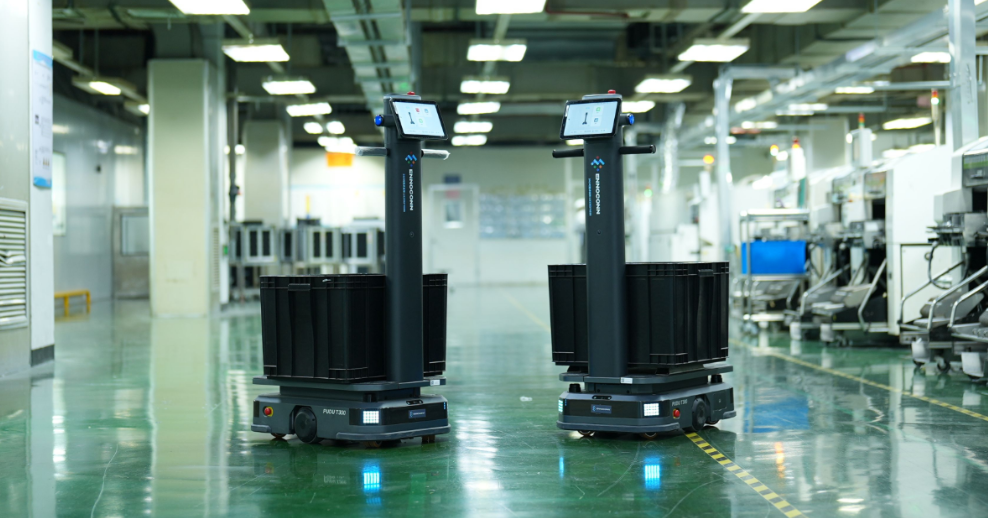
Ennoconn’s deployment provides a relevant example for manufacturers evaluating AMRs for SMT lines within a wider EMS operation.
PUDU describes a facility previously dependent on manual cart transport and fragmented logistics coordination. T300 deployment connected five production flows, extending from material supply through to finished-goods dispatch.
SMT Material Supply
In the SMT supply route, T300 transports solder paste, component reels and bare PCBs between the raw-material warehouse and feeding area.
PUDU describes a two-hour delivery cycle, automatic material-demand triggers and support for round-the-clock SMT operation. This cycle refers to the supply cadence; it is not the duration of an individual robot trip.
For an SMT plant, the important design consideration is how scheduled supply interacts with changing material demand. Replenishment requests need clear priorities, ready loads and available receiving locations.
PCB Processing and DIP Component Supply
The PCB-processing route involves racks and substrate carriers moving between fabrication stages according to batch completion.
For DIP assembly, T300 supplies items including connectors, components and heatsinks to assembly stations and wave-soldering buffer areas.
These routes demonstrate that a transport deployment can serve different production requirements, provided each has an appropriate carrier, release condition and handoff.
Testing, Ageing and Finished-Goods Movement
T300 also connects assembly, FCT testing and ageing areas through a circulating workflow with task priorities.
The final route handles vacuum-packed PCBs and boxed PCBA units moving from warehouse locations towards shipping.
| Production flow | Materials or loads | Operating arrangement described by PUDU |
|---|---|---|
| SMT supply | Solder paste, reels and bare PCBs | Two-hour supply cycle and demand triggers |
| PCB processing | PCB racks and substrate carriers | Batch-driven transfers |
| DIP assembly | Connectors, components and heatsinks | Supply to stations and buffer areas |
| Testing and ageing | Loads circulating between production and test locations | Priority-based scheduling |
| Finished-goods dispatch | Vacuum-packed PCBs and boxed PCBA units | Warehouse-to-shipping transfers |
Integration and Traceability
PUDU describes requests through PUDU Link and call buttons, elevator coordination and integration with the production-management system. Delivery information includes batch details and timestamps.
For businesses considering AMRs for SMT lines, this provides a useful reference for connecting transport requests with production events and delivery records.
Battery Manufacturing: A 32-Unit Delivery Fleet and T300 Fixture Transport
A separate PUDU case study describes an unnamed lithium-ion battery manufacturer in China using PuduBot 2, T300 and CC1.
This application provides supporting evidence for production logistics, fleet operations and system integration. It should remain distinct from the direct SMT supply example at Ennoconn.
PuduBot 2: Samples, Replenishment and Return Collection
The manufacturer deployed 32 PuduBot 2 units for sample delivery, material replenishment, inbound transport and waste collection.
PUDU also identifies MES integration as part of the operation.
| Measure | Manufacturer-reported result |
|---|---|
| Delivery efficiency | 40% improvement |
| Daily material handling | More than 3,000 batches |
| Overall production capacity | 18% improvement |
| Material-flow and delivery processes | Approximately 60% optimised through MES integration |
Source: PUDU Robotics’ battery-manufacturing case study. Figures are manufacturer-reported outcomes for that application, not guaranteed results for other facilities.
These figures describe that particular application. The article does not publish the measurement methods needed to reproduce the calculations.
T300: Fixture Transport Between Production Lines
T300 handles fixture movement between production lines. Workers request the robot using PUDU Pager, with deliveries made to designated stations.
PUDU reports a 50% improvement in material-turnover efficiency for this application.
Fixture movement is relevant to manufacturers evaluating AMRs for SMT lines because the transport requirement can extend beyond components and kits. Tooling and other production-support loads may also consume material-handler capacity.
CC1: Supporting Cleaning Operations
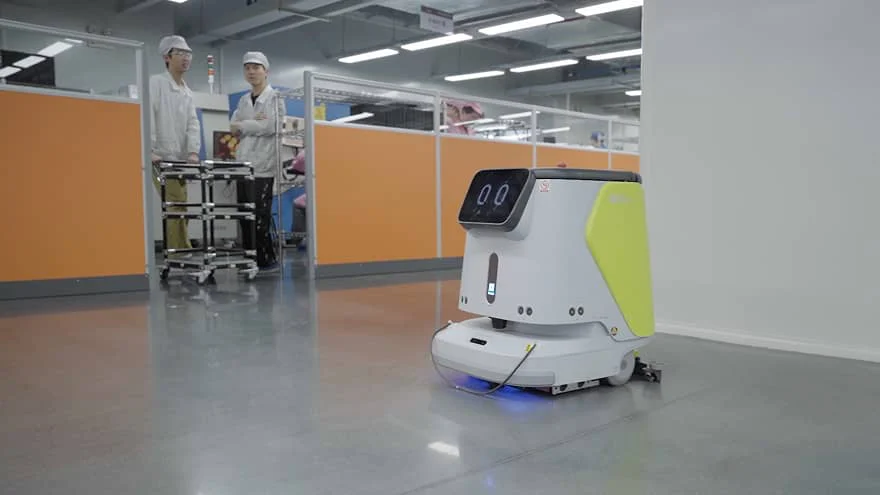
CC1 addresses cleaning requirements alongside the delivery operation, including production-floor oil contamination and warehouse dust.
Its role provides factory context. The material-supply case remains centred on PuduBot 2 and T300.
Relevance to SMT Automation Planning
The example shows different platforms assigned to different tasks. It also demonstrates why fleet size, integration and operating results must be tied to a defined application.
When evaluating AMRs for SMT lines, the plant should establish its own demand profile, handoff times and performance baseline before estimating capacity or savings.
T300 Roller Application: Equipment-Linked Transport at Fleet Scale
PUDU T300 Roller application has been successfully deployed at an battery manufacturer’s SMT workshop.
The requirements included material feeding, production transport and scheduling in a dense layout with narrow aisles and other vehicles operating nearby.
What Was Transported?
Semi-finished and finished batteries in boxes measuring approximately 350 × 265 × 240 mm, with a stated weight below 30 kg.
Automatic line calling, equipment docking and multi-robot scheduling were relevant parts of the application.
What Scale Was Reported?
PUDU reports 16 T300 Roller robots handling approximately 2,000 trips per day.
Why the Roller Interface Matters
For manufacturers considering AMRs for SMT lines, this application highlights the importance of the receiving interface.
A repeatable equipment-linked transfer needs compatible containers, transfer alignment, station readiness and completion confirmation. These requirements affect mission time and recovery as much as travel does.
Designing Replenishment, Changeovers and Material Returns
Replenishment and returns share transport resources, receiving space and operator attention. They should be planned together.
Coordinate Scheduled and Demand-Triggered Supply
Scheduled deliveries can support predictable requirements, while operator or system requests can address changing demand.
The operating rules should define priority levels, request ownership and escalation. Urgent work should remain visible alongside the scheduled tasks it affects.
Plan for the Next Changeover
Before the next production job begins, its materials need an approved receiving location.
At the same time, previous-job loads may need collection. The workflow should identify the outgoing material, return destination and available carrier capacity.
This helps prevent the staging area from becoming a mixture of incoming kits, unused materials and empty containers.
Preserve Control of Returned Materials
Transporting an unused reel back to stores does not determine whether it can be reused.
The plant’s material and quality processes should establish the required checks, including identity, quantity, packaging condition and applicable exposure records.
The transport workflow then moves the identified load to its approved destination.
Combine Delivery and Collection Where Practical
A return movement may be included in a delivery mission when:
- Carrier capacity is sufficient.
- Incoming and outgoing loads remain separated.
- Pickup and destination information are clear.
- Collection does not compromise the next delivery window.
- The configuration supports the required handling.
Combined missions should be evaluated using complete cycle time rather than assumed to improve capacity automatically.
Measure the Complete Material Cycle
| Measure | Purpose |
|---|---|
| Replenishment received within the required window | Checks production service |
| Urgent-task response time | Checks peak responsiveness |
| Return-material dwell time | Checks clearance of outgoing loads |
| Empty-carrier availability | Checks readiness for subsequent work |
| Receiving-position occupancy | Identifies staging constraints |
| Delivery and collection interventions | Reveals remaining manual workload |
For AMRs for SMT lines, this complete-cycle view helps prevent a faster delivery process from creating congestion at the next handoff.
For AMRs for SMT lines, this complete-cycle view helps prevent a faster delivery process from creating congestion at the next handoff.
Planning replenishment and return automation? Share your delivery demand, changeover pattern and carrier details with Autofina Robotics to scope the application.
Connecting AMRs with MES, WMS and Production Equipment
AMRs for SMT lines can connect material transport with production and warehouse systems, allowing requests, deliveries and completion records to follow a defined workflow. The available interfaces depend on the selected robot configuration and integration scope.
Request and Dispatch
An operator, schedule or connected system creates a delivery request. The transport-control system then assigns the task according to robot availability and configured priorities.
The workflow should confirm that materials are ready for collection and establish how urgent replenishment is handled.
Receiving Handoff
At the destination, an operator or compatible station receives the load. Equipment-linked transfers require agreed signals for station readiness, permission to transfer and unloading completion.
Autofina, PUDU, the plant and the equipment vendor should define responsibility for these interfaces.
Confirmation and Exceptions
The workflow records transport completion and, where required, material acceptance. Inventory updates remain the responsibility of the designated factory system.
It should also define who responds when a destination is occupied, a task is interrupted or confirmation is missing. This gives production teams visibility of unresolved deliveries and a clear recovery process.
ESD, Safety and Operational Recovery
AMRs for SMT lines must preserve component protection and fit the plant’s safety procedures. Before acceptance, confirm the following:
- ESD approval: Have the plant’s ESD team assess and document the complete handling arrangement, including packaging, contact surfaces and transfer procedures.
- Material controls: Maintain applicable moisture-protection, exposure-record and return-material verification processes throughout transport.
- Safety responsibilities: Define operating rules for shared areas, equipment interfaces, emergency stops and authorised intervention.
- Exception recovery: Establish who responds to blocked destinations, interrupted missions or localisation loss, and what must be checked before restarting.
- Change control: Review modifications to loads, stations, maps or interfaces and update the affected validation records and operator instructions.
Record these requirements in the commissioning and acceptance scope so production, engineering and support teams share clear responsibilities.
Fleet Sizing, Pilot Acceptance and Investment Evaluation
Fleet sizing should follow delivery demand and complete mission time.
For AMRs for SMT lines, daily trip totals alone are insufficient. A facility may have manageable average demand but several short periods when multiple lines require materials simultaneously.
Establish the Demand Profile
Record requests by route and time window, including:
- Routine deliveries.
- Urgent replenishment.
- Changeover movements.
- Return collection.
- Load and carrier types.
- Required receipt times.
- Shift and production-pattern differences.
This reveals which routes compete for capacity and whether demand is concentrated around specific events.
Measure the Complete Mission
A transport mission can include waiting for assignment, travelling to pickup, loading, loaded travel, receiving wait, unloading and confirmation.
The capacity assessment must also account for charging, maintenance, traffic interaction and recovery.
Dividing daily demand by a product’s maximum travel speed will not produce a dependable fleet estimate.
Test a Representative Production Route
The pilot should use the proposed carrier and representative materials under the conditions that matter to production.
It should include busy periods, shared traffic, the intended handoff and selected recovery scenarios. Testing only an empty aisle demonstrates little about the complete application.
Agree Acceptance Criteria Before the Trial
| Criterion | What to measure |
|---|---|
| Delivery service | Percentage received within the required window |
| Mission completion | Tasks completed with the agreed handoff |
| Response time | Request-to-receipt performance, including peak periods |
| Manual intervention | Frequency and cause of operator assistance |
| Receiving performance | Waiting and unloading time |
| Recovery | Handling of agreed interrupted-task scenarios |
| Data completeness | Required task and delivery records |
| Operational effect | Change in transport workload or material-related interruptions |
Targets should be agreed with the customer and measured against a comparable baseline.
Evaluate the Full Deployed Cost
The commercial assessment should include the components required to make the application operate:
- Robots and charging arrangements.
- Carriers, attachments and transfer stations.
- Software and system integration.
- Door, elevator or other infrastructure interfaces.
- Installation, commissioning and acceptance.
- Training, maintenance and support.
- Batteries, consumables and other applicable lifecycle costs.
Benefits should distinguish measured savings from opportunities. Time released from manual transport becomes a financial saving only when the business can use that capacity productively or avoid an actual expense.
Expand After the Workflow Is Validated
A successful first deployment should produce documented interfaces, operating procedures and performance evidence.
Additional lines or sites may require further assessment because their traffic, demand and carriers differ. This provides a controlled approach to expanding AMRs for SMT lines across a larger manufacturing operation.
| Criterion | What to measure |
|---|---|
| Delivery service | Percentage received within the required window |
| Mission completion | Tasks completed with the agreed handoff |
| Response time | Request-to-receipt performance, including peak periods |
| Manual intervention | Frequency and cause of operator assistance |
| Receiving performance | Waiting and unloading time |
| Recovery | Handling of agreed interrupted-task scenarios |
| Data completeness | Required task and delivery records |
| Operational effect | Change in transport workload or material-related interruptions |
Targets should be agreed with the customer and measured against a comparable baseline.
Evaluate the Full Deployed Cost
The commercial assessment should include the components required to make the application operate:
- Robots and charging arrangements.
- Carriers, attachments and transfer stations.
- Software and system integration.
- Door, elevator or other infrastructure interfaces.
- Installation, commissioning and acceptance.
- Training, maintenance and support.
- Batteries, consumables and other applicable lifecycle costs.
Benefits should distinguish measured savings from opportunities. Time released from manual transport becomes a financial saving only when the business can use that capacity productively or avoid an actual expense.
Expand After the Workflow Is Validated
A successful first deployment should produce documented interfaces, operating procedures and performance evidence.
Additional lines or sites may require further assessment because their traffic, demand and carriers differ. This provides a controlled approach to expanding AMRs for SMT lines across a larger manufacturing operation.
How Autofina Robotics Supports AMR Deployment in India
Deploying AMRs for SMT lines requires the robot, material carrier, production workflow and receiving interface to work together. Autofina Robotics, working with PUDU Robotics, supports Indian manufacturers from application assessment through deployment and after-sales service, with responsibilities defined in the project scope.
Application Assessment and Robot Selection
Autofina reviews the proposed routes, load dimensions, carrier design, delivery frequency and receiving arrangements. This establishes which movements suit automation and which robot configuration should enter a trial.
The assessment also identifies requirements such as trolley modifications, equipment transfers, door or elevator interfaces and production-system connectivity.
Trials, Integration and Commissioning
Application trials should use representative materials and carriers. Autofina coordinates the agreed robot configuration, mapping, destination setup and operating workflow, alongside PUDU and relevant equipment vendors where required.
Before commissioning, the project should define responsibility for mechanical interfaces, control signals, task creation and receipt confirmation. Acceptance then checks the complete workflow against agreed delivery and recovery criteria.
Operator Training and Ongoing Support
Training covers routine operation, loading and unloading, charging, basic checks and authorised recovery. The support scope should specify maintenance, troubleshooting, escalation and applicable spare-parts arrangements.
Autofina’s Pune demonstration facility provides a location for initial application discussions and demonstrations. Site trials establish how the proposed solution performs under the customer’s actual production conditions.
Local Application Experience
For enterprise buyers, the most useful evidence is a comparable Indian application showing what Autofina supplied, integrated, commissioned and supported.
[Approved local evidence — insert here: Add an anonymised electronics-manufacturing example after confirming disclosure permission. State the region, transport task, robot and carrier used, Autofina’s completed responsibilities, and any verified operating result. Describe a demonstration or trial accurately; do not present it as a completed production deployment.]
[Media — beside the local example: Add an approved photograph or short video showing the loaded robot and receiving arrangement. Remove customer names, screens, labels and other identifying details covered by confidentiality commitments.]
Planning AMRs for SMT lines? Share your route layout, carrier details and shift demand with Autofina Robotics to discuss a suitable configuration, integration scope and application trial.
Frequently Asked Questions About AMRs for SMT Lines
- Can an existing factory introduce AMRs without stopping production?
Deployment can be phased around an agreed route, with mapping, trials and commissioning scheduled to limit disruption. Any equipment connections, layout changes or restricted-access work should be planned with the plant team.
- Can we retain our existing trolleys and material carriers?
Potentially. Autofina can assess their dimensions, condition, stability and coupling or lifting interfaces. Some carriers may need modifications; others may require replacement to suit the proposed handling arrangement.
- Do AMRs require continuous Wi-Fi or internet access?
Requirements differ between navigation, task dispatch, fleet coordination and MES/WMS connectivity. Confirm the network requirements of the supplied configuration and test how the application responds to communication interruptions.
- What happens when the production layout changes?
Affected maps, destinations and operating rules may need updating. Changes to stations or equipment interfaces should be reviewed and tested before the revised route enters production.
- Can different PUDU robot models work in the same area?
They can be assessed for a shared operating environment, but common fleet control and traffic coordination must be confirmed for the specific models and software. A shared manufacturer does not automatically establish compatibility.
- What information should we share with Autofina for an initial assessment?
Provide the route layout, load and carrier dimensions, pickup and receiving points, delivery demand by shift and current handling method. Include relevant system interfaces and the operational problem you want to resolve.
Request an SMT Material-Flow Assessment
The starting point for AMRs for SMT lines is a clearly defined material-flow requirement: what must move, when production needs it and how the receiving process works.
Autofina Robotics can help assess the route, carrier, robot configuration and integration needed to develop that requirement into a reviewable proposal.
For an initial discussion, share:
- The pickup and receiving locations.
- Material and carrier dimensions.
- Typical and maximum load weight.
- Delivery demand by shift, including busy periods.
- Current loading, transport and unloading methods.
- Relevant MES, WMS or equipment interfaces.
- The delay, workload or production issue the project should address.
Contact Autofina Robotics to assess AMRs for SMT lines and plan a representative application trial.
Tell us about your facility and cleaning challenges. We provide Pan India support and installations. Our team at Autofina Robotics will propose routes, coverage estimates, and ROI.
Email: [email protected]
Phone: +91 98192 22944