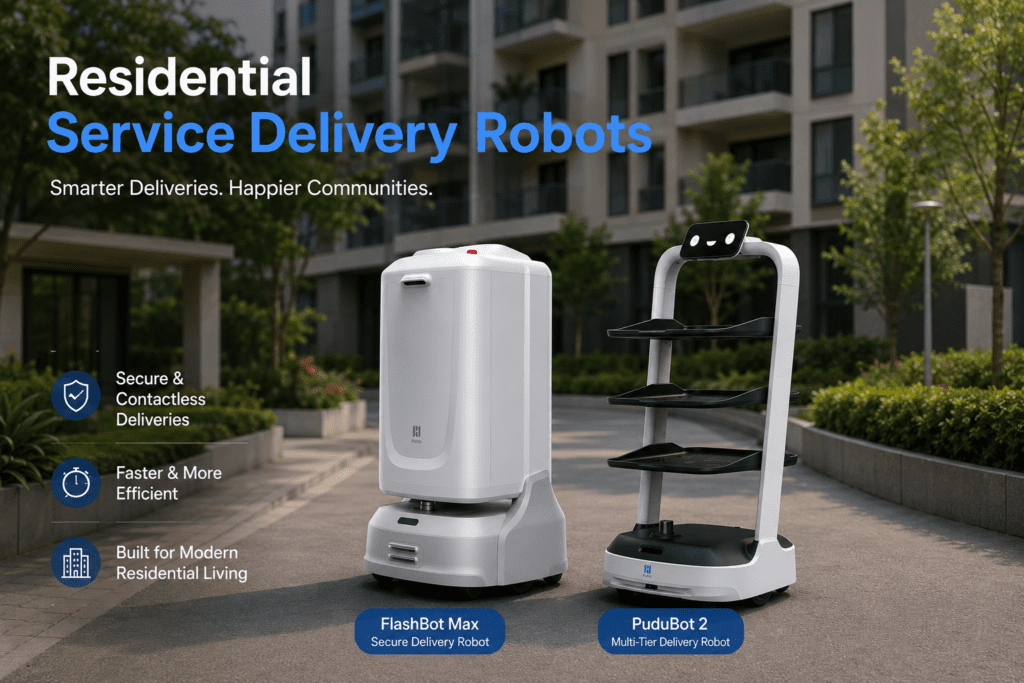
Urban residential ecosystems in India are evolving rapidly. With the rise of high-rise apartments, gated communities, and large integrated townships, the operational complexity within residential environments has increased significantly.
At the same time, the surge in e-commerce, food delivery, and hyperlocal logistics has led to a sharp increase in daily entries into residential societies. A typical mid-to-large society in cities like Mumbai or Bangalore may handle anywhere between 150 to 400 deliveries per day.
This creates multiple challenges:
- Congestion at entry gates
- Increased dependency on security personnel
- Safety concerns due to frequent external movement
- Inefficient and unstructured delivery processes
- Resident inconvenience due to repeated trips to the gate
Traditional manual systems are no longer scalable for this volume. As a result, residential service delivery robots in India are emerging as a practical solution to automate internal logistics and enhance overall efficiency.
Table of Contents
What Are Residential Service Delivery Robots?
How Residential Service Delivery Robots in India Work
Key Use Cases of Residential Service Delivery Robots in India
Benefits of Residential Service Delivery Robots in India
Best Residential Service Delivery Robots in India
How Builders Can Design Future-Ready Communities for Residential Service Delivery Robots?
What Are Residential Service Delivery Robots?
How Residential Service Delivery Robots in India Work
Residential service delivery robots in India operate through an intelligent, automated workflow designed to manage high delivery volumes efficiently within gated communities, apartment complexes, and residential societies. These robots streamline last-mile delivery by reducing manual coordination, improving security, and enabling faster doorstep deliveries.
The entire system is built to handle the real operational challenges of Indian residential environments – including high-density living, multi-floor buildings, restricted delivery access, and dynamic human movement.
1. Delivery Arrival and Task Creation
The process begins when a parcel, food order, grocery item, or essential delivery arrives at the society gate or reception area.
Instead of allowing every delivery executive to enter the premises, the package is handed over to security or designated staff. The delivery is then logged into the robot management system using a mobile app, tablet, or centralized dashboard.
Key information such as:
- Flat number
- Tower or block
- Type of delivery
- Priority level
is recorded instantly, and a delivery task is automatically generated for the robot.
This creates a more structured and secure workflow while reducing unnecessary movement of external delivery personnel inside the society.
For example, if a Swiggy or Blinkit order arrives at the gate, the delivery partner can hand over the package immediately, and the residential service delivery robot takes over the last-mile delivery to the resident’s apartment.
2. Intelligent Robot Allocation
Once the task is created, the system automatically assigns the most suitable robot for the delivery.
The allocation process is based on real-time operational parameters such as:
- Distance from pickup point
- Robot availability
- Battery level
- Current delivery queue
- Delivery priority
The system selects the nearest available robot to ensure the fastest possible completion time. During peak delivery hours, tasks can also be intelligently queued and distributed across multiple robots for smooth operations.
This automated allocation significantly reduces delays and improves fleet efficiency, especially in large societies handling hundreds of daily deliveries.
3. Pickup and Loading at Entry Point
After assignment, the robot moves autonomously to the pickup point – usually the security gate, reception desk, or delivery hub.
Depending on the robot model:
- Deliveries are placed in open multi-tray systems in case of PuduBot 2
- Deliveries are stored in secure closed compartments in case of FlashBot Max
Open trays are ideal for:
- Fast loading and unloading
- High-frequency food or parcel deliveries
Secure compartments are better suited for:
- Premium residential societies
- High-security deliveries
- Multi-floor automated operations
This stage ensures proper loading, secure handling, and accurate dispatch before the robot begins autonomous movement.
4. Autonomous Navigation Inside the Society
Once loaded, the residential service delivery robot begins navigating toward the destination apartment.
The robot uses advanced technologies such as:
- VSLAM (Visual Simultaneous Localization and Mapping)
- LiDAR-based navigation
- Real-time obstacle detection
- Pre-mapped society layouts
This allows the robot to move safely through:
- Corridors
- Lobbies
- Shared residential spaces
- Narrow pathways
Residential service delivery robots in India are specifically designed to handle dynamic environments where movement is constantly changing. They can detect and avoid:
- Children playing
- Pets moving around
- Residents walking through corridors
- Temporary obstacles
The robot automatically adjusts speed, reroutes itself if paths are blocked, and pauses safely when required. This makes the system highly reliable even in crowded and unpredictable residential settings.
5. Elevator Integration for Multi-Floor Delivery
For high-rise apartment complexes, elevator integration is one of the most important features of residential service delivery robots.
Advanced robots like FlashBot Max can:
- Call elevators automatically
- Enter and position themselves correctly inside the lift
- Select the required floor
- Exit at the correct destination level
The robot integrates directly with elevator control systems, enabling fully automated multi-floor movement without human assistance.
This is particularly useful in Indian residential societies where:
- Delivery personnel are restricted from upper floors
- Towers have strict access control systems
- Multi-building layouts increase delivery complexity
By automating vertical movement, the robot can complete true doorstep delivery efficiently and securely.
6. Secure and Contactless Delivery to Residents
Once the robot reaches the correct apartment floor, the resident receives a notification through:
- Mobile app alerts
- SMS notifications
- Optional call integrations
To retrieve the delivery, the resident:
- Enters an OTP
- Or unlocks the compartment using a mobile app
The compartment or tray then opens securely, allowing the resident to collect the item.
This process ensures:
- Contactless delivery
- Reduced delivery errors
- Controlled and secure handovers
- Complete delivery traceability
For premium residential communities, this adds both convenience and security to daily operations.
7. Task Completion and Continuous Operations
After the delivery is completed:
- The robot updates the task status automatically
- Delivery records are stored for analytics and tracking
- The robot proceeds to the next assignment or returns to the charging dock if idle
This enables continuous operations throughout the day without requiring constant human coordination.
For residential societies, this means:
- Faster delivery turnaround
- Reduced dependency on staff
- Better operational visibility
- Scalable delivery management
The result is a structured and technology-driven delivery ecosystem that improves convenience, efficiency, and security across the entire residential community.
Key Use Cases of Residential Service Delivery Robots in India
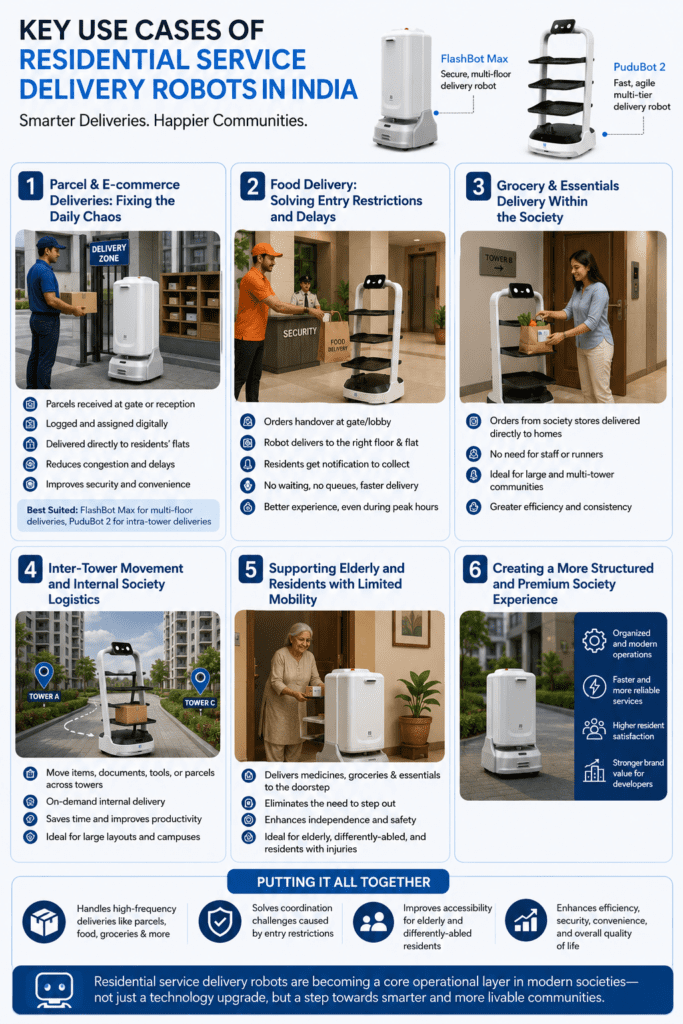
Residential service delivery robots in India are most valuable when you look at day-to-day society operations. These are not occasional use cases – they solve problems that happen every single day in gated communities.
Instead of viewing robots as just “technology,” it’s more practical to see them as a solution to repetitive coordination work, especially in societies dealing with high delivery volumes, restricted access policies, and diverse resident needs.
1. Parcel & E-commerce Deliveries: Fixing the Daily Chaos
In most residential societies today, parcel deliveries are the biggest operational challenge. On any given day, dozens – sometimes hundreds – of packages arrive from platforms like Amazon, Flipkart, and Meesho. During sale periods or festive seasons, this number increases even further.
What typically happens is predictable. Delivery agents gather at the gate, security guards try to contact residents one by one, and residents are asked to come down to collect parcels. This creates delays, congestion, and unnecessary coordination.
Residential service delivery robots simplify this entire process.
Instead of allowing every delivery person inside, all parcels are collected at a central point – usually the security gate or reception. From there, the robot takes over. Deliveries are logged, assigned digitally, and sent directly to the respective flats.
In practical terms, this means a resident who would otherwise make multiple trips downstairs in a day does not need to leave their home at all.
For societies with multiple towers or floors, FlashBot Max is particularly effective because it can handle multi-floor movement with secure compartments. For intra-tower deliveries, PuduBot 2 works efficiently due to its speed and ease of use.
The result is not just faster delivery, but a much more organized and secure system.
2. Food Delivery: Solving Entry Restrictions and Delays
Food delivery is one of the most frequent activities in any urban society. Orders from Swiggy, Zomato, and similar platforms occur throughout the day, especially during lunch and dinner hours.
However, many societies have strict policies where delivery personnel are not allowed beyond the gate or lobby, particularly to upper floors. While this improves security, it creates a gap in last-mile delivery.
Residents are either required to come down or coordinate with guards, which slows things down and creates inconvenience.
Robots solve this problem naturally.
The delivery partner hands over the order at the gate. From there, the robot delivers it to the resident’s floor and apartment. The resident receives a notification, unlocks the tray or compartment, and collects the order.
This setup is especially useful during peak hours when multiple deliveries arrive at the same time. Instead of delivery agents waiting in queues, robots distribute orders in a structured and efficient manner.
It also improves late-night deliveries, where security protocols are stricter and manual coordination becomes more difficult.
3. Grocery & Essentials Delivery Within the Society
In larger residential setups – especially townships with internal stores – grocery delivery becomes an internal logistics challenge.
Residents place orders with society shops, but the last-mile delivery often depends on available staff or manual runners. During busy periods, this leads to delays and inconsistent service.
Robots streamline this process.
Once the order is ready, it is placed inside the robot and delivered directly to the resident’s home. There is no need for a person to carry items across buildings or floors.
This works particularly well in:
- Large gated communities
- Multi-tower societies
- Developments with internal retail setups
Over time, this reduces dependency on manpower and makes operations more efficient.
4. Inter-Tower Movement and Internal Society Logistics
A use case that is often overlooked is internal movement within the society.
Consider how frequently small items need to be transported:
- Documents between towers
- Items shared between residents
- Notices from the society office
- Maintenance tools or small parts
Currently, these tasks require someone to physically carry the items, which takes time and interrupts other responsibilities.
With robots, these movements can be handled on demand. A request is created, and the robot delivers the item to the required destination.
In larger societies where distances between towers are significant, this leads to noticeable efficiency improvements.
5. Supporting Elderly and Residents with Limited Mobility
One of the most meaningful impacts of residential service delivery robots is in supporting residents who need assistance.
In many Indian households, elderly family members may not be comfortable or physically able to walk to the gate multiple times a day. Similarly, residents with disabilities or temporary injuries face similar challenges.
Even routine tasks like collecting a parcel or food delivery can become inconvenient.
Robots remove this dependency.
Deliveries such as groceries, medicines, and essentials are brought directly to the doorstep, eliminating the need to step out.
For example:
- An elderly resident living alone can receive medicines without leaving their home
- A person recovering from surgery does not need to move across floors
- A differently-abled resident can manage deliveries independently
In this context, robots are not just improving efficiency – they are enhancing independence and safety.
6. Creating a More Structured and Premium Society Experience
Beyond operational efficiency, robots also improve the overall perception of the society.
A residential complex that uses robots for deliveries appears more organized and modern. The entire process becomes structured, predictable, and easier to manage.
For residents, this means:
- Less daily inconvenience
- Faster and more reliable services
- A smoother living experience
For developers and builders, this becomes a strong differentiator. It helps position the society as:
- Modern and technology-driven
- Well-managed and efficient
- Future-ready in terms of infrastructure
This can also contribute to higher property value and better resident retention.
Putting It All Together
When viewed collectively, these use cases highlight why residential service delivery robots in India are gaining relevance.
They address:
- High-frequency tasks such as food and parcel deliveries
- Coordination challenges caused by entry restrictions
- Accessibility needs for elderly and differently-abled residents
They do not replace people entirely, but they significantly reduce the need for constant manual coordination.
From daily deliveries to improving quality of life for residents who need assistance, these robots become a core operational layer in modern residential societies rather than just an added feature.
Benefits of Residential Service Delivery Robots in India
The real value of residential service delivery robots in India becomes clear when you look at how they impact different stakeholders within a society. From residents to management teams to builders, these systems create measurable improvements in daily operations as well as long-term positioning.
For Residents: Convenience, Speed, and Better Living Experience
For residents, the biggest change is felt in daily routines. Tasks that previously required coordination, movement, or waiting are simplified significantly.
Doorstep Convenience
One of the most immediate benefits is that everything is delivered directly to the resident’s home. Whether it’s a parcel, food order, groceries, or medicines, there is no longer a need to go down to the gate or lobby.
In practical terms, this removes multiple small inconveniences throughout the day. For example:
- A working professional on calls does not have to step away to collect deliveries
- A parent managing household tasks can receive items without disruption
- Elderly residents or those with mobility challenges can access essentials without assistance
Over time, this significantly improves overall comfort and ease of living.
Reduced Waiting Time and Faster Deliveries
Traditional delivery systems inside societies often involve delays:
- Guards calling residents
- Delivery agents waiting at entry points
- Residents taking time to come down
Robots eliminate these delays by creating a direct and automated flow. Once the delivery is handed over, it moves immediately toward the destination without unnecessary waiting.
This becomes especially noticeable during:
- Peak food delivery hours
- Festive sale periods with high parcel volumes
- Late-night deliveries where coordination is slower
Residents experience a much faster and more predictable delivery cycle.
Contactless and Safer Delivery Experience
Contactless delivery is no longer just a preference – it has become an expectation.
Robots enable a system where:
- Delivery personnel do not need to enter residential spaces
- Interaction is minimal and controlled
- Items are securely handed over via OTP or app-based access
This improves hygiene and also adds a layer of safety, especially in societies where residents prefer restricted external movement.
For Society Management: Better Control, Lower Workload, Higher Efficiency
From a management perspective, residential service delivery robots solve one of the biggest operational challenges – handling high-volume, unstructured deliveries.
Reduced Workload on Security and Staff
Security guards in most societies spend a significant portion of their time managing deliveries:
- Verifying delivery personnel
- Calling residents
- Coordinating handovers
This takes away from their primary responsibility – security.
With robots in place, the role of guards becomes simpler:
- Collect deliveries at a single point
- Log them into the system
- Let the robot handle the rest
This reduces manual effort and allows staff to focus on more critical tasks.
Better Delivery Control and Monitoring
Robots introduce a structured and trackable system.
Every delivery:
- Is logged digitally
- Has a defined flow
- Can be tracked in real time
This eliminates ambiguity and improves accountability.
For management, this means:
- Clear visibility of delivery volumes
- Reduced chances of lost or misplaced items
- Better coordination across large societies
Improved Operational Efficiency
When deliveries are automated, the entire system becomes more efficient.
Instead of multiple people handling individual tasks, a robot can:
- Handle multiple deliveries in sequence
- Operate continuously without breaks
- Maintain consistent performance throughout the day
This is particularly useful in:
- Societies with 200+ daily deliveries
- Multi-tower complexes
- High-rise buildings with restricted access policies
Over time, this leads to smoother operations and fewer complaints from residents.
For Builders and Developers: Strong Differentiation and Long-Term Value
Beyond daily operations, residential service delivery robots also play a role in how a property is positioned in the market.
Premium Positioning
In today’s competitive real estate environment, differentiation is critical. Projects that offer tangible, practical technology solutions stand out more than those offering only traditional amenities.
Deploying robots allows builders to position their projects as:
- Modern and forward-thinking
- Designed for convenience and efficiency
- Aligned with global smart living standards
This is especially relevant for premium and luxury housing segments.
Smart Society Branding
“Smart living” is often used as a marketing term, but robots bring actual functionality behind that claim.
Instead of abstract features, developers can demonstrate:
- Automated delivery systems
- Reduced dependency on manual processes
- Integration of technology into everyday living
This strengthens the credibility of the project as a true smart society.
Higher Property Value and Market Appeal
When a residential project offers better convenience, security, and efficiency, it naturally becomes more attractive to buyers and tenants.
Robots contribute to:
- Better resident experience
- Reduced operational friction
- Improved perception of society management
Over time, this can translate into:
- Higher resale value
- Better rental demand
- Stronger long-term occupancy rates
Best Residential Service Delivery Robots in India
When deploying residential service delivery robots in India, choosing the right product depends on society size, building structure, delivery volume, and security requirements.
Two of the most relevant and proven solutions are:
- PuduBot 2 – optimized for high-frequency, short-distance delivery
- FlashBot Max – designed for secure, multi-floor, high-rise environments
Both operate on advanced autonomous navigation systems but serve different operational roles.
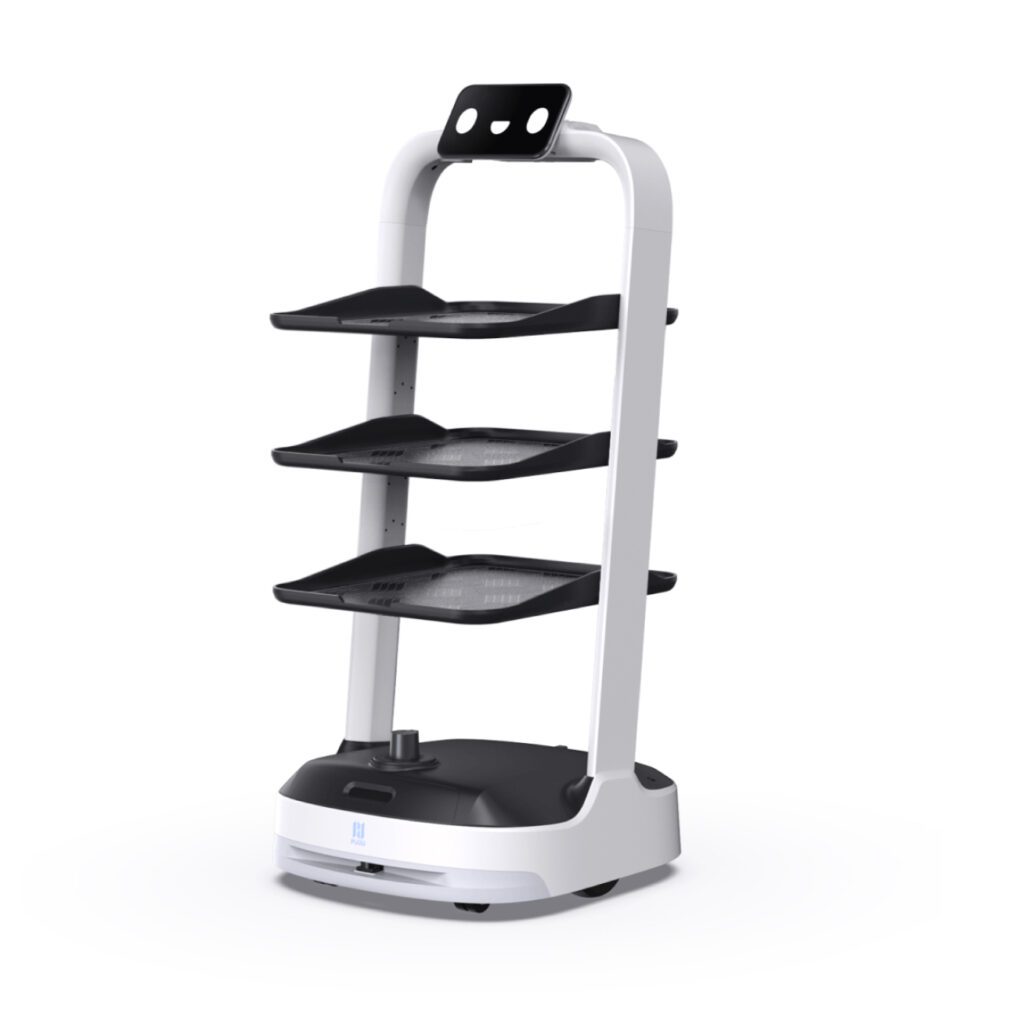
1. PuduBot 2 – High-Frequency Delivery Workhorse
 Where It Fits Best
 Where It Fits Best
PuduBot 2 is ideal for:
- Medium-sized societies
- Single-tower or low-rise buildings
- High-frequency deliveries (food, parcels, internal logistics)
It is essentially a high-efficiency internal delivery system, built to handle continuous operations throughout the day.
Core Capabilities
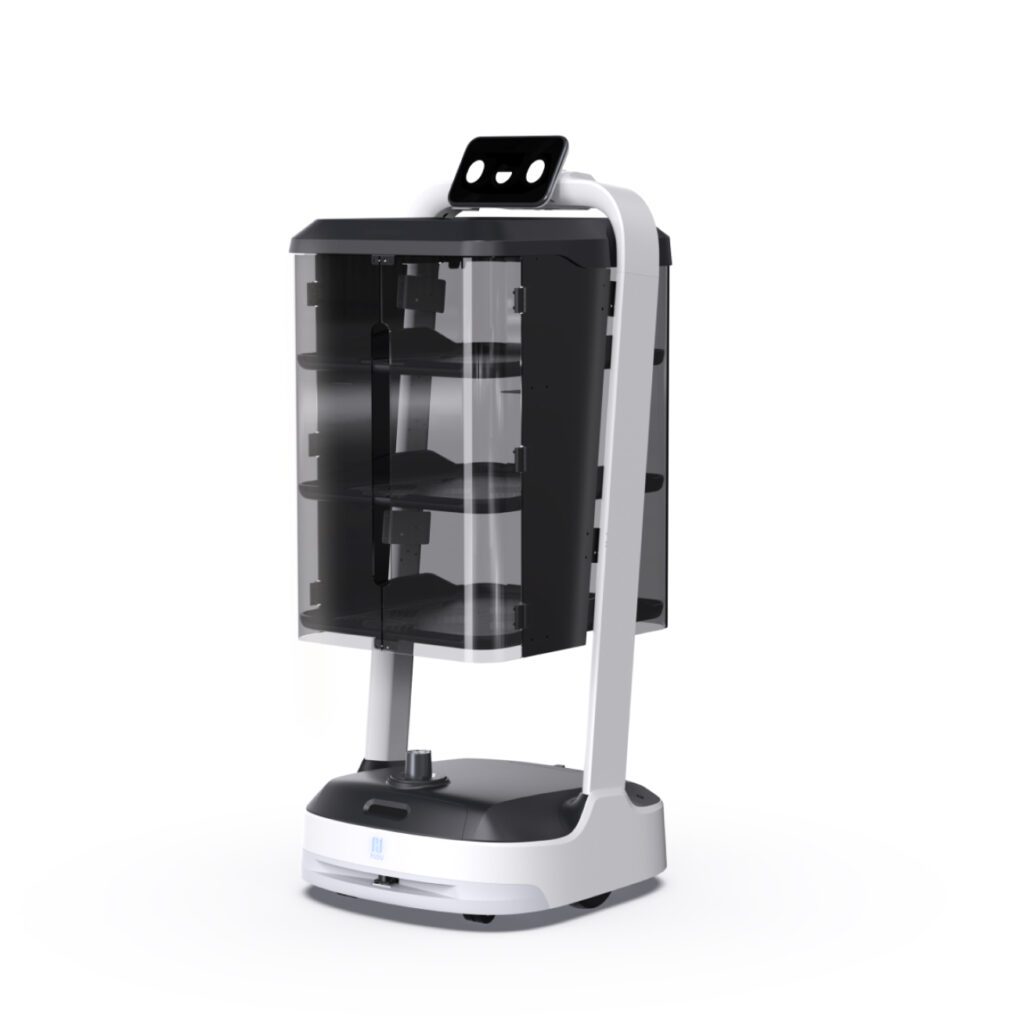
Multi-Tray Delivery System
- Default: 3 trays (expandable up to 7 trays)
- Each tray can carry multiple items simultaneously
- Total payload capacity: up to 40 kg
 Default: 3 trays (expandable up to 7 trays)
This enables:
- Batch delivery (multiple flats in one trip)
- Faster throughput during peak hours
Advanced Navigation & Perception
- Uses PUDU VSLAM+ + Laser SLAM for mapping
- Equipped with dual LiDAR with 360° sensing
- Can map spaces up to 40,000 sq. m.
Practical advantage in Indian societies:
- Works without QR codes or markers
- Handles dynamic environments (kids, pets, furniture)
Performance & Mobility
- Speed: 0.5 – 1.2 m/s (adjustable)
- Minimum path clearance: ~80 cm
- Climbing capability: up to 5° incline
Suitable for:
- Narrow corridors
- Mixed flooring (tiles, ramps, uneven surfaces)
Battery & Runtime
- Runtime: 10 to 24 hours (depending on usage)
- Charging time: ~3–4 hours
- Auto-charging dock supported
Enables:
- Full-day operation without manual intervention
- Continuous delivery cycles in high-demand societies
Build & Design
- Weight: ~37–39 kg
- Fully enclosed chassis (dust & splash resistant)
- Materials: ABS + aviation-grade aluminum
Important for Indian conditions:
- Durable in dusty environments
- Stable movement even in uneven surfaces
Connectivity & System Integration
- Supports Wi-Fi, 4G, LoRa, Type-C
- Runs on PUDU OS platform (cloud + IoT integration)
- Multi-robot fleet coordination supported
Enables:
- Integration with society apps
- Centralized delivery management
- Scalable deployment
PuduBot 2 works best as:
- A delivery runner replacement
- A high-volume logistics handler
- A continuous delivery system for repetitive tasks
2. FlashBot Max – Secure Multi-Floor Delivery System
Where It Fits Best
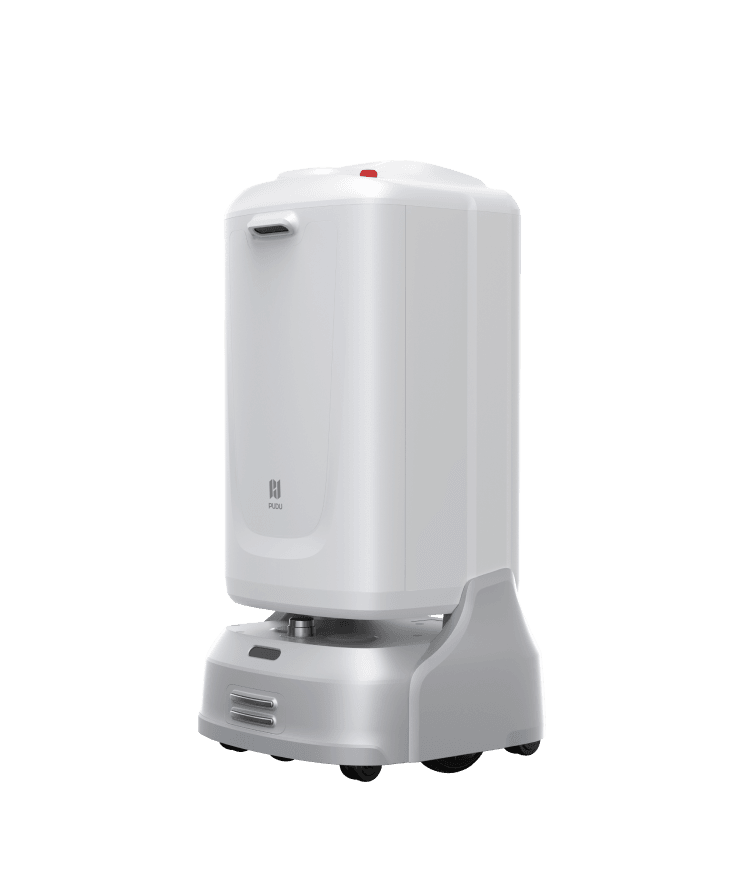 Where It Fits Best
FlashBot Max is designed for:
- High-rise buildings
- Multi-tower societies
- Premium gated communities
- Environments with restricted access policies
It is a fully automated vertical + horizontal delivery system.
Core Capabilities
Secure Compartment-Based Delivery
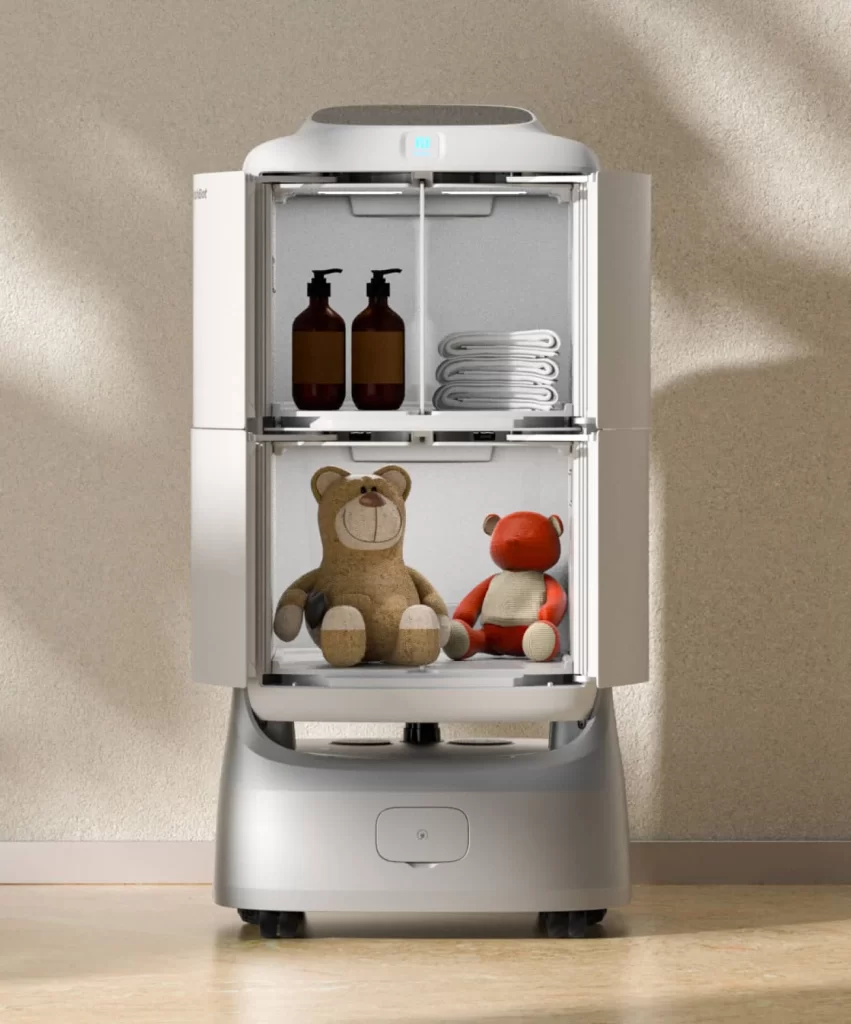
- Enclose Access-controlled via:
- OTP
- Mobile app
Critical for:
- Parcel security
- High-value deliveries
- Privacy-sensitive environments
Advanced Elevator Integration
This is the defining feature.
FlashBot Max can:
- Call elevators automatically
- Select floors
- Navigate between levels without human intervention
Why this matters:
- Enables true doorstep delivery in high-rise societies
- Eliminates need for staff involvement
Autonomous Navigation System
- Uses VSLAM-based mapping + sensor fusion
- Adapts to:
- Multi-floor layouts
- Complex corridors
- High foot traffic environments
Works effectively in:
- Indian high-density residential buildings
- Mixed infrastructure layouts
Multi-Point Delivery Capability
- Can handle multiple deliveries in sequence
- Optimizes routes across floors and towers
Important for:
- Large societies with 200+ daily deliveries
- Efficient batch processing
System Integration & IoT Connectivity
- Integrated with:
- Elevator systems
- Cloud-based platforms
- Notification systems
Enables:
- Real-time tracking
- Remote monitoring
- Centralized control
FlashBot Max functions as:
- A complete building delivery automation system
- A secure logistics layer for societies
- A replacement for manual last-mile delivery inside buildings
Product Comparison
| Feature | PuduBot 2 | FlashBot Max |
|---|---|---|
| Delivery Type | Open trays (multi-layer) | Closed secure compartments |
| Payload Capacity | Up to 40 kg | Comparable multi-compartment payload |
| Navigation | VSLAM + Dual LiDAR (360° sensing) | VSLAM + sensor fusion |
| Speed | 0.5 – 1.2 m/s | Optimized for multi-floor delivery |
| Path Clearance | ~80 cm | Suitable for residential corridors |
| Elevator Integration | Limited / external setup required | Fully integrated, automated |
| Best Environment | Single tower, low-rise, mid-size societies | High-rise, multi-tower societies |
| Delivery Type | High-frequency batch delivery | Secure, controlled delivery |
| Security Level | Moderate (open trays) | High (locked compartments + OTP) |
| Runtime | 10–24 hours | Full operational shift-based usage |
| Charging | Auto-docking supported | Auto-docking supported |
| Use Case Strength | Speed + volume | Security + automation |