


What is VDA 5050 Standard? A Complete Guide for Warehouse Automation Teams
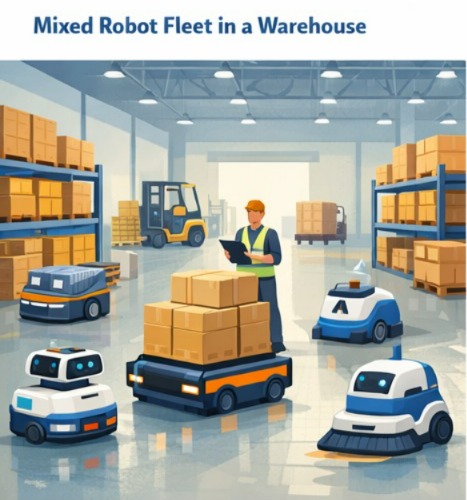
Table of Contents
What is VDA 5050 Standard for Warehouse Automation?
Why the Industry Needed a Standard Like VDA5050?
How VDA 5050 Works in AMR and AGV Systems
Key Components of VDA 5050 Communication
VDA 5050 vs Traditional AGV Systems
Benefits of VDA5050 Standard for Warehouses and Manufacturing Facilities
Where VDA 5050 is Commonly Used Today?
VDA 5050 Standard as the Foundation for Scalable Robot Automation
What is the VDA 5050 Standard in Robotics?
The VDA 5050 standard is a communication framework used in AMR and AGV fleet management. In simple terms, it defines how mobile robots and fleet management systems exchange tasks and status information in a common format. Instead of each robot brand using its own communication method, VDA 5050 allows different robots to operate under one coordinated system. As robotics adoption increases across warehouses and factories in India, this standard helps facilities scale automation without creating integration complexity.
In practice, the VDA 5050 standard enables:
- Standardized task assignment between fleet manager and robots
- Consistent reporting of position, battery, and operational status
- Coordination between multiple robot types in the same facility
- Easier expansion of automation without rebuilding integrations
Origin of the VDA 5050 Standard
The VDA 5050 standard originated in the German automotive and intralogistics industry, where large factories used robots from multiple vendors. Managing separate systems created operational challenges, so industry leaders introduced a standard communication structure to simplify integration and improve interoperability.
The objective was to:
- Reduce vendor dependency
- Simplify system integration
- Support scalable automation across large facilities
Why the VDA 5050 Standard Was Created
As automation expanded, companies faced common problems:
- Different robots required different fleet software
- Systems could not easily share traffic or task information
- Scaling automation meant repeating integration work
For example, a warehouse using separate robots for pallet movement and material delivery would struggle to manage traffic and reporting centrally. The VDA 5050 standard solves this by standardizing communication, allowing robots and fleet systems to work together more efficiently.
The Problem VDA 5050 Solves
At its core, VDA 5050 solves the challenge of scaling mixed robot environments. It allows facilities to add new robots without redesigning their control systems, improves fleet visibility, and reduces long-term dependency on a single vendor. For Indian industries moving toward structured warehouse automation, understanding the VDA 5050 standard helps build automation systems that remain flexible as operations grow.
Why the Industry Needed a Standard Like VDA 5050
As AMR adoption increased across warehouses, manufacturing, and large facilities, companies quickly moved beyond single-robot deployments. Most facilities now use robots for multiple tasks- material movement, pallet transport, and cleaning- often from different vendors. However, traditional proprietary AMR fleet management systems created operational challenges because each robot ecosystem worked independently. This made automation harder to scale and manage efficiently. The VDA 5050 standard emerged to solve this problem by creating a common communication framework between robots and fleet management systems.
Challenges of Proprietary AMR Fleet Management Systems
Vendor lock-in
Many fleet systems only support robots from one manufacturer. As operations grow, businesses struggle to introduce new robot types without replacing or heavily modifying existing systems.
Integration complexity
Different robots bring separate dashboards, traffic rules, and reporting formats. In a warehouse or factory, this leads to poor coordination and limited fleet visibility.
Scaling limitations
Automation usually starts with one use case but expands over time. Without a standard like VDA 5050, every expansion requires new integrations, increasing cost and deployment time.
Growth of Multi-Robot and Multi-Vendor Automation
Modern facilities increasingly deploy different robots for different workloads:
- Light AMRs for bin or carton movement
- Heavy robots for pallet or bulk transport
- Cleaning robots for large floor areas
For example, a 3PL warehouse may run logistics robots during operations and autonomous cleaning robots after shifts. Without standardized communication, these systems operate separately. The VDA 5050 standard enables multi-vendor robot fleet management, allowing different robots to share task information and operate under a coordinated system. This helps Indian facilities scale automation while keeping operations flexible and future-ready.
How VDA 5050 Works in AMR and AGV Systems
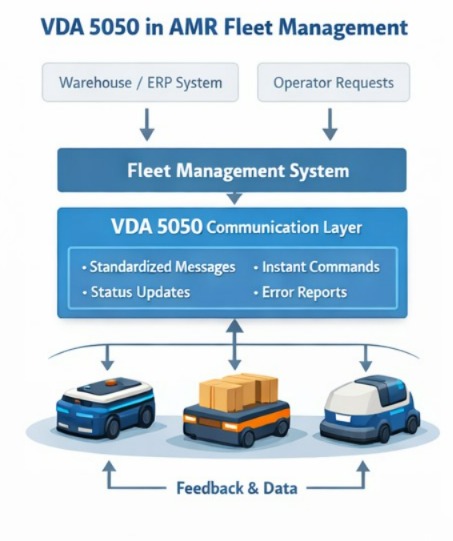
The VDA 5050 protocol defines how AMR and AGV robots communicate with a fleet management system during daily operations. It does not control robot navigation or internal logic. Instead, it standardizes how tasks, status updates, and operational data move between systems. This allows different robots to operate together under a common AMR fleet management standard, enabling structured and scalable automation.
In practical terms, VDA 5050 creates a continuous communication loop between the fleet manager and robots. The system assigns work, robots execute tasks, and real-time feedback allows the system to adjust operations dynamically. This approach supports multi-vendor robot integration, improves visibility, and keeps workflows predictable even as fleets grow across warehouse and manufacturing environments.
Operational Flow Under VDA 5050
The workflow typically follows this sequence:
Fleet Manager Sends Order
The fleet management system generates a task based on warehouse, production, or operator requirements. The order is sent in a standardized format defined by the VDA 5050 protocol, ensuring all compatible robots interpret instructions consistently.
Robot Executes Task
The robot accepts the mission and performs the assigned activity, such as material movement or delivery. It follows mapped routes and operational rules while adapting to real-time conditions inside the facility.
Robot Sends Status Updates
During execution, the robot continuously reports its position, battery level, task progress, and any alerts. Because the AGV communication protocol standardizes reporting, the system receives uniform data from different robot types.
System Updates and Optimizes
The fleet manager updates dashboards using live data and adjusts task allocation or traffic flow if needed. This feedback loop improves efficiency and allows automation systems to scale smoothly, especially in warehouse automation in India where workloads and layouts often change.
Orders and Task Communication
In a VDA 5050 environment, the fleet manager assigns missions using a standardized order structure. The robot receives the instruction, confirms acceptance, and begins execution while continuously reporting progress. This removes dependency on vendor-specific communication methods and simplifies fleet coordination.
Typical communication includes mission assignment, execution updates, and completion confirmation. For example, a robot may receive an order to move material from inbound staging to storage, while the system tracks progress automatically without manual monitoring.
Nodes, Edges, and Map-Based Navigation
VDA 5050 uses a structured map model based on nodes and edges. Nodes represent defined locations such as workstations or loading points, while edges define approved paths between them. This creates structured movement logic across the facility.
Defined routing improves coordination when multiple robots share the same environment. In manufacturing and pharma facilities, this helps maintain predictable movement and prevents route conflicts between robots operating simultaneously.
Robot Status and Real-Time Reporting
Robots continuously send operational updates back to the fleet manager during task execution. These updates include battery level, current position, task progress, and operational alerts. Operators therefore maintain real-time visibility across the entire fleet.
Standardized reporting ensures that different robots communicate in the same format. This improves monitoring, reduces downtime risk, and simplifies operations in mixed robot environments.
Traffic Management and Collision Avoidance
When multiple robots operate in shared spaces, coordination becomes critical. The VDA 5050 protocol enables shared communication so robots can move safely without competing for the same paths. The fleet manager manages priorities and resolves conflicts centrally.
This reduces congestion at intersections and improves safety around human workers and forklifts. In large warehouses and factories, coordinated traffic management helps maintain smooth flow and supports long-term scalable automation.
How VDA 5050 Works in AMR and AGV Fleet Management
Warehouse Management System (WMS) / Operator Request / Production Requirement
Task allocation • Robot selection • Traffic planning • Mission scheduling
Standardized Order Messages • State Messages • Instant Actions • Error Reporting
Material Movement
Pallet Transport
Facility Hygiene
Position Updates • Battery Status • Task Completion • Error Alerts
Fleet Manager Adjusts Tasks and Traffic Based on Live Data
Key Components Defined by the VDA 5050 Standard
VDA 5050 Standard vs Proprietary Fleet Management Systems
| Factor | VDA 5050 (Standard-Based Fleet Management) | Proprietary Fleet Management Systems |
|---|---|---|
| Vendor dependency | Lower vendor lock-in; the communication interface is standardized. | High vendor lock-in; typically tied to one robot brand/ecosystem. |
| Integration effort | Reduced integration effort when adding compliant robots or systems. | Higher integration effort; custom APIs/connectors often needed per vendor. |
| Scalability | Designed for scale; expand fleets with less rework at the control layer. | Scaling can slow down as fleet size grows due to system silos and custom work. |
| Multi-brand compatibility | Supports multi-vendor fleets (when both robots and FMS support VDA 5050). | Usually limited; mixing robot brands requires parallel systems or heavy customization. |
| Future expansion | Easier to add new robot types (different payloads/use-cases) over time. | Expansion often constrained to the same vendor roadmap and product range. |
| Cost of integration | Typically lower long-term integration cost due to standardized interfaces. | Typically higher long-term cost from custom integrations and duplicated tooling. |
Benefits of VDA 5050 Standard for Warehouses and Manufacturing Facilities
As automation expands across warehouses and manufacturing environments, companies need systems that remain flexible as operations grow. The VDA 5050 standard supports this by standardizing communication between robots and fleet management systems. Instead of treating each robot deployment as a separate project, facilities can build automation that scales in a structured and predictable way. For operations teams managing material movement, hygiene, and internal logistics together, this brings both operational and financial advantages.
Vendor Independence and Flexibility
One of the biggest advantages of VDA 5050 is reduced dependency on a single robot vendor. Facilities can select robots based on application needs rather than software limitations. For example, a warehouse may use lighter AMRs for bin movement and heavier robots for pallet transport. With VDA 5050, both can operate under a common fleet communication framework. This flexibility allows businesses to adopt better solutions over time without replacing existing automation.
Easier Expansion of Robot Fleets
Automation rarely stays limited to one workflow. Many facilities begin with a pilot deployment and then expand across zones or processes once results are proven. The VDA 5050 standard simplifies this expansion because new robots can integrate into the existing fleet structure without major software changes. As a result, scaling from a few robots to a larger fleet becomes faster and operationally smoother.
Reduced Integration Cost
Without a standardized communication protocol, every new robot introduction requires custom integration work. This increases engineering effort and long-term maintenance costs. VDA 5050 reduces this burden by using a consistent message structure between robots and fleet systems. Over time, this lowers integration complexity and helps organizations control automation costs as deployments grow.
Centralized Fleet Visibility
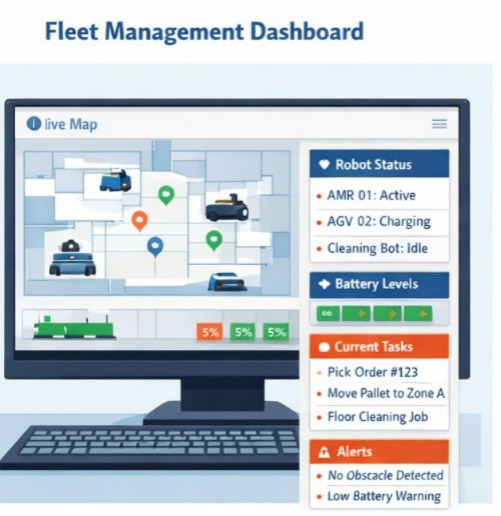
In multi-robot environments, operations teams need a clear view of what is happening across the facility. VDA 5050 enables centralized monitoring by standardizing how robots report status and task progress. Supervisors can view robot locations, battery levels, and operational status within a unified interface instead of switching between multiple systems. This improves decision-making and helps prevent operational bottlenecks.
Future-Proof Automation Investments
Automation investments typically run for many years, while operational needs continue to evolve. The VDA 5050 standard helps future-proof these investments by allowing facilities to introduce new robot types, workflows, or vendors without redesigning the entire system architecture. For warehouses and manufacturing facilities in India, this ensures that automation remains adaptable as volumes increase, layouts change, and new technologies emerge.
A simple way to understand the VDA 5050 protocol is to compare it with USB-C. USB-C standardizes how devices connect, so you don’t need a different cable for every brand. In the same way, VDA 5050 standardizes how robots and fleet management systems communicate. It gives warehouses a common interface, making multi-vendor robot integration much easier as automation expands.
In practical terms, this AMR fleet management standard allows different robots to receive tasks and send updates using the same communication structure. Instead of building separate integrations for every robot supplier, operations teams can manage fleets through a unified system. This becomes especially important in warehouse automation in India, where facilities often deploy different robot types for logistics, material movement, and cleaning. By acting as a common AGV communication protocol, VDA 5050 reduces integration risk and helps automation scale without adding unnecessary complexity.
VDA 5050 Standard as the Foundation for Scalable Robot Automation
Automation in India is moving from isolated robot deployments to structured, long-term automation strategies. As warehouses expand, manufacturing volumes fluctuate, and labour availability remains inconsistent, businesses need systems that can grow without becoming complex. The VDA 5050 standard supports this shift by introducing standardized communication between robots and fleet management systems, allowing automation to scale in a controlled and predictable way.
At the same time, mixed robot environments are becoming normal. Facilities increasingly deploy different robots for logistics, material movement, and cleaning within the same operational space. Without a common communication framework, coordination becomes difficult and expansion slows down. VDA 5050 reduces this risk by ensuring that different robots can share task information, operate under centralized visibility, and adapt as operational requirements change. This makes automation more flexible and better suited for long-term planning.
Organizations that understand and adopt communication standards early gain a clear advantage. They avoid vendor lock-in, reduce future integration effort, and build automation systems that remain adaptable as technology evolves. For Indian warehouses and manufacturing facilities planning automation beyond pilot projects, VDA 5050 provides a practical foundation for scalable and future-ready AMR deployments.
Autofina Robotics is Pudu Robotics’ certified national partner for India; offering demos, mapping studies, ROI reports, and end-to-end commissioning. To evaluate which AMR fits your warehouse or factory, schedule a 30-minute consultation.