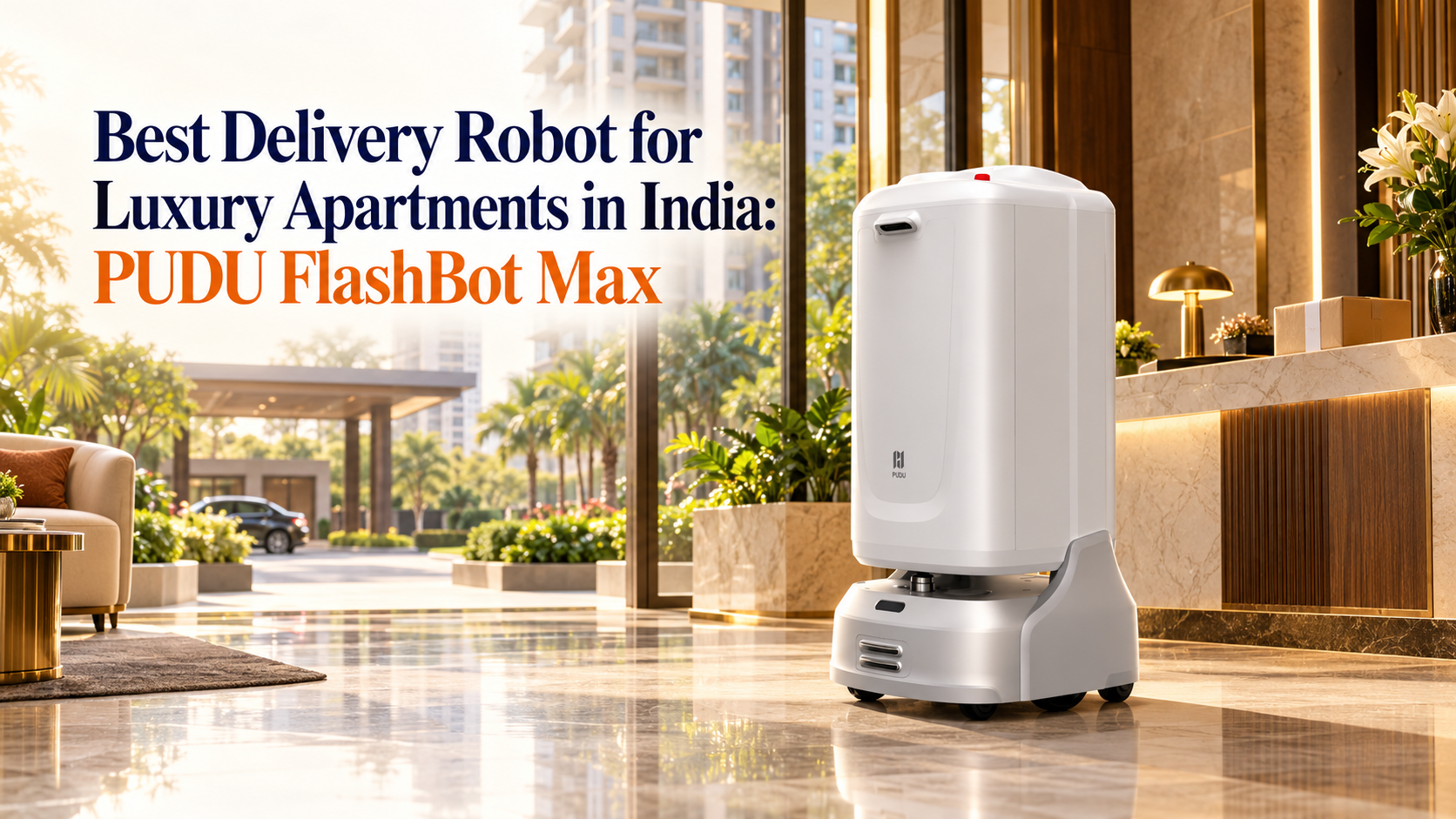
Best Delivery Robot for Luxury Apartments in India: PUDU FlashBot Max
When a homebuyer chooses a luxury apartment, they are investing in how everyday life will feel- its convenience, privacy and quality of service. As a builder, your opportunity is to make those benefits visible before the buyer moves in.Consider the daily arrival of food orders, groceries and courier parcels. How can residents receive suitable deliveries conveniently while reducing the need for unfamiliar delivery personnel to visit their apartment doors? How can your concierge team provide attentive service with fewer repetitive trips upstairs? A delivery robot for luxury apartments, such as PUDU FlashBot Max, offers a practical way to address these questions.
With a properly integrated delivery workflow, your building team can receive orders at a designated point and dispatch them to approved residential destinations. For women living alone and families with children, fewer outside delivery visits upstairs can be a meaningful privacy benefit alongside the building’s existing security arrangements.
For your project, the appeal extends to presentation: a premium robotic delivery service gives prospective buyers a smart-living amenity they can see and experience.
This guide explains how PUDU FlashBot Max can support your project’s premium positioning, improve resident convenience and introduce more controlled delivery access. You will also learn what elevator integration involves, how daily operations work and what to assess before making it part of your development.
As a Builder, What Makes Your Luxury Project Stand Out?
A prospective homebuyer walks through your entrance lobby, views the sample apartment and reviews the amenities. The next question is simple: what will make everyday life here feel different?
For a builder, this is an opportunity to make premium living tangible. Spacious rooms and attractive finishes establish the setting. Thoughtfully planned services help buyers imagine living there.
Everyday Convenience Belongs in Your Luxury Offering
Consider something as ordinary as receiving dinner or a courier parcel. Does the resident need to visit reception? Must a concierge employee leave the desk? Does an outside delivery person need access to the apartment floor?
A delivery robot for luxury apartments gives you another way to organise that experience: suitable orders are received at a designated point and transported to an approved residential destination.
Introduce an Amenity with a Clear Purpose
Position FlashBot Max around benefits buyers can understand:
- Convenience: fewer trips downstairs to collect suitable orders.
- Privacy: less need for external delivery personnel to reach apartment doors.
- Service: an organised receiving and delivery process.
- Project identity: a visible example of your approach to smart residential living.
For your development, the strongest story is a service residents can picture using regularly. That makes robotic delivery easier to explain, demonstrate and evaluate as part of your luxury amenity offering.
Strengthen Your Project’s Perceived Value with Premium Delivery
When you position a residential project at a premium, every amenity should help answer the buyer’s question: “What additional value am I getting here?”
A FlashBot Max delivery service can contribute to that answer by connecting technology with a familiar daily need. Rather than asking buyers to appreciate automation in the abstract, you can show how their orders would reach them.
Give Buyers a Service They Can Picture Using
Imagine explaining the proposed service during a walkthrough:
“Your suitable food orders and parcels can be received by the building team downstairs, then brought to your floor through our robotic delivery service.”
That gives prospective residents a specific benefit to consider. A working professional may value fewer interruptions. A parent may appreciate avoiding a reception collection while caring for a child. A privacy-conscious resident may prefer fewer delivery-related visits to their door.
Support Your Premium Positioning
An apartment delivery robot can become part of a broader service proposition that includes attentive concierge support, controlled visitor access and well-managed common areas.
For the builder, this creates opportunities to:
- Differentiate the project through a demonstrable amenity.
- Connect smart-building features to everyday convenience.
- Give sales teams a clear service benefit to discuss.
- Show that the resident experience has been considered beyond possession.
Make the Value Last After Handover
Perceived value depends on the service continuing to work. Plan staffing, maintenance, charging and ownership before presenting the amenity to buyers.
A dependable delivery service can strengthen your premium offering. Any effect on selling price or purchase decisions must be assessed through your own buyer feedback and project results.
Keeping the Safety and Privacy of Women and Children at the Forefront
For families evaluating a home, the journey from the entrance gate to the apartment door deserves attention. Alongside visitor management and security staffing, builders can consider how everyday deliveries move through the property.
A residential delivery robot offers a practical way to reduce the need for outside delivery personnel to enter residential corridors.
Keep External Handovers at a Designated Point
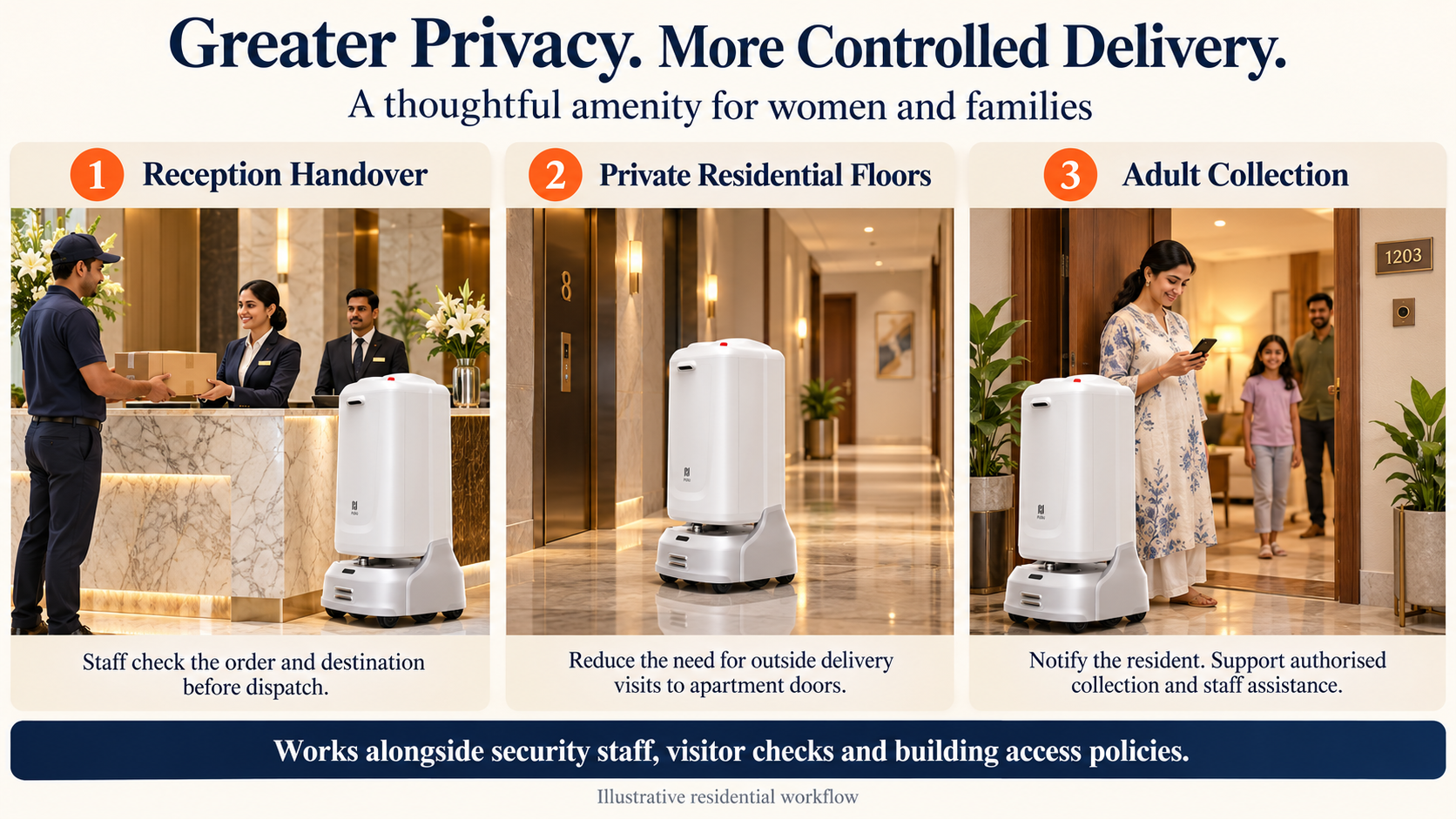
Under the proposed operating model, delivery personnel hand suitable orders to the authorised receiving team. Staff verify the destination, load the robot and dispatch it along the approved route.
This allows the building to offer doorstep convenience while retaining a central handover point for external deliveries.
The arrangement should include:
- A clearly identified receiving location.
- Order and apartment checks before dispatch.
- Defined access permissions for the robot.
- Staff assistance for missing, incorrect or uncollected orders.
- A separate process for oversized or unsuitable deliveries.
Support Privacy for Women and Families
A woman living alone may prefer not to interact with an unfamiliar delivery person outside her apartment. Parents may value fewer delivery-related visitors in corridors where their children move between home and shared facilities.
These are useful conversations for your sales team. Explain the benefit precisely: the service can reduce the need for external delivery visits upstairs when supported by building policy.
Make Resident Collection Straightforward
Provide simple instructions, an appropriate arrival-notification method and an accessible staff contact. Adults should remain responsible for collection where appropriate; the service should not depend on children receiving orders alone.
For the builder, the proposition is greater convenience within a more controlled delivery process. Security staff, visitor checks and resident awareness remain essential.
Turn Everyday Orders into a Convenient Resident Service
A successful automated doorstep delivery service needs a clear journey from receiving point to resident collection. As the builder, you should be able to demonstrate that journey before making it part of your project’s promise.
Who Operates the Service?
The building team manages the handover. Concierge or authorised staff receive the order, check the destination and load a suitable compartment. Residents collect their items at the assigned delivery point.
Facility managers oversee availability, cleaning, staff training and exception handling.
A Simple Residential Delivery Journey
Consider a resident receiving dinner:
- The order arrives: the external delivery person hands it to the designated receiving team.
- Staff check and load it: the apartment details and package suitability are confirmed.
- The robot is dispatched: it follows the configured route and integrated elevator workflow.
- The resident is notified: the approved notification method indicates arrival.
- Collection takes place: the resident follows the configured compartment-access procedure.
- The task closes: the robot continues according to its operating instructions.
This is an illustrative residential workflow; the exact steps should be confirmed during deployment.
Choose Deliveries That Fit the Service
Suitable applications may include securely packaged takeaway meals, small grocery orders, documents and courier parcels within the approved size and weight limits.
Leaking containers, bulky cartons and items needing special handling require another process.
Plan for Unanswered Deliveries
Define how long the robot waits, who contacts the resident and where uncollected items are held. These details matter to the buyer because they determine whether the amenity feels dependable.
For your project, convenience comes from the complete service—not simply the journey upstairs.
A Delivery Robot for Luxury Apartments is an Amenity Buyers Can Experience
Some amenities are explained through plans and brochures. A robotic delivery service can be demonstrated during the property visit itself.
For a builder marketing luxury apartment amenities, that creates an opportunity to turn a technical feature into a memorable experience.
Complement the Visual Identity of Your Project
FlashBot Max has curved styling, a matte metallic finish and a large screen.
Its presentation within your building deserves the same attention as other resident-facing services. Plan an orderly loading area and a discreet charging position that preserves circulation and keeps reception presentable.
Demonstrate a Resident Benefit
During a buyer walkthrough, show a representative delivery from the receiving point to a mapped destination. Explain who loads the order, how it travels and how collection works.
Your sales team can then discuss specific questions:
- How would a resident receive a suitable parcel?
- How does the service reduce reception collections?
- Where do outside delivery personnel hand over orders?
- Who assists if a delivery cannot be completed?
Build Credible Marketing Around the Demonstration
Use project videos, brochures and sales presentations to show the actual proposed service. Describe destinations and features that have been assessed and agreed for your development.
A demonstration may attract attention, but the stronger message is the thought behind it: your project has planned how premium living should work every day.
That gives buyers a practical reason to remember the amenity after the property visit.
The FlashBot Max Features Behind the Experience
For a builder, product specifications become useful when they answer a project question: how will this feature improve the service we offer residents?
Elevator Integration and Building Connectivity
PUDU offers cloud and hardware elevator-control options, plus integration with supported building devices such as telephones and access controls. Multi-floor map replication assists deployment.
Your project team should confirm the lift controller, permissions, interfaces and notification method. Test the full route before promising apartment-door delivery.
Compartments and Controlled Collection
Adjustable compartments have independently controlled doors, with password, phone-number and NFC access options.
For your development, test typical packages and agree how staff assign each order. Select a collection method residents can use easily.
Navigation Through Shared Spaces
VSLAM+ supports indoor and suitable semi-outdoor navigation, while 3D obstacle detection supports movement around obstacles.
Validate lift entrances, turns, thresholds and approved amenity connections under representative traffic. Semi-outdoor capability should not be presented as unrestricted operation in rain.
Ventilation, Charging and Oversight
Compartment fans circulate air; automatic charging supports operating schedules. Multi-robot coordination is available, and the management platform supports location and status monitoring.
Assign responsibility for cleaning, charging availability and assistance. Ventilation does not replace cleaning.
FlashBot Max: Key Specifications for Luxury Apartments
Explore the specifications that matter when planning robotic delivery for your residential project.
| Specification | Published Detail | What It Means for Your Project |
|---|---|---|
| Robot Dimensions | 538 × 534 × 1,052 mm (L × W × H) | Assess elevator space, corridor turns and suitable waiting and charging locations. |
| Robot Weight | 60 kg | Include the robot and its load when assessing elevator and route suitability. |
| Payload | 10 kg per layer | Check individual orders against the approved layer load. Confirm the total permitted load for your configuration. |
| Compartment Configuration | Adjustable, 2–4 compartments | Choose an arrangement suited to your expected mix of packaged meals and small parcels. |
| Single Compartment Size | 187 × 410 × 280 mm | Test typical delivery packages to confirm they fit comfortably inside the compartment. |
| Double Compartment Size | 380 × 410 × 280 mm | Assess larger packages using the proposed compartment arrangement. |
| Navigation | VSLAM + LiDAR SLAM | Supports navigation along mapped routes. Validate destinations and operating conditions on site. |
| Published Path Clearance | 60 cm | An initial planning reference. Turns, passing space and elevator entry require a site assessment. |
| Travel Speed | Adjustable, 0.5–1.2 m/s | Select an operating speed appropriate to shared residential spaces and assessed routes. |
| Published Runtime | 9 hours | Plan delivery schedules around actual demand, elevator waiting times and operating conditions. |
| Charging | 4-hour published charging time; automatic charging supported | Position the charging station conveniently and schedule charging around delivery demand. |
| Collection Verification | Password, phone-number and NFC options | Configure and test a collection method that is straightforward for residents to use. |
| Elevator Integration | Cloud and hardware control options | Confirm compatibility with the elevator controller, approved interfaces and floor-access permissions. |
Reduce Routine Delivery Trips for Your Building Team
A premium residential service needs an operating model that remains practical after possession. For a builder considering a delivery robot for luxury apartments, this means assessing how the robot supports staff and resident service throughout the day.
Reduce Repetitive Movement Between Floors
Every small order can involve someone leaving reception, waiting for a lift, travelling upstairs and returning. FlashBot Max can handle suitable internal transport journeys once staff have received, checked and loaded the order.
The opportunity is to reduce time spent carrying items between floors, particularly where delivery demand is frequent.
Keep Concierge Teams Available for Residents
An available concierge can attend to visitors, respond to resident requests and coordinate building services. Reducing routine delivery trips can help keep that team closer to its primary service point.
For your project, the potential benefits include:
- Fewer interruptions caused by individual delivery requests.
- A consistent process for dispatching suitable orders.
- More staff availability for resident-facing assistance.
- Less dependence on finding an employee to accompany every delivery.
Actual time savings should be measured during a trial, including loading, lift waiting and any assistance required.
Make Responsibilities Clear
Staff remain responsible for checking destinations, loading packages, cleaning compartments and handling exceptions. Oversized orders and items requiring special handling need an alternative process.
The builder’s opportunity is to combine automated transport with attentive human service, creating an amenity the facility team can manage confidently.
PUDU FlashBot Max at Apaxis Hospital, Chennai
An Indian deployment helps explain why building integration matters. Autofina’s published case study describes FlashBot Max operating at Apaxis Hospital, Chennai, with a seven-floor workflow combining Johnson elevator integration, telephone notifications and pharmacy logistics.
Connect Movement with Collection
The application connects several steps: navigate to the lift, travel to the required floor, reach the destination and notify the recipient.
For a residential builder, the relevant lesson is that reaching an upper floor is only part of the service. The recipient also needs a clear way to know the order has arrived and collect it.
The hospital’s published dashboard reported 1,157 tasks between 15 September and 14 October 2026. These figures came from an “All Modes” report and should not be presented as a delivery-only total.
The example demonstrates integrated operation in an Indian building. Your apartment project still needs its own route, elevator and delivery assessment.
What Should You Plan Before Buying and Handover?
The right time to plan a residential delivery robot is while you can still coordinate the building’s systems, service spaces and operating responsibilities.
Assess Your Building’s Readiness
Arrange a site assessment covering:
- Elevators: controller compatibility, integration method and vendor coordination.
- Routes: doorways, turning space, thresholds and lift entry.
- Connectivity: coverage and communication requirements along the route.
- Access permissions: approved floors and controlled entrances.
- Service spaces: loading, waiting and charging locations.
For projects under construction, early coordination can help incorporate these requirements into the building design.
Test the Service Buyers Will Actually Receive
Use representative food bags and parcels. Test journeys during normal lift traffic, along with unanswered collections and blocked routes.
Agree acceptance criteria before the demonstration: successful arrival, correct collection, assistance requirements and the time taken for a complete task.
Understand the Complete Ownership Cost
Request a quotation that identifies the robot, elevator and building integration, commissioning, training, maintenance and ongoing support. Confirm any recurring platform or connectivity charges.
Then establish who will own the robot, pay operating costs and manage service after handover.
Protect the Resident Experience
Before promoting the amenity, agree the receiving hours, eligible deliveries, collection procedure and assistance contact.
A clear operating plan helps you present the service accurately to buyers and hand over an amenity the society or facility manager is prepared to maintain.
Make Premium Delivery Part of
Your Next Residential Project
As a builder, you are shaping the experience residents associate with your development. A thoughtfully deployed FlashBot Max delivery robot can give that experience a visible point of difference: suitable orders brought upstairs through an organised service, with controlled collection and fewer reasons for outside delivery personnel to visit residential corridors.
For women living alone and families with children, the privacy benefit is easy to understand. For busy residents, convenient collection matters. For your sales team, a working demonstration creates a practical conversation about premium living.
The strongest proposition combines three elements:
- Presentation: an amenity that complements your project’s premium identity.
- Convenience: a useful service for everyday orders.
- Control: a defined handover process supported by existing building security.
Start with your building’s requirements and validate the complete journey.
Explore FlashBot Max with Autofina Robotics. Arrange a demonstration and project assessment to evaluate elevator compatibility, delivery routes and the resident collection experience for your development.