10 AMR Use Cases That Could Save Your EMS Factory Time
In an electronics manufacturing services (EMS) factory, materials move throughout the shift. Components travel from stores to kitting. Prepared kits go to production lines. Boards move between assembly, inspection and testing. Empty trays and bins need to return for reuse.
When these movements depend on people collecting and pushing loads, delays can build up. Operators may leave their stations to find materials. Completed batches may wait for someone to move them.
Autonomous mobile robots, or AMRs, can handle suitable transport tasks between defined locations. The right application depends on the load, delivery frequency, route and loading arrangement.
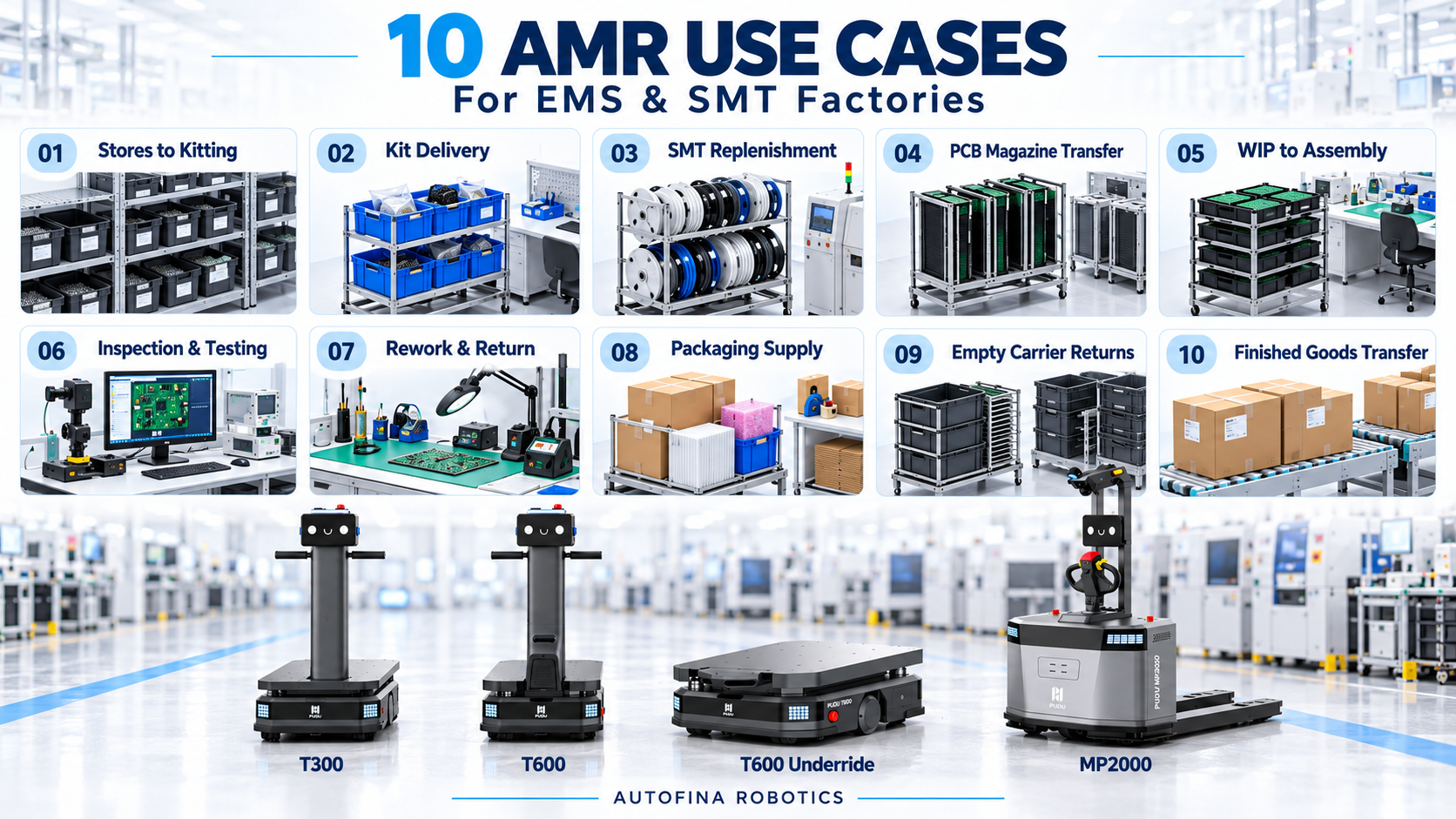
This article covers ten practical AMR use cases in EMS factories. For each one, we explain what moves, how the delivery could work and what the plant should check before investing.
Which EMS Material Movements Are Suitable for AMRs?
Start with journeys your team repeats every shift. Look for routes where people spend time carrying materials, pushing trolleys or waiting for collection.
A suitable application usually has defined pickup and delivery points, a load that can be secured, and enough space for the robot to travel and stop.
| Material flow | Processes to assess |
|---|---|
| Inbound supply | Stores to kitting, kit delivery and SMT replenishment |
| Production movement | PCB magazine transfers, WIP delivery, testing and rework |
| Return and outbound logistics | Packaging supply, empty carrier returns and finished-goods movement |
Before selecting a robot, confirm who loads it, who receives the material and what happens when the destination is occupied.
10 Material-Handling Processes to Assess for AMR Automation
Think about the journeys your team repeats every shift. Someone collects component reels, pushes a trolley of assemblies to testing or brings empty trays back to production. These movements keep the factory running, but they also take time away from other work.
The following AMR use cases in EMS factories show where automated transport could help. Look for a process that resembles your own, then check the load, delivery frequency and loading arrangement.
Autofina can use these details to assess a suitable Pudu Robotics solution for your electronics manufacturing material flow.
1. Move Released Materials from Stores to Kitting
Kitting teams need the right materials before they can prepare a production order. When picked components wait in stores for collection, kit preparation can fall behind.
An AMR can support stores-to-kitting material transport by moving prepared loads to a designated receiving point. Store personnel pick, verify and release the materials before requesting delivery.
For example, your team is preparing kits for a controller PCB production order. Reels, connectors and other issued components are ready in stores, but the kitting operator makes several trolley trips to collect them. With an AMR workflow, stores can place the checked materials in identified bins and request delivery. The kitting team can continue preparing orders while the load is brought over.
Define suitable carriers, component protection, load identification and loading responsibilities. Material picking and verification remain part of the stores process.
What to measure: Collection waiting time, manual trips and whether materials reach kitting before preparation is due to start.
2. Deliver Prepared Production Kits to Assembly Lines
A verified kit can still reach production late if delivery depends on someone becoming available. Operators may wait or leave their stations to collect it.
Automated kit delivery to assembly lines can reduce these collection trips. An AMR transports completed kits to assigned receiving points, following a schedule or a request raised when the kit and destination are ready.
For example, an assembly line is changing from one product variant to another. The next kit contains connectors, wiring harnesses, housings and fasteners. It is ready, but the supervisor must arrange collection. An AMR could deliver the identified kit to an agreed staging point before the changeover, once the receiving team confirms space.
Define kit and production-order references, delivery timing and the unloading method. This may involve removing bins or exchanging a compatible trolley.
What to measure: On-time kit delivery, collection trips by production staff and delays caused by kits arriving late.
3. Replenish SMT Component Reels and Consumables
SMT lines need replenishment throughout the shift. Repeated collection trips become harder to manage when several lines request material at once.
An AMR can support SMT material replenishment by carrying prepared component reels and approved consumables to designated receiving points.
For example, a line operator sees that a frequently used resistor reel will need replacement soon. The operator raises a request, and the material team checks and prepares the correct reel. Instead of the operator walking to collect it, an AMR delivers it in a suitable container. The authorised operator then completes the feeder-related work.
For component reel delivery to SMT lines, define how requests are raised, how reels are verified and how quickly they must arrive. Follow the plant’s ESD and moisture-sensitive material procedures. Transport does not automatically include feeder preparation or machine loading.
What to measure: Request-to-delivery time, urgent collection trips and production waiting caused by delayed material supply.
4. Transfer PCB Magazines Between Production Stages
PCB magazines can wait at completed processes because collection is manual. This can leave one area crowded while the next stage waits for boards.
PCB magazine transport automation can help move secured loads between defined buffers or compatible equipment interfaces.
For example, completed boards collect in magazines at the SMT unloading station. An operator periodically moves them to the next inspection or production buffer. An AMR could collect prepared magazines from an agreed pickup point and deliver them to that buffer. Operators can handle loading and unloading, or automatic transfer can be assessed where suitable interfaces are available.
Check magazine dimensions, loaded weight, restraint and board protection. Automatic transfer also requires compatible transfer heights, docking performance and equipment signals.
What to measure: Magazine waiting time, completed transfers and operator interventions. Define what happens when the receiving buffer is full.
5. Move WIP from SMT Output to Downstream Assembly
After SMT, boards may need manual insertion, through-hole assembly or another operation. Delayed collection can leave work-in-progress (WIP) waiting between departments.
An AMR can support WIP transport between production stages by moving identified batches to their assigned next process, subject to receiving capacity.
For example, a power-supply board completes SMT and needs transformers, large capacitors and connectors fitted at manual insertion stations. Loaded trays wait until someone can push them to that area. An AMR could move the secured trays after the batch is released and the receiving team confirms space. Different batches can be assigned to their correct destinations.
Maintain batch identity, approved routing and carrier protection. Delivery rules should prevent material from overwhelming the next operation.
What to measure: WIP transport waiting time, destination accuracy and manual handling time. Review downstream production queues separately from transport delays.
6. Transport Assemblies to Inspection and Testing
Assemblies often move from production to a separate inspection or test area. Manual collection can add waiting time even when the next station is available.
An AMR can automate assembly transport to inspection and testing buffers using suitable protective trays or fixtures.
For example, after manual assembly, a batch of populated boards needs to reach the functional test benches. A technician currently collects the trays whenever time permits. An AMR could deliver an identified batch when the test-area buffer has capacity, then collect completed loads after their next destination has been authorised.
Define unit or batch identification, receiving readiness and delivery acknowledgement. Test results and quality status must come from the approved factory process.
What to measure: Collection waiting time, delivery accuracy and manual transport trips. Separate transport delays from time spent waiting for a free test bench.
7. Move Identified Units to Rework and Back
Units requiring rework need controlled movement and clear identification. Otherwise, they may remain in the wrong area or return to production before clearance.
An AMR can transport authorised loads to PCB rework stations and return them to an approved process point after the required checks.
For example, functional testing identifies several boards with a connector soldering defect. The boards are labelled and placed in a designated tray. An AMR could carry that tray to the repair station. Once repair and inspection are complete, an authorised request could send the boards back for retesting.
Keep separate identification for units awaiting repair, awaiting inspection and cleared for return. Quality personnel or the approved system must control release and destination.
What to measure: Collection waiting time, correct routing and complete handover records. Keep repair and retesting time separate from transport performance.
8. Replenish Packaging Materials at Packing Stations
Packing teams need cartons, trays, inserts and other supplies throughout the shift. Collecting them repeatedly takes staff away from packing.
Automated packaging material delivery can bring prepared supplies to receiving points on scheduled rounds or in response to requests.
For example, a packing station is preparing finished electronic units for shipment. Inner trays and cartons are stored away from the station, so a packer makes repeated trolley trips to replenish them. An AMR could deliver the next prepared load before the station runs short.
Check load dimensions, stability, delivery quantity and unloading responsibility. Packaging may be lightweight but bulky, so the full load must fit the route and receiving area.
What to measure: Replenishment response time, collection trips and packing interruptions caused by unavailable supplies. Avoid delivering more material than the station can safely hold.
9. Return Empty Bins, Trays, Magazines and Compatible Carts
Empty carriers can build up at production stations while stores or kitting teams run short. Collection often happens only when someone has spare time.
An AMR can support returnable container transport by collecting empties from defined points and returning them to an approved storage, inspection or preparation area.
For example, assembly operators stack empty component bins beside the line. Kitting staff later walk around collecting them for the next orders. An AMR could collect secured empties during an agreed return round. Where the workflow allows, it could deliver a new load and take an empty carrier back.
Define stacking limits, load restraint and any inspection or cleaning required before reuse. Automated cart transport requires a robot and attachment suited to the specific cart.
What to measure: Collection delays, carrier availability and journeys made without a useful load.
10. Transfer Finished Goods to Warehouse or Dispatch Staging
Finished goods can occupy packing space while waiting for internal transport. This leaves less room for the next batch and adds handling near completed products.
An AMR can support finished-goods transport from production to warehouse receiving points or dispatch staging.
For example, packed electronic assemblies are checked, labelled and placed on a trolley at the end of packing. They wait until a material handler can collect them. An AMR could move the prepared load after release and deliver it to an available receiving point. Palletised goods would require a suitable autonomous pallet-handling solution.
Check load weight, dimensions, stability, release status and warehouse receipt. Confirm that pickup and delivery conditions suit the selected handling method.
What to measure: Packing-to-staging time, collection backlog, successful receipt and manual transport effort.
Which of These AMR Use Cases Matches Your EMS Factory?
When comparing AMR use cases in EMS factories, start with a route that repeats often, has a consistent load and causes a clear delay or regular collection trips.
Share the pickup and delivery points, carrier details, loaded weight, trips per shift and current handling method with Autofina. These details will help us assess a suitable Pudu Robotics configuration for your material-handling application, define the handoffs and propose a pilot with measurable acceptance criteria.
What Must Be in Place Before These Workflows Can Run Reliably?
Once you identify a suitable process, check how the full journey will work—from preparing the load to confirming receipt.
Protect the material
Select carriers that keep reels, boards and assemblies secure during travel. Confirm the ESD requirements for the complete transport arrangement. Moisture-sensitive components must remain within the plant’s approved handling controls.
Define loading and unloading
Decide who places the load on the robot and who removes it. If automatic transfer is required, check carrier compatibility, docking requirements, transfer heights and equipment signals.
For example, delivering PCB magazines to a buffer with operator unloading is a different project from transferring them directly into equipment.
Agree how deliveries are requested and tracked
A pilot may use operator requests or scheduled deliveries. MES, WMS or equipment connections can be assessed where the workflow requires them. Define the material reference, destination and delivery acknowledgement.
Check the route
Review aisle widths, crossings, floor conditions, doors, stopping points and charging space. Where several robots share routes, assess their traffic coordination.
Plan for interruptions
What happens if the destination is full, the load is not ready or an aisle is blocked? Agree where the robot should wait, who receives the alert and who can restart the task.
Autofina can assess these requirements with your team when defining a suitable Pudu Robotics application.
Which Process Should Your EMS Factory Automate First?
Start with a route that happens often and has a clear transport problem. A consistent load and straightforward handoff usually make the first application easier to assess.
Compare your shortlisted routes using these questions:
- Frequency: How many trips take place per shift, including busy periods?
- Current impact: How much time goes into walking, pushing loads or waiting for collection?
- Load consistency: Can the material travel in a defined bin, rack, magazine or compatible cart?
- Receiving readiness: Is there a suitable delivery point with someone or something ready to receive the load?
- Route conditions: Can the robot travel and stop without regularly obstructing other work?
For example, repeated kit deliveries from one preparation area to several assembly lines may offer a clearer pilot than a route carrying many different, unsecured loads.
Choose a bounded application with a measurable baseline. Expand after the pilot shows that transport, handoffs and recovery work under normal production conditions.
What Should You Measure During an EMS AMR Pilot?
| What to assess | How to measure or evaluate it | What it tells your team |
|---|---|---|
| Current process baseline | Before introducing the robot, record delivery demand, transport times, staff effort and delays. Compare the pilot using the same route and representative production demand, including busy periods. | Provides a fair starting point for assessing AMR use cases in EMS factories and identifying what actually improves. |
| Delivery time | Record the time from a delivery request to confirmed receipt. Include queueing, loading, travel and unloading. Review typical times and delays during peak demand. | Shows whether the complete delivery process is fast enough for production—not just whether the robot travels quickly. |
| On-time delivery | Agree a delivery window for the route. Divide deliveries completed within that window by total deliveries due during the measurement period, then multiply by 100. | Shows how consistently materials arrive when needed. Review late or incomplete deliveries and record their causes. |
| Manual effort | Record staff time spent preparing transport requests, loading, unloading, walking, moving carriers and resolving interruptions. Compare equivalent workloads before and during the pilot. | Shows how much transport-related work remains and whether staff time becomes available for other tasks. |
| Handoff success | Record whether each pickup and delivery completes using the agreed method. For automatic transfers, track completion without unplanned assistance. For manual handoffs, check correct receipt and acknowledgement. | Confirms that the robot, carrier and receiving arrangement work together reliably. |
| Operator interventions | Count unplanned assistance events and record the cause and recovery time. Examples include blocked routes, unavailable receivers, docking problems or loads that are not ready. | Identifies recurring problems and the support needed to keep the workflow running. Separate planned loading from unplanned help. |
| Production waiting | Record waiting time caused specifically by late material collection or delivery. Separate this from machine downtime, material shortages, quality holds and unavailable production capacity. | Shows whether improved transport reduces production delays without attributing unrelated problems to the AMR. |
| SMT replenishment performance | Test whether prepared reels and approved consumables reach the receiving point within the required response time, including when several SMT lines request materials together. | Checks whether the proposed workflow can handle simultaneous requests and peak replenishment demand. |
| Empty-carrier availability | Track collection times for empty bins, trays and magazines. Record whether usable carriers are available when stores or kitting teams need them. | Shows whether return collections support the next production cycle and prevent carrier shortages. |
| Pilot acceptance criteria | Before the trial, agree route-specific targets for delivery time, on-time performance, handoffs and interventions. Define the trial workload, measurement period and responsibilities. | Different AMR use cases in EMS factories need different acceptance criteria. Agreed targets give both teams a clear basis for accepting the pilot or addressing gaps. |
| Complete business case | Include the robot, carriers, handling interfaces, integration, commissioning and ongoing support costs. Compare these with measured changes in staff effort, delivery reliability and transport-related production waiting. | Helps your team judge whether the operational benefit justifies the full implementation cost and a wider rollout. |
Frequently Asked Questions About AMR Use Cases in EMS Factories
Can AMRs be introduced in an EMS factory without full MES integration?
Yes, some material transport applications can begin with operator requests or scheduled deliveries, depending on the selected solution. AMR integration with MES becomes relevant when deliveries need production-order data, equipment signals or automatic destination assignment.
Can AMRs transport ESD-sensitive electronic components?
The complete handling arrangement must meet the plant’s ESD requirements. For component reel delivery or PCB transport, assess the robot configuration, carrier, packaging and handoffs together. Confirm suitability before moving sensitive materials.
Can one AMR supply materials to several SMT or assembly lines?
It may, depending on trip frequency, travel distance, loading time, charging and simultaneous requests. For SMT material replenishment, assess peak demand and required delivery times before deciding how many lines one robot can serve.
Does automated material transport include loading and unloading?
Only when suitable handling equipment and interfaces are included. Many AMR use cases in EMS factories can begin with operators loading and unloading the robot. Automatic transfer requires compatible carriers or equipment, controls and confirmation signals at both ends.
Automate Material Handling With Autofina Robotics
Which movement in your factory takes people away from their main work every shift? It could be collecting reels, delivering kits, moving WIP or returning empty carriers.
Start with that route. Head towards our blog on AMRs for SMT Lines to learn more.
Share your pickup and delivery points, load dimensions, loaded weight, trips per shift and current handling method with Autofina. Our team can assess a suitable Pudu Robotics configuration and identify the carriers, handoffs and integration required.
From there, we can define a practical pilot with clear acceptance criteria- so your team can judge the results before planning a wider rollout.
Contact Autofina Robotics to discuss your EMS material-handling application.