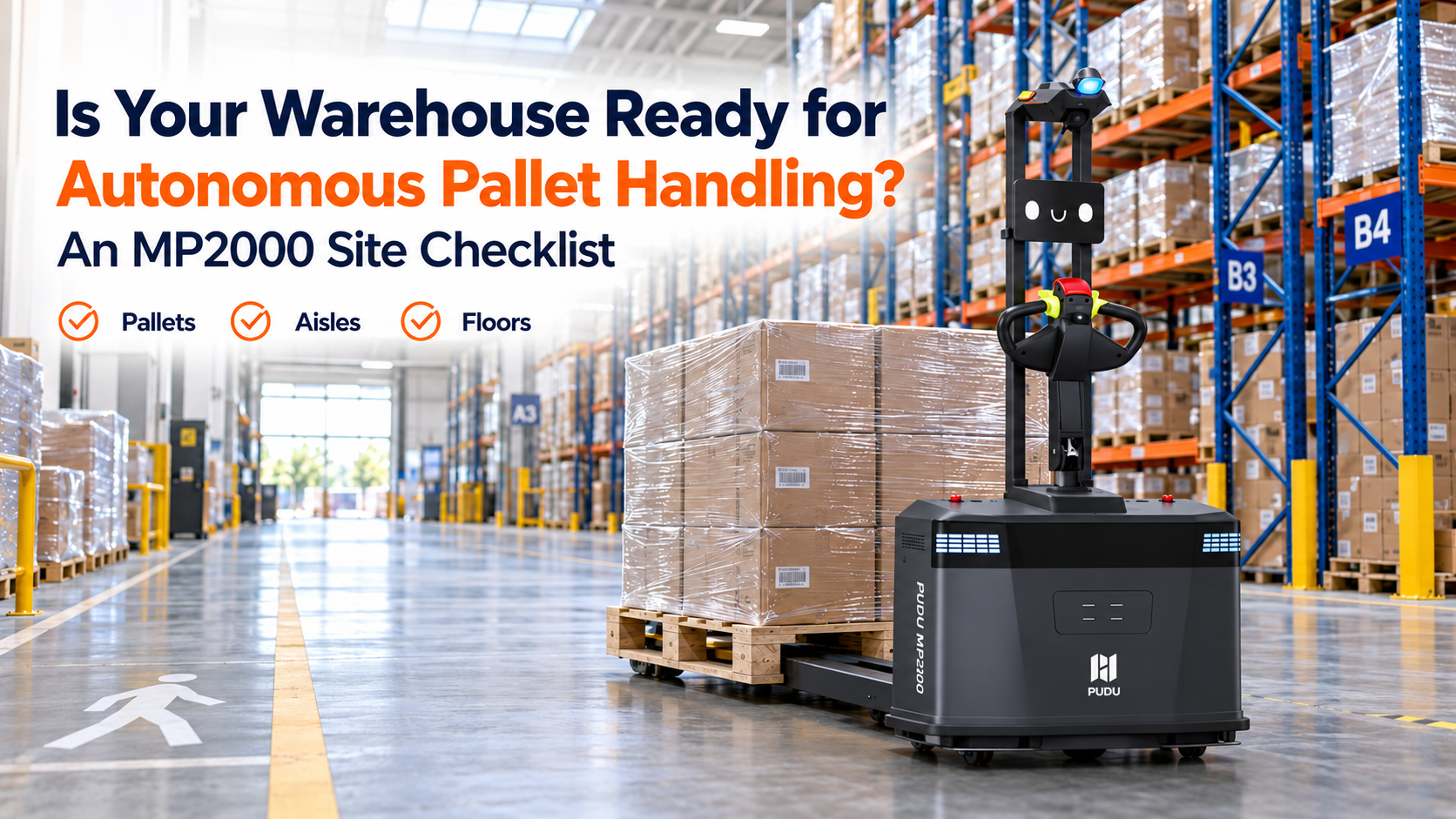
Autonomous Pallet Handling For Warehouses: PUDU MP2000 Site Checklist
A warehouse may have enough room for a pallet robot-but can that robot reliably collect your pallets, negotiate the route and complete deliveries during a busy shift?
Successful autonomous pallet handling starts with checking the details: pallet openings, loaded dimensions, turning space, floor conditions and pickup locations. A small mismatch at any of these points can interrupt an otherwise suitable application.
This guide explains what to measure before introducing PUDU MP2000 into your warehouse. Whether you handle raw materials, finished goods or distribution stock, these checks will help you prepare for a site assessment, identify potential changes and test the complete pallet journey before investing.
Start with the Pallet Movement You Want to Automate
Before comparing robot specifications, define the job. “Move pallets around the warehouse” is too broad to assess. A useful application has a clear source, destination, load type and delivery requirement.
Identify the Source, Destination and Responsibilities
Start with a repeatable movement, such as receiving-to-buffer, storage-to-dispatch or warehouse-to-production delivery.
For each route, establish:
- Who prepares the pallet for collection.
- How the transport request is generated.
- Where the robot collects and deposits the pallet.
- Who clears the destination for the next delivery.
- What happens when collection or delivery cannot proceed.
This reveals whether the robot can complete a useful task or will repeatedly wait for another process.
Record Demand Across the Shift
Measure daily trips, peak-hour requests and travel distances. Include empty return journeys, loading delays and congestion.
Average demand alone can be misleading. A route with modest daily volume may still experience a concentrated burst of requests before dispatch.
Separate Transport from Stacking
MP2000 is a low-lift pallet transport robot. Its published maximum lift height is 200 ± 5 mm, so it should not be assessed as a replacement for a forklift placing pallets into elevated racks.
The strongest first application is a defined pallet-transfer route with measurable demand and clear handover responsibilities.
Check Pallet and Load Compatibility
A pallet that works with your current handling equipment is not automatically suitable for an autonomous pallet handling robot. The robot must approach, engage, lift and transport the actual pallet-and-load combination consistently.
Measure Every Pallet Type on the Route
Document each format rather than submitting one “typical” pallet. Include supplier variations, returnable carriers and any custom bases.
Measure the external dimensions and the clear openings available for fork entry. Check runners, bottom boards, support blocks and anything that may obstruct the forks or wheels.
PUDU lists three-runner and perimeter-base pallet compatibility, alongside recognition of non-standard carriers. The physical suitability of each carrier still needs testing.
Compare the Fork Configuration with the Pallet Openings
The published fork outer widths are 620 mm for the standard model and 550 mm for the narrow-fork model. Lowered fork height is 80 ± 5 mm. These are useful references, but they do not describe the entire fork-entry geometry.
Ask the supplier to verify the complete fit, including fork length, individual fork dimensions, entry clearance and pallet-base construction.
Check the Complete Load
Record pallet weight plus goods, load height and any overhang. Identify uneven loading, shifting contents, loose wrapping and damaged bases.
MP2000’s published maximum load is 2,000 kg. Confirm suitability for your load distribution and operating conditions rather than treating weight alone as approval.
Use the following checklist when preparing pallet samples for the site assessment.
| Check | What to Record | Why It Matters |
|---|---|---|
| Pallet Dimensions | Length, width, height and permitted entry directions. | Establishes the carrier geometry and approach requirements. |
| Fork Openings | Clear opening height, width, spacing and internal obstructions. | Helps verify whether the proposed forks can engage correctly. |
| Base Construction | Runners, blocks, bottom boards, feet and underside photographs. | Identifies possible interference during entry, lifting or withdrawal. |
| Loaded Weight | Total pallet-and-goods weight, including the heaviest case. | Supports capacity assessment for the actual application. |
| Loaded Envelope | Overall length, width and height, including overhang. | Determines the space needed beyond the pallet footprint. |
| Stability and Condition | Load distribution, wrapping, damage, sagging and loose components. | Highlights loads that need correction or a different handling process. |
Measure Aisles, Turns, Doorways and Handover Space
For warehouse pallet transport automation, the important measurement is usable operating space- not simply the distance between two racks.
A route must accommodate the vehicle, its load and the manoeuvre being performed.
Measure the Narrowest Usable Space
Walk the proposed route during a representative shift. Record the clear width at rack ends, columns, doors, protective barriers and temporary staging areas.
Include protruding goods and equipment parked along the route. A drawing may show a clear aisle that daily operations regularly obstruct.
MP2000’s published vehicle dimensions are 1,585 × 910 × 1,870 mm. Vehicle width alone does not establish the required passage width.
Distinguish Straight Travel from Right-Angle Pickup
Turning into a pallet position requires a different assessment from travelling straight through an aisle.
The product page gives right-angle aisle figures tied to specific pallet sizes and orientations. Do not treat these as universal minimums for every load or traffic arrangement.
Verify manoeuvres using your pallet, overhang, approach direction and site-specific clearances.
Check the Full Route and Handover Points
Record:
- Door clear openings and opening behaviour.
- Turning space before and after narrow passages.
- Overhead obstructions relative to the loaded height.
- Space for alignment, fork insertion and withdrawal.
- Interaction with other vehicles and pedestrians.
Measure destinations as carefully as travel lanes. A robot may reach a location successfully yet lack sufficient room to collect or deposit the pallet.
The site assessment should validate the complete loaded journey, including its tightest manoeuvre.
Inspect Floors, Gaps, Thresholds and Slopes for Autonomous Pallet Handling
A floor that appears suitable during a quick walkthrough may contain joints, damaged edges or slippery areas that affect autonomous pallet handling.
Inspect every planned route, including pickup positions, charging approaches and transitions between warehouse sections.
Record Defects and Changes in Level
Photograph and measure cracks, expansion joints, drainage covers, floor plates and doorway thresholds. Note loose material, damaged concrete and areas where water or oil accumulates.
MP2000’s published threshold and gap figures are 10 mm and 35 mm respectively. These are product capability references, not a reason to leave defects unassessed.
Crossing direction, approach angle, traction and load condition should be checked during validation.
Measure Ramps Correctly
Record slope angle or percentage gradient, ramp length and the transitions at both ends. Clearly identify the unit: degrees and percentage gradient are different.
For reliable autonomous pallet handling, assess the complete ramp rather than its slope alone. A modest incline may still present a difficult transition or inadequate stopping space. Confirm the permitted loaded operation with the supplier.
Assess the Surface and Supporting Structure
Your floor survey should also cover:
- Grip under normal cleaning and operating conditions.
- Unevenness at collection and deposit points.
- Loose covers or plates that move under load.
- Floor, cover and platform capacity where relevant.
The load assessment must consider the vehicle and cargo together, including concentrated wheel loads, rather than only the pallet’s weight.
Before introducing autonomous pallet handling into washdown areas, cold stores or hazardous zones, obtain separate confirmation of suitability.
Make Pickup and Drop-off Locations Repeatable
A suitable route can still produce frequent interruptions if pallets are placed unpredictably or destinations remain occupied.
For reliable automated pallet pickup, define what a ready location looks like.
Establish Clear Placement Rules
Identify the permitted pallet orientation, approach direction and staging position. Keep the entry face free from loose wrapping, debris and adjacent goods.
Staff should know:
- Which pallet types are accepted.
- Where each pallet should be placed.
- How to identify a damaged or unstable load.
- Who corrects a pallet that cannot be collected.
Allowing some placement variation does not remove the need for staging discipline.
Prepare the Destination Before Dispatch
Define how the system or operator confirms that a deposit position is available. Decide what happens when the destination is occupied: wait, select an approved alternative or request assistance.
Avoid workflows that depend on someone noticing the robot and clearing space at the last moment.
Test Variations You Actually Encounter
During the trial, include representative placement differences and nearby obstructions, within an agreed controlled test plan. Check that the robot can complete alignment, insertion, lifting, deposit and withdrawal.
Record why assistance was required rather than counting only successful journeys.
Repeatable handover conditions make autonomous pallet handling more dependable- and make problems easier to diagnose when they occur.
Assess Mixed Traffic and Operating Conditions
A warehouse route must work during normal operations, when people, forklifts and other equipment are moving. For autonomous pallet handling, available space and predictable traffic behaviour matter as much as the mapped route.
Identify Crossings and Congestion Points
Walk the route during a representative shift. Identify pedestrian crossings, blind rack ends, forklift intersections and areas where pallets accumulate.
For example, a receiving-to-storage route may look straightforward before unloading begins. During the morning arrival window, parked equipment and temporary staging may reduce its usable width.
Agree how these interactions will be managed, including designated crossings, operating priorities and any restricted areas.
Assess the Complete Application
The site assessment should consider dock edges, pinch points, emergency access and places where people could become trapped between the robot, load and fixed structures.
A site-specific risk assessment and operator training are part of deployment planning, as highlighted in MiR’s AMR deployment guidance.
Define Assistance and Recovery Procedures
Specify who responds when the robot stops and who is authorised to recover or restart it.
Also confirm environmental suitability for the proposed route. Cold stores, washdown zones, heavy dust and hazardous areas require specific assessment; suitability for an ordinary warehouse does not establish suitability for these environments.
Plan Charging, Connectivity and Task Requests
A warehouse robot needs an operating schedule that accounts for charging, waiting and peak demand- not only travel time.
Match Charging to the Working Day
Choose a charging location with suitable power, clear access and protection from passing equipment. It should remain available when required, without obstructing emergency routes or staging.
For example, if outbound movements peak before an afternoon dispatch deadline, plan battery availability around that period rather than relying on an average shift workload.
Decide How Tasks Will Be Requested
Define whether an operator requests each movement or whether a warehouse system generates it. Agree source, destination, priority and task-completion information, including how duplicate requests and failed tasks are handled.
A small pilot could begin with authorised operators requesting transfers between selected points. A larger deployment may need coordinated requests from warehouse software.
Confirm the Connectivity Requirements
Ask the supplier to document the requirements for your selected dispatch, monitoring and integration arrangement.
Test communication interruptions as part of commissioning. Confirm what happens to an active movement, new requests and task-status reporting.
Warehouse robot integration should follow the workflow you need. Establish that workflow before deciding the software scope.
Prepare Your Site-Survey Pack and Pilot
A useful MP2000 site assessment starts with evidence. Share the layout, load details and operating requirements before the demonstration so the trial addresses your application.
Gather Representative Information
Include pallet samples from the actual operation, including relevant supplier variations. Mark proposed routes, handover points and constraints on the layout.
Use the checklist below to organise the information.
| Area | Evidence to Provide | Purpose |
|---|---|---|
| Pallets and Loads | Dimensions, weights, underside photos and representative samples. | Verify engagement, lifting and transport suitability. |
| Routes and Locations | Layout with clearances, turns, doors and pickup/drop-off points. | Identify travel and manoeuvring constraints. |
| Floors and Traffic | Defect measurements, ramp details and observations from busy shifts. | Assess surface conditions and shared-space interactions. |
| Demand | Trips per shift, peak requests, distances and delivery deadlines. | Evaluate capacity against actual operating needs. |
| Infrastructure | Charging location, power provision and proposed system interfaces. | Define installation and integration work. |
| Acceptance | Target cycle time, handoff success and permitted intervention levels. | Agree how the pilot will be evaluated. |
Test the Complete Cycle
Measure from the transport request to successful deposit. Include waiting, empty travel, pickup and any assistance.
For example, a storage-to-dispatch trial should test an occupied destination and a temporarily blocked route, alongside normal transfers. Conduct exception tests under an agreed, controlled plan.
Agree What Success Looks Like
Record completed tasks, cycle times, pickup/drop-off success and interventions with reasons. Compare results against representative demand.
A fast individual pickup does not establish shift capacity. Scale only after the complete workflow meets the agreed acceptance criteria.
Frequently Asked Questions About Autonomous Pallet Handling
Can MP2000 Handle Every Pallet Type?
Do not assume universal compatibility. For reliable autonomous pallet handling, check pallet construction, openings, dimensions, condition and loaded behaviour. Test each proposed carrier type.
Is a Two-Metre Aisle Sufficient Everywhere?
No. The published aisle references depend on specified pallet geometry and orientation. Load overhang, turns, traffic and protective clearances require application-specific assessment.
Can It Replace a High-Lift Warehouse Forklift?
MP2000 supports autonomous pallet handling for low-lift transport tasks. Assess elevated rack placement or other lifting requirements separately.
Does It Need WMS Integration?
Define your task-request method first. Confirm the integration and connectivity needed for that arrangement; do not assume every pilot requires full WMS integration.
What If the Warehouse Uses Mixed Pallets?
Group them by geometry and construction, provide samples and agree which types are approved for autonomous pallet handling. Define a separate process for unsuitable or damaged carriers.
Does a Successful Demonstration Mean the Entire Warehouse Is Ready?
It validates only the conditions tested. Additional loads, routes, shifts or operating environments need review before expanding autonomous pallet handling across the warehouse.
Conclusion
Warehouse readiness comes down to compatible pallets, usable routes, suitable floors and clear operating responsibilities. These checks apply across industries, while specialist environments need additional assessment.
Start with one useful movement and test it under representative conditions. Use the results to identify changes and decide where autonomous pallet handling can deliver dependable operational value.
Planning an MP2000 deployment? Share your warehouse layout, pallet details and handling requirements with Autofina Robotics to arrange a site assessment.
Request a Live Demo
Tell us about your facility and cleaning challenges. We provide Pan India support and installations for Pudu Robotics. Our team will propose routes, coverage estimates, and ROI.
Email: [email protected]
Phone: +91 98192 22944