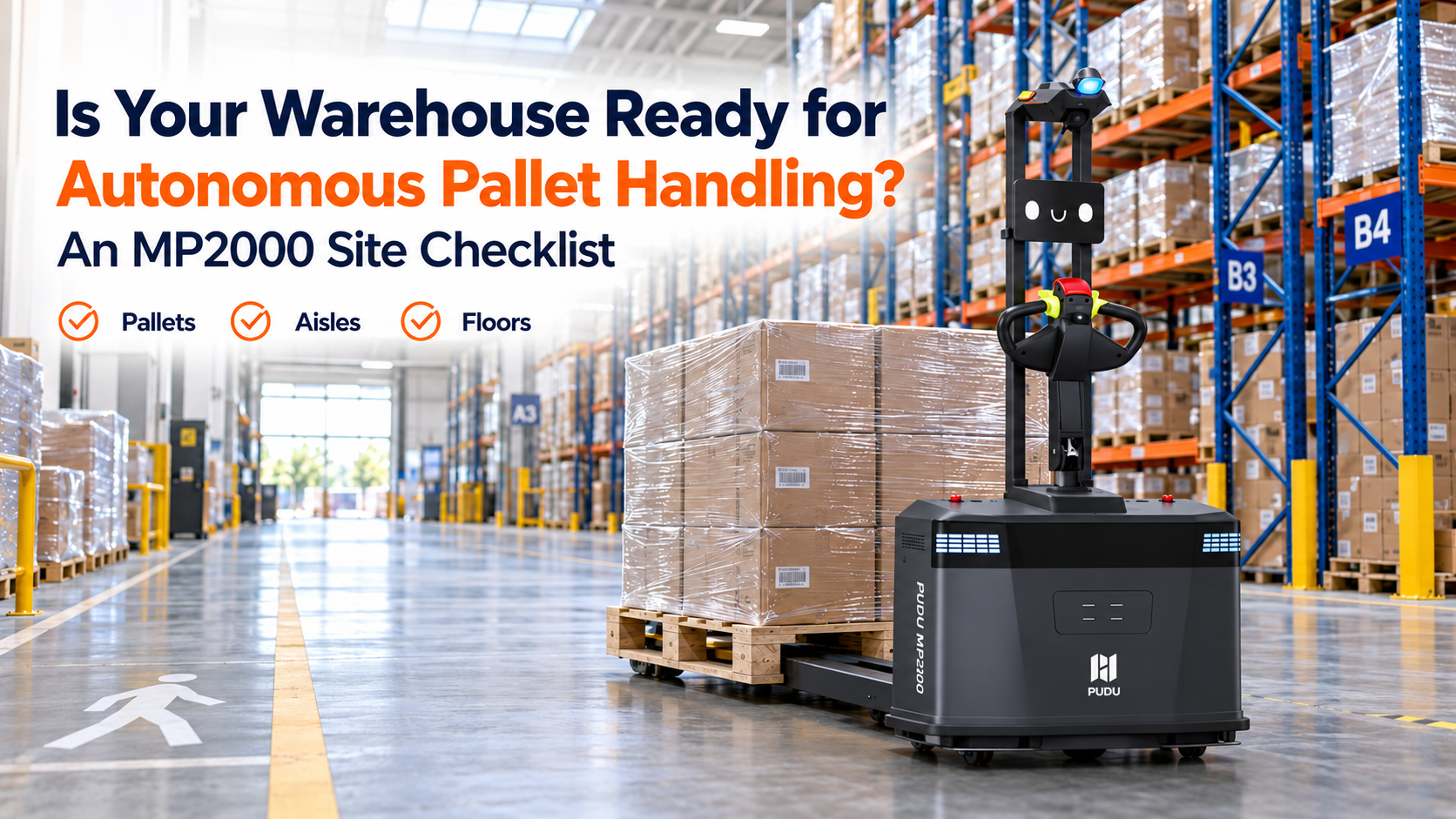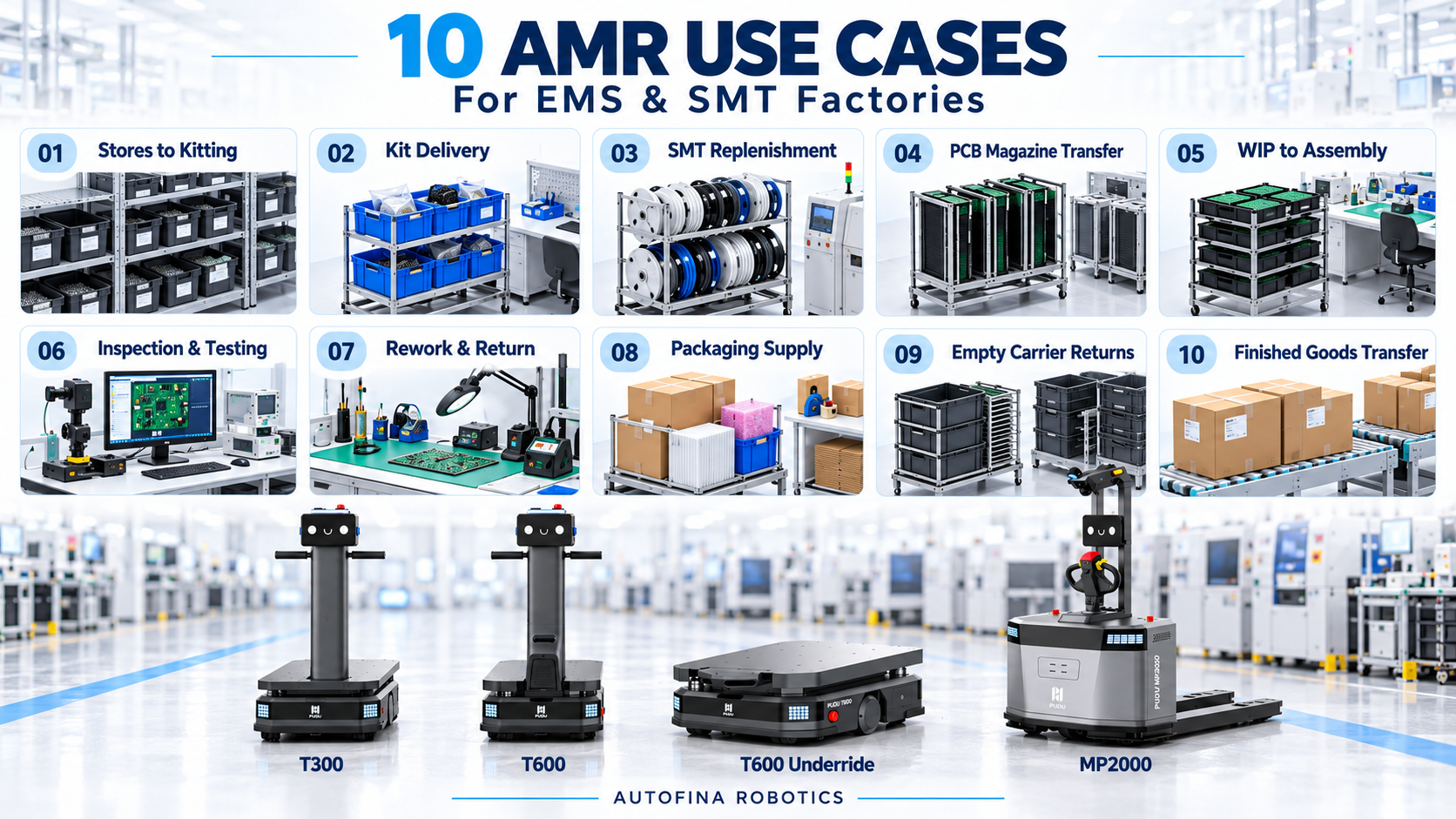
PUDU MP2000 Buyer’s Guide: Buying Checklist for India
Is the PUDU MP2000 Right for Your Operation?
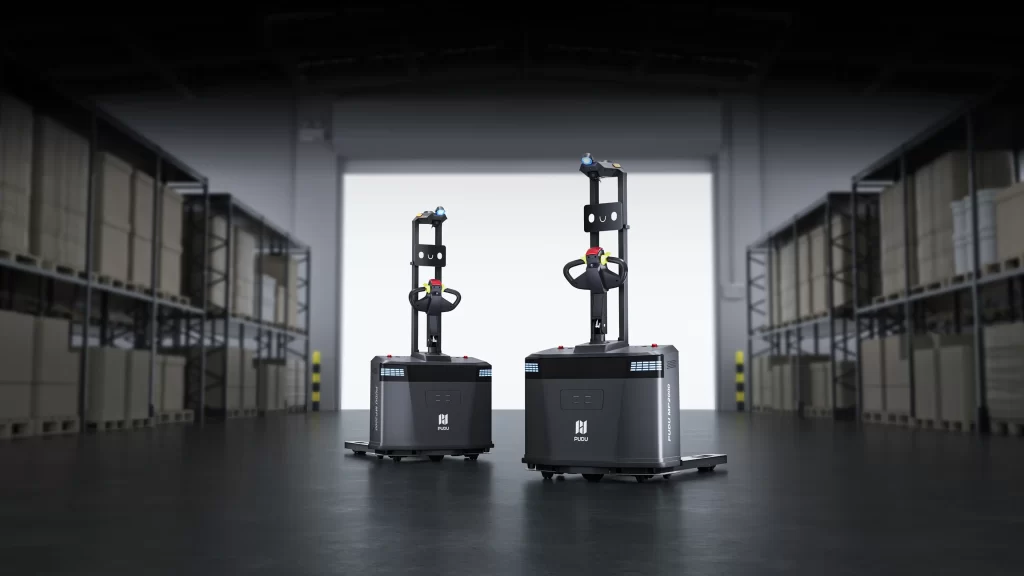
Buying an autonomous pallet truck begins with a practical question: can it handle your pallets, follow your routes, and complete deliveries when your operation needs them?
This PUDU MP2000 buyer’s guide focuses on those decisions for Indian factories, warehouses, and distribution centres. Before requesting a quotation, buyers should understand their load variations, daily movements, site constraints, and remaining operator responsibilities.
The MP2000’s published maximum payload is 2,000 kg, with a maximum lift height of approximately 200 mm. Its application is low-lift pallet transport; elevated rack placement requires different equipment.
The following sections explain where autonomous pallet handling may help and what to validate before committing to a deployment.
Which Industries and Pallet Movements Could Benefit?
The opportunity for autonomous pallet handling in India depends on the movement itself. Frequent transfers of stable palletised loads between defined locations are worth assessing across many sectors.
The applications below are illustrative buying scenarios, not claims of confirmed MP2000 deployments or certification for every listed industry.
| Industry or field | Pallet movements to assess | Main buying consideration |
|---|---|---|
| Electronics and EMS | Bulk components, enclosures, and packed products between stores, production staging, and dispatch | Packaging protection, load identity, and applicable ESD controls |
| Automotive, auto components, and EV manufacturing | Parts bins, assemblies, and approved packaged components | Carrier compatibility, weight distribution, and production deadlines |
| Engineering and industrial equipment | Machined parts, motors, pumps, and subassemblies | Concentrated loads, restraint, and pallet strength |
| FMCG and consumer goods | Packed cartons from production to storage or dispatch | High movement frequency and peak-shift demand |
| Food and beverage | Sealed ingredients, packaging supplies, and finished cartons | Hygiene zoning, spill prevention, and environmental suitability |
| Pharmaceuticals and medical devices | Packaging materials and released, packed products | Quality status, traceability, and site validation |
| Cosmetics and personal care | Packaging components and finished goods | Secure loads and assessment of any hazardous materials |
| E-commerce, retail distribution, and 3PL | Inbound staging, replenishment, and outbound consolidation | Mixed pallet formats and changing workloads |
| Textiles, garments, and footwear | Secured cartons, accessories, and palletised finished products | Load overhang and stability of soft or irregular loads |
| Printing, paper, and packaging | Palletised paper, cartons, and packaging output | Load security and protection from dust or debris |
| Plastics and rubber | Bagged materials and boxed moulded products | Spill control and stability of bags or containers |
| Electrical equipment, appliances, and renewable energy | Packed inverters, electrical assemblies, and appliances | Product dimensions, fragility, and load height |
| Furniture and building-product distribution | Suitable boxed fittings and palletised products | Oversized loads and operating-space requirements |
| Agricultural inputs and processed commodities | Compatible palletised bags, cartons, and containers | Dust, moisture, packaging condition, and material restrictions |
| Institutional supply stores | Bulk consumables in hospital, campus, or hospitality warehouses | Segregated logistics routes and suitable staging areas |
Start with a Defined Movement
For example, an EMS plant could assess finished-carton transfers to dispatch, while a packaging factory could evaluate repeated movements between production and storage. These examples have different loads but a similar transport requirement.
Record the source, destination, pallet type, load range, transfers per shift, and delivery deadline before selecting equipment.
Separate Special Environments from General Applications
Freezers, washdown areas, explosive atmospheres, cleanrooms, hazardous-material zones, and exposed outdoor routes require explicit suitability confirmation. Their inclusion in an industry’s operations does not establish MP2000 compatibility.
Assess indoor pallet transport separately from truck loading, high-rack storage, and movements across open yards.
Will Your Existing Pallets Work?
MP2000 pallet compatibility should be established using the actual pallets circulating through your operation. A facility may receive different designs from domestic suppliers, import shipments, and returnable-packaging systems.
Nominal pallet length and width provide only part of the information.
Check Fork Entry and Underside Construction
Record the opening height, entry width, underside supports, and intended approach direction. Check whether wrapping, loose boards, or damaged sections obstruct the fork path.
Pudu publishes a lowered fork height of 80 ± 5 mm. The Standard and Narrow Fork versions have fork outer widths of 620 mm and 550 mm respectively. These dimensions need checking against the pallet’s complete geometry.
Selecting the narrower version does not automatically resolve every compatibility issue. Entry clearance, support positions, and load distribution also matter.
Evaluate the Loaded Pallet
Provide the supplier with:
- Minimum, typical, and maximum gross load, including the pallet.
- Loaded height and any side overhang.
- Position of heavy or unevenly distributed items.
- Details of straps, wrapping, or other load restraint.
- Photographs of the underside and every intended entry face.
Loose cartons, shifting bags, or concentrated loads may require changes to packaging or the carrier before transport can be automated.
Test the Variations Used in Daily Operations
Include representative wooden, plastic, or other carriers where relevant, together with the variations actually received from suppliers. Damaged pallets should be removed under the plant’s handling procedure.
The trial should verify entry, lifting, turning, stopping, placement, and fork withdrawal. Request a written compatibility list identifying approved pallet designs and any restrictions.
For non-standard carriers, recognition is only one part of the assessment. The carrier must also provide adequate mechanical support, clearance, and stability throughout the movement.
Is Your Indian Facility Ready for Autonomous Pallet Handling?
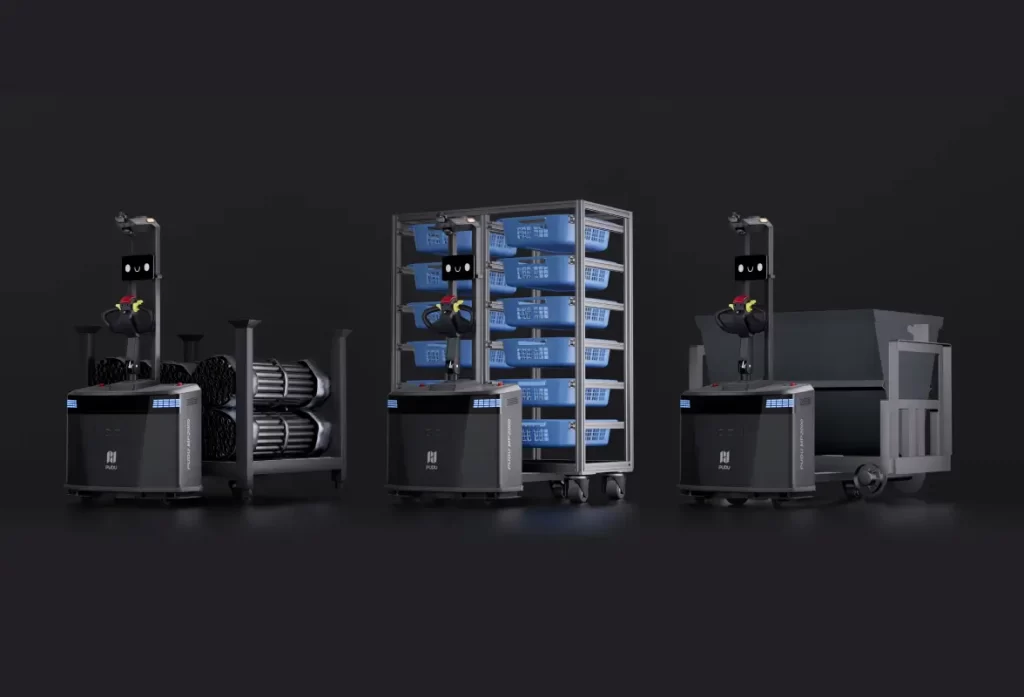
An existing facility may need operational adjustments before autonomous pallet movement can run reliably. These could include clearer staging positions, revised traffic rules, or improvements to a particular floor transition.
A site study should follow the entire loaded route.
Measure Working Space, Including Pickup and Turning
The MP2000’s published body dimensions are 1,585 × 910 × 1,870 mm. Pudu also describes approximately 2-metre aisles for specified right-angle pallet-pickup arrangements. These figures do not establish suitability for every loaded route.
Measure the space required around the pallet, including load overhang, turning, fork approach, withdrawal, and interaction with nearby equipment.
Keep designated receiving positions available. A robot cannot complete a delivery if the destination has become temporary storage for another department.
Inspect Floors and Traffic Conditions
Check joints, drain covers, ramps, thresholds, and damaged patches with representative loads. Consider whether dust, moisture, loose wrapping, or packaging debris could affect the route.
Pudu lists a maximum threshold height of 10 mm and gap crossing of 35 mm. These are product limits to assess against the application, not targets for acceptable floor quality.
Map pedestrian crossings, blind corners, manual pallet trucks, and forklift routes. Agree passing rules, waiting positions, and operating speeds as part of the site assessment.
Review Charging and Environmental Requirements
Confirm a suitable power supply, charging position, and access for maintenance. If doors or lifts are involved, assess dimensions, capacity, controls, and recovery procedures separately.
For Indian facilities with routes near loading bays or open sheds, check exposure to rain, direct sunlight, dust, and temperature variation. Obtain confirmation for the actual environment before including those routes in the deployment.
Can the MP2000 Meet Your Required Transfers per Shift?
Fleet size should follow the complete task cycle and peak demand. Travel speed alone cannot show how many pallets a robot will move during a shift.
A cycle includes approaching the load, aligning, picking up, travelling, placing, withdrawing, and reaching the next task. Waiting and charging also consume operating time.
Calculate Capacity Using a Representative Route
The following example is illustrative, not measured MP2000 performance:
| Cycle element | Assumed time |
|---|---|
| Empty travel to pickup: 100 metres at an average 0.8 m/s | 125 seconds |
| Alignment and complete pickup | 50 seconds |
| Loaded travel: 100 metres at an average 0.8 m/s | 125 seconds |
| Placement and withdrawal | 40 seconds |
| Traffic and coordination allowance | 60 seconds |
| Total cycle time | 400 seconds |
Under these assumptions, one robot completes approximately nine cycles per hour. Six productive hours would provide roughly 54 transfers, before adding any further operational reserve.
If a dispatch window requires 14 transfers per hour, the example indicates a capacity shortfall even when the daily average appears manageable.
Size for the Busiest Period
Measure demand around production starts, changeovers, packing peaks, and dispatch deadlines. Assess whether tasks can be scheduled earlier or combined with useful return movements.
Pudu lists approximately six hours of battery life at maximum load and about two hours of charging with a 200–240 V supply. Actual coverage needs validation against the duty cycle.
Use pilot results to establish sustainable transfers per hour and an appropriate reserve for delays.
What Will Operators Still Need to Do?
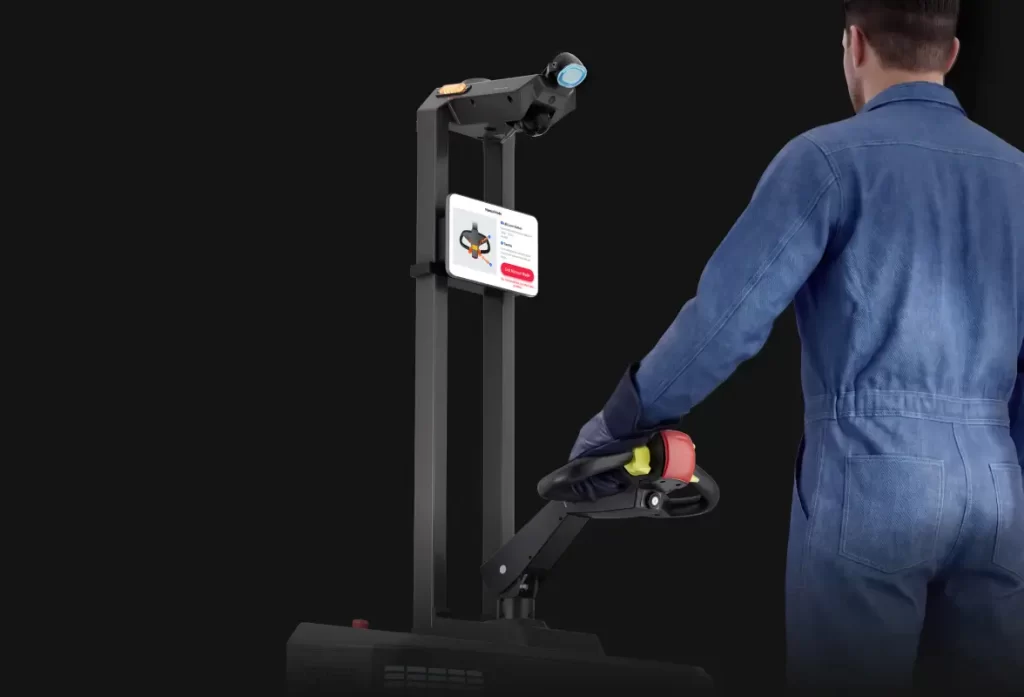
An autonomous pallet truck changes the transport role, while people remain responsible for material readiness, quality decisions, and exceptions.
Before deployment, assign each responsibility clearly.
| Activity | Responsibility to define |
|---|---|
| Prepare and secure the load | Warehouse or production team |
| Inspect pallet condition | Designated handling team |
| Authorise movement | Operator or connected business system |
| Keep the destination available | Receiving department |
| Resolve failed pickups or incorrect requests | Trained operator |
| Handle quality-held material | Authorised quality or production personnel |
| Inspect and maintain the robot | Maintenance team or service provider |
For plants operating several shifts, ensure trained personnel and escalation contacts are available whenever the robot operates.
The pilot should include common interruptions, such as an occupied destination, damaged pallet, or cancelled request. Record how often intervention is needed and how long recovery takes.
This information gives a more realistic picture of labour capacity released. Time saved accompanying pallets can be reassigned to picking, checking, packing, or other work, while the remaining responsibilities stay visible in the operating plan.
What Integration Does Your Operation Need?
The right integration level depends on how pallet movements are requested and recorded today. A single repeatable route may begin with operator-triggered tasks, while a busy distribution centre may require automatic requests from its warehouse system.
Start with a Defined Task Process
For a standalone pilot, agree the approved pickup points, destinations, request method, and completion procedure.
Autofina’s MP2000 page lists task options including PUDU Link, APIs, voice commands, and task buttons, together with optional door and elevator integration. Confirm which methods and accessories are included in the proposed deployment.
Connect Systems Where the Workflow Requires It
A Warehouse Management System may generate replenishment or dispatch movements. A Manufacturing Execution System may request production supply, while ERP information can provide the relevant order reference.
Define the information exchanged:
- Task and pallet identifiers.
- Pickup and destination.
- Priority and required delivery time.
- Material readiness.
- Completion, cancellation, or failure status.
The system should distinguish arrival from successful placement and material acceptance. It should also prevent duplicate requests and preserve the task state during an interruption.
Agree Network Requirements and Ownership
Ask the supplier to document local network coverage, internet dependencies, hosting, access permissions, and recovery behaviour. Any offline capability should be explained for the exact configuration.
For Indian organisations with central IT approval or restricted factory networks, involve IT before commissioning dates are agreed.
The quotation should identify who develops, tests, and supports each interface. This makes integration costs and responsibilities clear before the purchase order is placed.
What Should an MP2000 Quotation Include?
When requesting a PUDU MP2000 price in India, ask for the complete deployment cost. The robot’s purchase price is only one part of the investment.
Give each supplier the same pallet details, routes, operating hours, and transfer requirements so quotations can be compared on a consistent basis.
Define the Equipment and Project Scope
| Quotation item | What to confirm |
|---|---|
| Robot configuration | Exact model, fork configuration, and included accessories |
| Charging equipment | Included hardware, installation, and electrical responsibilities |
| Delivery | Freight, unloading arrangements, and delivery location |
| Commissioning | Mapping, task configuration, trials, and acceptance testing |
| Integration | Interfaces with business systems, doors, or other equipment |
| Software | Included functionality, licence period, and recurring charges |
| Training | Operator and maintenance training across the required shifts |
| Warranty and support | Coverage, exclusions, response arrangements, and service location |
| Taxes and payment terms | Applicable GST, quotation validity, and payment milestones |
Identify Additional Costs Before Ordering
Ask whether pallet modifications, floor repairs, network improvements, or third-party equipment work are included. Clarify who pays for travel and accommodation if commissioning or service requires an on-site visit.
The proposal should also state what happens if the trial identifies a compatibility issue. Agree the acceptance criteria, corrective-action process, and responsibilities before placing the order.
A clearly defined scope helps buyers assess the total cost of autonomous pallet handling and reduces uncertainty during installation.
How to Assess Cost and Payback
A useful MP2000 business case connects measured transport effort with achievable financial benefits. Start by recording how much time employees spend moving pallets, including collection, travel, and return journeys.
Separate Time Released from Cash Savings
Consider an illustrative workload:
80 transfers per day × 5 minutes of employee time = 400 minutes per day.
If a validated automated workflow reduces that involvement to two minutes per transfer, it releases four person-hours daily. Those hours become cash savings only where expenditure actually falls—for example, through reduced overtime or avoided additional hiring.
Time reassigned to inspection, picking, or production should be recorded as additional staff capacity.
Calculate Net Financial Benefit
Include recurring maintenance, software, energy, and other operating costs. Count production gains only where the improvement is measured and the additional capacity can be used.
Simple payback = total initial project cost ÷ annual net cash benefit.
For example, a hypothetical ₹30 lakh project generating ₹10 lakh in annual net cash benefit has a simple three-year payback. These figures illustrate the method and are not an MP2000 quotation or expected return.
Avoid counting the same improvement twice. Labour savings and increased output may partly arise from the same released working time.
A pilot provides a stronger basis for investment than calculations based solely on maximum speed or advertised runtime.
How Does MP2000 Compare with Other Options in India?
The right comparison begins with the required movement. Floor-level pallet transport, elevated stacking, and rack retrieval need different equipment and operating space.
For buyers considering autonomous pallet handling in India, the following options provide a useful starting shortlist.
| Robot or range | Supplier or sales route | Application to assess |
|---|---|---|
| PUDU MP2000 | Autofina Robotics | Low-lift transport of compatible palletised loads |
| Addverb FlowT | Addverb | Pallet transport or elevated handling, depending on the selected variant |
| Hachidori Autonomous Pallet Jack | Hachidori Robotics | Repeated pallet movements within factories and warehouses |
| SEER SFL-CBD20 / SFL-CBD30 | Listed by Robots Bharat in India | Autonomous pallet-truck applications at different load requirements |
| Waaree Autonova pallet-jack range | Waaree Autonova | Pallet transport using an application-matched configuration |
These are published product options, not an independently tested performance ranking. Confirm the exact model, current supply arrangements, and local support scope during evaluation.
Compare the Complete Application
Ask shortlisted suppliers to assess the same loaded pallets and routes. Compare successful pickup rates, complete cycle time, manual interventions, charging coverage, and recovery behaviour.
Also compare commissioning responsibilities, software charges, warranty terms, and spare-parts support.
The MP2000 should be evaluated where the requirement is low-lift pallet transport. If the operation needs elevated rack placement, shortlist equipment designed for the required height and load. A higher payload rating alone does not establish suitability for stacking.
Demonstration and Purchase Acceptance Checklist
A useful demonstration should reproduce the buyer’s working conditions. Use actual pallets, representative loads, and a route containing the manoeuvres expected during production.
Agree what success means before the trial starts.
Test the Tasks That Matter
| Test area | Evidence to record |
|---|---|
| Pallet compatibility | Successful pickup and placement across approved pallet variations |
| Loaded manoeuvring | Clearance through the tightest turns and approach positions |
| Delivery performance | Completed transfers and response time during representative demand |
| Load stability | Condition of the pallet and goods after movement |
| Operator involvement | Number, cause, and duration of interventions |
| Destination management | Response when the intended drop-off position is occupied |
| Recovery | Behaviour after a cancelled task, obstruction, or communication interruption |
| Shift coverage | Productive operating time, charging needs, and remaining capacity |
Use Agreed Pass Criteria
A few successful trips demonstrate basic operation. Acceptance testing should establish repeatability over a representative period, including normal variations in pallet placement and traffic.
Define thresholds appropriate to the application—for example, required deliveries within an agreed time window and an acceptable intervention rate. Avoid applying one universal target to every facility.
Record the Deployment Boundaries
Document approved pallets, maximum loads, routes, environmental conditions, and excluded applications. Record any changes needed before regular operation begins.
The final handover should include operating instructions, trained personnel, maintenance responsibilities, and escalation contacts.
This makes the demonstration a decision tool and gives both the buyer and supplier a clear basis for accepting the installation.
Buyer FAQs
Can We Test Our Pallets Before Ordering?
Request a compatibility trial using representative loaded pallets. Include different designs and conditions that are acceptable in normal operation.
What Information Is Needed for an MP2000 Quotation?
Share pallet drawings or measurements, load weights, photographs, route distances, pickup and delivery positions, transfers per shift, and integration requirements.
Can One Robot Cover Multiple Departments?
Potentially, provided the combined demand, travel time, charging, and delivery priorities fit its validated capacity. Check peak demand across departments.
Can We Begin with One Route?
A defined pilot route can establish compatibility and performance before expansion. Agree how additional routes, robots, or integrations would be priced and supported.
Does Autonomous Pallet Handling Remove All Manual Work?
People may still prepare loads, inspect pallets, authorise movements, and resolve exceptions. Measure this remaining involvement during the trial.
Make the Buying Decision with a Validated Trial
This PUDU MP2000 buyer’s guide centres on four checks: pallet compatibility, site readiness, delivery capacity, and complete project cost.
Choose a representative route, test actual loads, and agree measurable acceptance criteria. The results will show whether the proposed configuration fits your operation and what changes are needed.
Tell us about your facility and cleaning challenges. We provide Pan India support and installations. Our team at Autofina Robotics will propose routes, coverage estimates, and ROI.
Email: [email protected]
Phone: +91 98192 22944