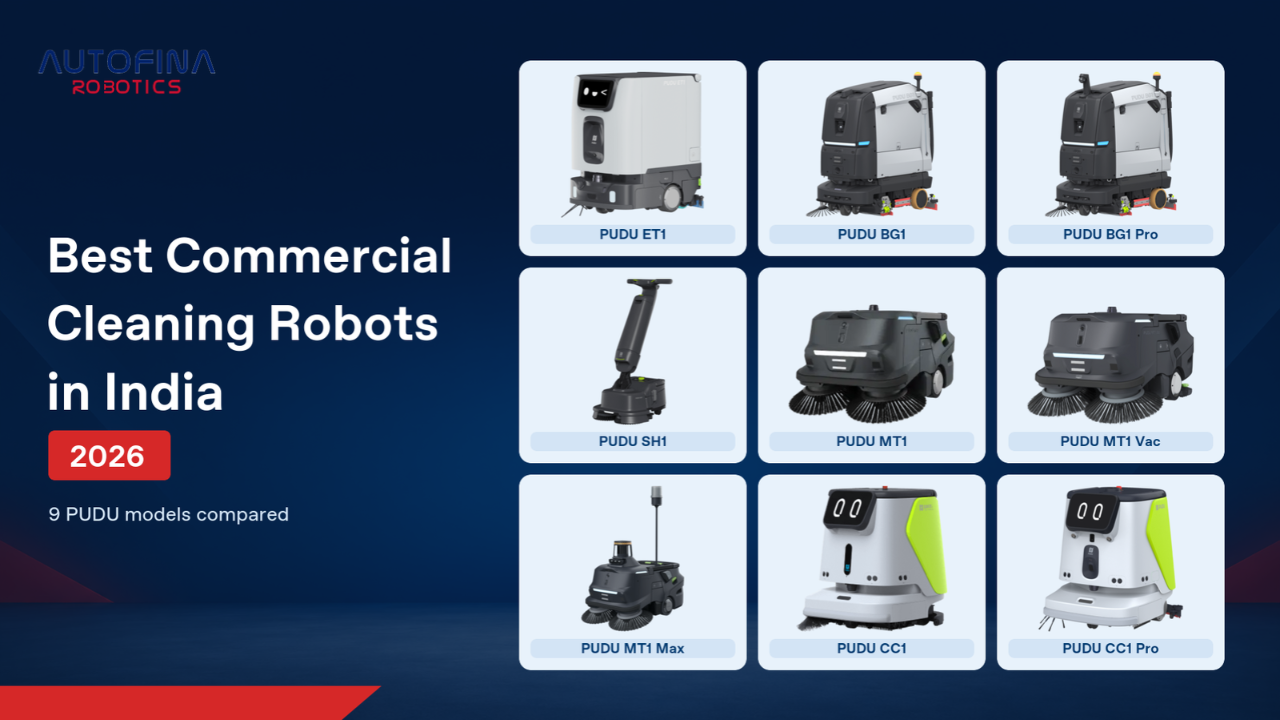
Best Commercial Cleaning Robots in India [2026]
The best commercial cleaning robot for your facility depends on what needs to come off the floor. A supermarket may need to pick up packaging scraps and scrub trolley marks along the same aisle. A hotel may need a compact robot that can move around furniture and through narrow corridors. A warehouse may mainly need to sweep dust and loose debris across long routes. This best commercial cleaning robots in India guide compares the top commercial cleaning robots most suitable for your facility. It explains what each model does, which floors and facilities it suits, and what to check before requesting a quote or booking a demo with Autofina Robotics.
Start with three questions. What needs to come off the floor? How much floor needs cleaning? When is the area available? Your answers will help you shortlist the right type of machine and choose a representative route to test.
What Are Commercial Cleaning Robots?
Commercial cleaning robots are floor-cleaning machines designed for business and industrial facilities. Autonomous models map a site and follow assigned cleaning routes. Operator-guided machines assist staff with floor cleaning while a person directs where the machine goes.
What tasks can a commercial cleaning robot perform?
- Sweeping collects loose debris such as dust and small packaging scraps from suitable floors.
- Vacuuming uses suction to pick up dust and particles from compatible carpet or hard flooring.
- Scrubbing uses water and a powered brush or roller to loosen marks and dirt. A scrubber-dryer also recovers dirty water as it moves.
- Dust-mopping removes fine surface dust during routine floor maintenance.
- Spot cleaning targets individual messes. Some models can detect certain messes automatically within a mapped area.
Where do commercial cleaning robots help?
Warehouses can assign recurring routes through long aisles to manage dust and loose debris. Supermarkets can clean around shelf replenishment and customer traffic. Hotels and offices can use compact machines for lobbies and corridors. Hospitals can assign suitable public-area routes, such as reception and waiting zones, in line with site housekeeping and infection-control procedures.
Assigning repeatable floor work to a robot can give staff more time for bathrooms, stairs, high-touch surfaces and unusual spills. When comparing machines, check how much staff time is still needed to refill tanks, empty bins, clean brushes and respond to interruptions.
List of the Best Commercial Cleaning Robots in India
1] PUDU ET1: Compact Commercial Cleaning Robot for Stores, Hotels and Offices
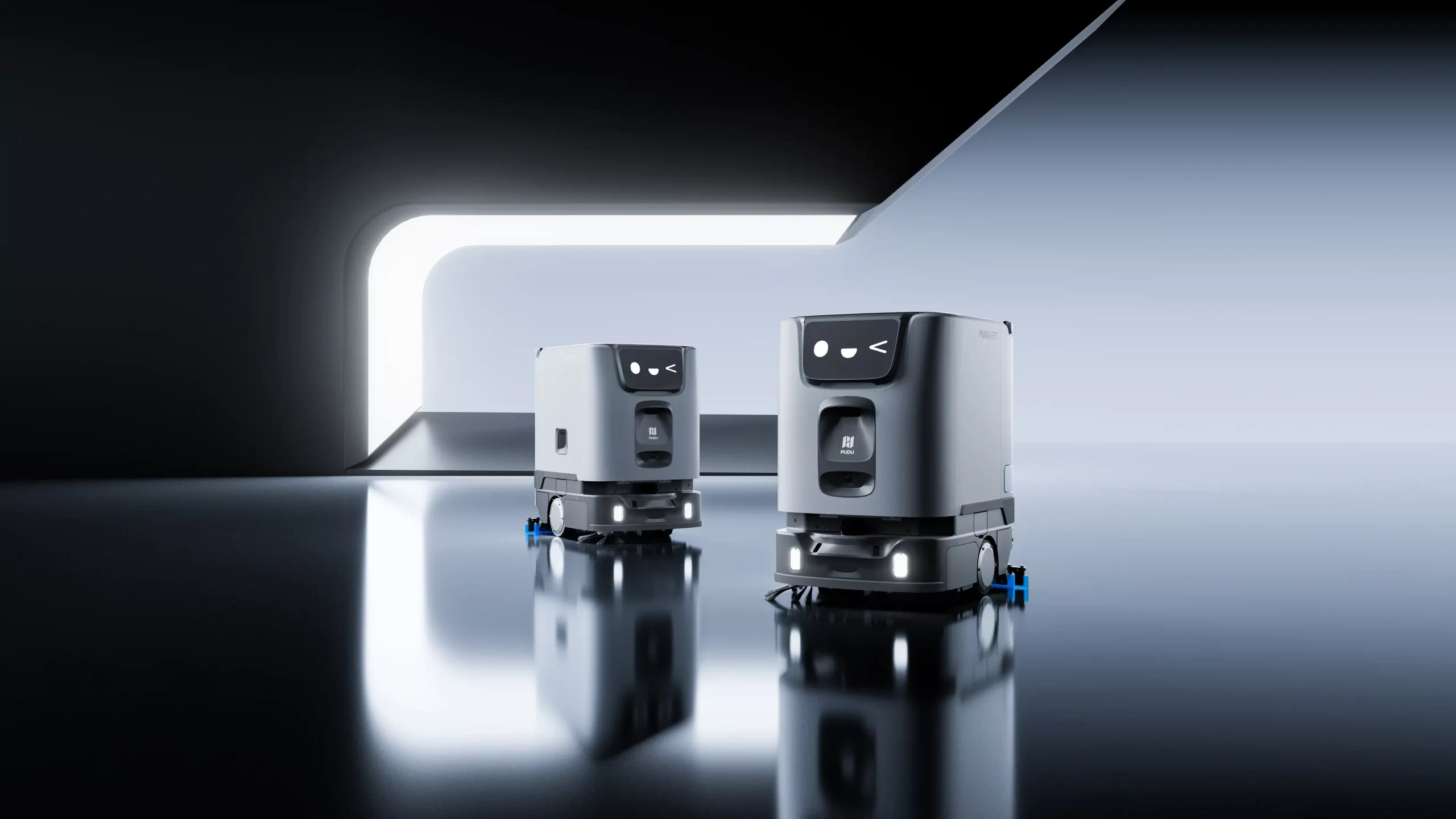
The PUDU ET1 is an AI-native compact scrubber-dryer robot for sites where the cleaning route winds between shelves, furniture or display fixtures. It can sweep, vacuum, dust-mop and scrub, so a facility can assign different types of cleaning to the same machine. Its compact footprint is particularly useful on smaller, furnished routes that still need regular wet scrubbing.
What the ET1 does
- Sweeps and scrubs in one pass. The front sweeping mechanism collects loose material before the rear roller scrubs the floor. A squeegee and water recovery system pick up dirty water behind the roller.
- Vacuums and dust-mops. Vacuuming uses suction to pick up dust and particles from suitable surfaces. Dust-mopping gives staff a lighter maintenance option for hard floors that need frequent attention.
- Responds to floor conditions. It can detect carpet edges and raise the scrubbing roller. At a detected wet spill, it can lift the sweeping brushes. For a stubborn mark, it can slow its travel, increase roller speed and increase water output.
- Supports hot-water scrubbing with the appropriate station. PUDU lists up to 85°C for this setup. Test it on representative residue and confirm that the floor finish allows hot-water cleaning.
- Supports automatic mapping and manual operation. Staff can use the touchscreen for daily operation. The product deck also lists mobile and PC management.
Where it works and how it helps
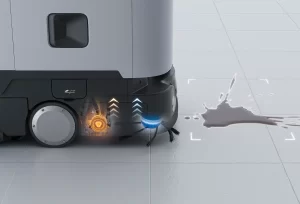
- Retail stores and showrooms. Assign a route from the entrance through display aisles to manage tracked-in dust, footprints and routine marks. Test the turns around display stands as well as the straight aisles.
- Hotels and serviced apartments. Use it on compatible hard-floor corridors and lift lobbies during quieter periods. Where the route crosses a mat or carpet edge, demonstrate the transition with the actual floor materials.
- Offices and clinics. Assign reception and circulation areas to the robot so staff can focus on desks, fixtures and high-touch surfaces. In a clinic, choose routes and cleaning methods that meet the site’s housekeeping procedures.
The onboard cleaning system includes the sweeping and scrubbing mechanisms, roller, squeegee, dust box, trash bin, and clean-water and wastewater tanks. The 8-in-1 station and 21.5-inch display are optional. The station can charge the robot, refill clean water, drain wastewater, dispense detergent, heat water, rinse the roller and squeegee, and spin-dry the roller.
Pro tip. Measure the narrowest opening at floor level. The chassis is 380 mm wide, and PUDU lists 500 mm of minimum passage clearance. Test a full turn around furniture or objects in your facility and inspect how much water remains on the floor after the robot passes.
| What to compare | PUDU ET1 |
|---|---|
| Machine type and modes | Autonomous compact scrubber-dryer. Sweeps, scrubs, vacuums and dust-mops. Manual mode supported. |
| Dimensions and weight | 500 × 380 × 580 mm (L × W × H); approx. 45 kg. |
| Route clearance | 500 mm minimum passage width; 600 mm minimum overhead clearance; 20 mm published obstacle-crossing height. |
| Cleaning widths | 300 mm for scrubbing and dust-mopping; 390 mm for sweeping and vacuuming. |
| Published cleaning rate and speed | 300–720 m²/h; maximum cruise speed 1.0 m/s. |
| Scrubbing and suction | Up to 800 rpm roller speed; 5,000 Pa published scrubbing pressure; 20 kPa suction. Up to 85°C hot-water setup with the applicable station. |
| Water and debris capacity | 8 L clean water; 7.2 L wastewater; 2.5 L dust box. |
| Battery, runtime and charging | 35 Ah battery; 2.5–4 hours runtime; approx. 3 hours charging. Quick battery swap supported. |
| Published operating noise | Below 65 dB(A), per PUDU’s technical deck. |
| Mapping and control | Automatic mapping; 7-inch touchscreen; mobile app and PC management listed in the technical deck. |
| Routine upkeep | Removable tanks, dust box, trash bin, brushes, roller and squeegee for cleaning and inspection. |
| Options and best-fit sites | Optional 8-in-1 station and 21.5-inch display. Suited to stores, showrooms, hotels, offices and approved clinic routes with limited clearance. |
2] PUDU BG1: Heavy-Duty Sweeping and Scrubbing for Large Hard Floors
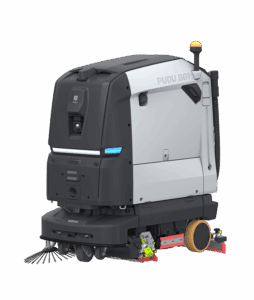
The PUDU BG1 is an autonomous sweeper-scrubber for large facilities where loose debris and stuck-on marks collect on the same hard-floor route. The BG1 Series is positioned as the world’s first AI-Native large scrubber-dryer robot, representing a shift from “AI-powered” to deep hardware + software integration.
Its front mechanism collects debris, the rear disc brush scrubs the surface, and the squeegee recovers the dirty water. A supermarket, for example, can assign both packaging-fragment pickup and trolley-mark scrubbing to the same aisle run.
What the BG1 does
- Combines sweeping and scrubbing. Separate sweeping and wet-cleaning systems allow the robot to handle both jobs on a continuous route.
- Reaches along walls and shelving. The extendable scrubbing mechanism works closer to the edges of fixtures and walls. Inspect corners, shelf legs and recessed areas during a trial to identify any manual touch-ups.
- Targets detected messes. In spot-cleaning mode, the robot scans a zone and treats recognised dirt or marks selectively. Its adaptive cleaning system can increase brush pressure on tougher stains or lift the sweeping mechanism over detected wet spills.
- Adjusts detergent dosing. The robot can vary the concentration using its dual cleaning-agent system. Confirm the approved chemistry for your floor material and finish.
- Supports staff intervention and easier upkeep. The series offers ride-on manual control and automatic disc-brush attachment. The optional workstation can handle charging, clean-water refill and wastewater drainage.
Where it works and how it helps
- Supermarkets and hypermarkets. Combine pickup of suitable loose scraps with scrubbing along aisles and checkout routes. Use a quieter window if restocking or customer queues regularly block the route.
- Malls and commercial complexes. Assign repeatable hard-floor routes in long corridors and concourses. Put shorter spot-cleaning patrols in zones that collect occasional dirt between full cleans.
- Warehouses and manufacturing facilities. Consider it for suitable sealed floors in packing, staging and circulation zones where the facility needs both dry pickup and wet floor washing. Trial the actual debris, floor joints and aisle access.
The BG1 has integrated sweeping and scrubbing systems, a squeegee, extendable edge-cleaning hardware, water tanks, a debris bin and dual cleaning-agent tanks.
| What to compare | PUDU BG1 |
|---|---|
| Machine type and core tasks | Autonomous sweeper-scrubber with dirty-water recovery, edge scrubbing, adaptive dosing and selective spot cleaning. |
| Dimensions and weight | 1,195 × 760 × 1,303 mm with squeegee; 1,120 × 660 × 1,303 mm without squeegee; approx. 344 kg. |
| Minimum route clearance | 850 mm. Verify turns, doorway approaches and the route to the workstation. |
| Cleaning widths | 550 mm scrubbing width; 708 mm cleaning width with side brushes. |
| Published coverage | Up to 2,000 m²/h in covered cleaning; up to 6,000 m²/h in selective spot cleaning. |
| Water and debris capacity | 75 L clean water; 60 L wastewater; 5 L debris bin; approx. 7 L total across two cleaning-agent tanks. |
| Navigation and cruise speed | LiDAR and 3D visual SLAM; 0.2–1.0 m/s cruise speed. |
| Battery and runtime | 90 Ah at 48 V; up to 7.5 hours sweeping and scrubbing. The technical deck lists 5.5+ hours in standard mode. |
| Charging time | Approx. 3 hours at higher AC input voltage; approx. 4.5 hours at lower AC input voltage, per PUDU. |
| Control and connectivity | Autonomous routes, ride-on manual control, 4G, Wi-Fi, Bluetooth and PUDU Link support. |
| Options | Workstation for charging, refill and drainage; optional dust-mopping, polishing, and compatible gate or lift integration. |
| Best-fit sites | Supermarkets, malls, warehouses and factories with broad hard-floor routes that need both sweeping and scrubbing. |
3] PUDU BG1 Pro: Heavy-Duty Floor Cleaning for More Complex Routes
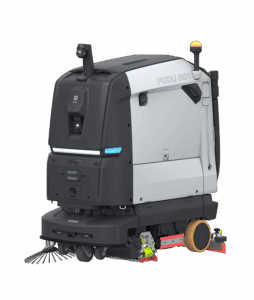
The PUDU BG1 Pro combines the BG1 series sweeping and scrubbing system with 3D LiDAR, 3D visual mapping and enhanced onboard processing. It’s worth evaluating when the route includes changing displays, high-clearance spaces or staging areas where traffic and obstacles vary between shifts. It has the same published covered-cleaning and spot-cleaning rates as the BG1. PUDU lists a higher maximum cruise speed for the Pro.
What the BG1 Pro does
- Sweeps, scrubs and recovers dirty water. The front sweeping and rear scrubbing systems clean suitable dry debris and hard-floor marks along the same route.
- Cleans edges and detected spots. It can extend its scrubbing mechanism near walls or shelving and target recognised messes during a patrol. Adaptive brush control and dosing allow the robot to vary how it treats the floor.
- Uses 3D sensing to navigate. The Pro combines 3D LiDAR and 3D visual SLAM, which uses sensor and camera information to map the surroundings and track the robot’s position.
- Supports repeated cleaning between service stops. With the optional workstation, it can return for charging, clean-water refill and wastewater drainage. Staff still need to inspect brushes, consumables and the cleaning result.
Where it works and how it helps
- Distribution centres. Evaluate a route through cross-aisles and around staging zones. Compare how often a temporary pallet position forces a pause, a reroute or staff intervention.
- Large malls and big-box retail. Test long hard-floor runs with open concourses, shelving, temporary displays or lighting changes. A representative trial should include the busiest transition between zones.
- Multi-zone factories. Assign suitable production-adjacent and circulation routes where sweeping and scrubbing are both needed. Test around marked crossings and follow the site’s pedestrian and vehicle traffic procedures.
The BG1 Pro includes the onboard sweeper-scrubber, water and debris tanks, squeegee, extendable edge hardware, dual cleaning-agent system and Pro navigation hardware. Confirm the charging dock or plumbed workstation, pads or brushes for your floor, starter consumables, mapping, training and service scope. Dust-mopping, polishing and compatible gate or lift integration are optional.
Pro tip. Compare the BG1 and BG1 Pro on the same route, at a similar time of day and in the same cleaning mode. Record area completed, unattended route completion, time lost to obstacles and staff interventions. These measures show whether the Pro configuration offers a practical advantage on your floor.
| What to compare | PUDU BG1 Pro |
|---|---|
| Machine type and core tasks | Autonomous sweeper-scrubber with wastewater recovery, edge scrubbing, adaptive dosing and selective spot cleaning. |
| Pro navigation hardware | 3D LiDAR and 3D visual SLAM; enhanced onboard AI processing. |
| Dimensions and weight | 1,195 × 760 × 1,303 mm with squeegee; 1,120 × 660 × 1,303 mm without squeegee; approx. 344 kg. |
| Minimum route clearance | 850 mm. Check aisle turns, staging lanes and access to the dock. |
| Cleaning widths and cruise speed | 550 mm scrubbing width; 708 mm cleaning width with side brushes; 0.2–1.2 m/s cruise speed. |
| Published coverage | Up to 2,000 m²/h in covered cleaning; up to 6,000 m²/h in selective spot cleaning. |
| Water, debris and detergent capacity | 75 L clean water; 60 L wastewater; 5 L debris bin; approx. 7 L across two cleaning-agent tanks. |
| Battery and runtime | 90 Ah at 48 V; up to 7.5 hours sweeping and scrubbing. The technical deck lists 5.5+ hours in standard mode. |
| Charging time | Approx. 3 hours at higher AC input voltage; approx. 4.5 hours at lower AC input voltage, per PUDU. |
| Control and connectivity | Autonomous routes, ride-on manual control, 4G, Wi-Fi, Bluetooth and PUDU Link support. |
| Options | Charging dock or workstation depending on configuration; optional dust-mopping, polishing, and compatible gate or lift integration. |
| Best-fit sites | Large malls, distribution centres, big-box retail and multi-zone industrial hard-floor routes where navigation performance matters. |
4] PUDU SH1: Walk-Behind Scrubber-Dryer for Restaurants and Small Commercial Areas
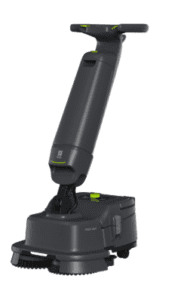
The PUDU SH1 is a cordless, operator-guided scrubber-dryer. A staff member steers it through the area while the powered brush scrubs and the squeegee and suction system collect dirty water. It suits short, irregular cleaning jobs where an employee needs to work around furniture, choose which mark to treat next or respond quickly to a spill.
What the SH1 does
- Scrubs and recovers water as the operator moves. The powered disc brush loosens food residue, dirt and other suitable soils. The squeegee and vacuum collect the dirty water into a separate recovery tank.
- Handles detailed cleaning in furnished areas. Staff can steer around tables, counters and small work zones and make another pass over marks that need more attention.
- Supports different brushes and pads. PUDU lists soft, medium and hard options. Choose a brush or pad that is appropriate for your floor finish.
- Displays maintenance alerts and cleaning reports. The touchscreen can show tank and component alerts. PUDU lists reports for cleaning duration, water use and estimated area cleaned.
- Supports accessory-based detail work. PUDU lists accessories for selected vertical surfaces, such as glass and tiled walls, and an optional inner filter box for separating debris from wastewater.
Where it works and how it helps
- Restaurants, cafés and food courts. Staff can clean around tables or tackle residue near counters and entrances during short gaps between service periods.
- Retail stores and auto showrooms. Use it where display stands, fixtures or vehicles make the available paths change during the day. Demonstrate it on the actual floor finish, especially polished surfaces.
- Schools, hotels and small work areas. Use it for short hard-floor routes, spill response and detailed cleaning around fixtures. The operator can select which areas to clean as rooms become available.
The machine has a disc-brush assembly, squeegee, removable solution and recovery tanks, touchscreen and removable battery. Confirm the charger, supplied brush or pad, spare battery, extra squeegee blades and any detail accessories on the quote. PUDU identifies the inner filter box as a separate purchase.
Pro tip. Time the full job on your floor, including tank refills and wastewater disposal. A battery may last through several short jobs while the tanks need servicing sooner.
| What to compare | PUDU SH1 |
|---|---|
| Machine type and main task | Cordless, operator-guided walk-behind scrubber-dryer for suitable hard floors. |
| Dimensions and weight | 490 × 530 × 1,200 mm; 17 kg. |
| Working and squeegee widths | 440 mm cleaning path; 490 mm squeegee. |
| Published productivity | 1,100–1,600 m²/h under PUDU’s operating assumptions. Check on-site output around furniture and with tank stops. |
| Brush and suction | Up to 350 rpm brush speed; 27 kg published brush downforce rating; 20 kPa suction. |
| Tank capacity | 4 L solution and 4 L recovery on the main product page. PUDU’s store lists 4.3 L each. Confirm quoted configuration. |
| Battery and runtime | 18 Ah; 70 min Standard. Eco is listed as 100 min on the main product page and up to 90 min on the store. The store lists 50 min in Heavy-Duty mode. |
| Charging and operating noise | Approx. 2.5 hours charging per PUDU’s store; 72 dB(A) Standard and 69 dB(A) Eco per the main product page. |
| Operating information | Touchscreen alerts and cleaning reports. PUDU’s store lists Wi-Fi syncing to PUDU Link. |
| Consumables and options | Soft, medium or hard brushes and pads; alternative squeegee rubber materials; separately purchased inner filter box and configuration-dependent detail accessories. |
| Best-fit sites | Restaurants, cafés, showrooms, schools, hospitality venues and smaller commercial hard-floor areas. |
5] PUDU MT1: Autonomous Dry Sweeping for Warehouses and Large Facilities
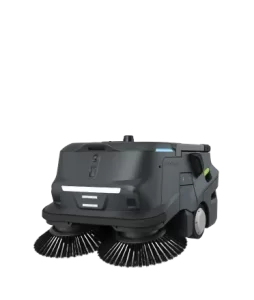
The PUDU MT1 is a robotic sweeper for large sites with recurring dust and loose debris. Its two disc brushes guide debris into a 35 L bin, and its filtered airflow helps contain dust during sweeping. Its main job is dry debris collection. Facilities that also need wet floor washing can evaluate a sweeper-scrubber such as the BG1 for those routes.
What the MT1 does
- Sweeps fine dust and suitable larger debris. The sweeping system can collect material such as loose dirt, leaves and some bottles or packaging scraps. Test the size and shape of the debris your site actually produces.
- Runs full cleaning routes or selective patrols. Standard mode sweeps a mapped area. In spot-cleaning mode, onboard cameras look for recognised litter and send the machine to collect it.
- Cleans along edges and navigates mapped routes. LiDAR, visual mapping and markers support positioning. A retractable steering handle lets staff move it manually when needed.
- Can empty its bin at a compatible station. The optional Auto-Empty Station and compatible waste box let the robot transfer collected debris into an on-site receptacle and then resume cleaning.
Where it works and how it helps
- Warehouses and fulfilment centres. Assign long aisles and staging routes where dry dust and small packaging scraps return throughout the shift.
- Industrial facilities. Use it on approved dry circulation routes and around suitable packing areas. Evaluate how the brushes handle your debris and how the robot responds to your site’s traffic.
- Large venues and covered concourses. Patrol suitable hard-floor routes for litter between busier periods. Include wall edges and pillar bases in the demo to check coverage.
The onboard system has two disc brushes, a filter, a removable debris bin and a retractable steering handle. The Auto-Empty Station and compatible waste box are optional paired accessories. Confirm the charging dock, station layout, compatible waste receptacle, spare brushes and filters, and any lift or e-gate integration in the quote.
Pro tip. Run a full shift test using the debris your site typically collects. Track how quickly the bin fills and whether long strips or straps need to be removed before the run. Use the standard sweeping rate to estimate full-route productivity, then check it against the measured run.
| What to compare | PUDU MT1 |
|---|---|
| Machine type and modes | Autonomous dry sweeper. Standard mapped sweeping and AI-assisted selective spot cleaning. |
| Dimensions and weight | 840 × 600 × 490 mm (L × W × H); 65 kg. |
| Cleaning width and passage | 700 mm practical cleaning width; 750 mm published minimum passage width. |
| Published cleaning rates | Up to 1,800 m²/h in standard mode; up to 6,000 m²/h in selective spot-cleaning mode. |
| Debris capacity and dust control | 35 L trash bin; filtered negative-pressure airflow for dust containment. |
| Runtime and charging | 4–8 hours depending on cleaning level; less than 3 hours published charging time. |
| Navigation and cruise speed | Visual SLAM, markers and LiDAR SLAM; adjustable 0.2–1.2 m/s cruise speed. |
| Handling and upkeep | Retractable steering handle; quick-release bin and serviceable cleaning consumables. |
| Optional Auto-Empty Station | Requires compatible waste box. Published station size is 760 × 2,010 × 680 mm (L × W × H), with support for a waste receptacle up to 1,350 mm high. |
| Integration and best-fit sites | PUDU Link and compatible gate or lift integration. Suited to warehouses, industrial dry routes and large covered venues. |
6] PUDU MT1 Vac: Commercial Robotic Vacuum for Carpet and Hard Floors
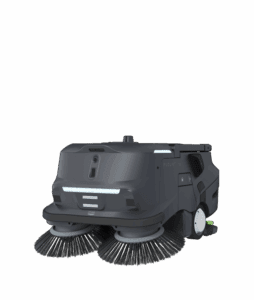
The PUDU MT1 Vac is an autonomous dry-cleaning machine for facilities where fine dust, lint and carpet vacuuming are recurring jobs. It combines sweeping, vacuuming and dry dust-mopping, with separate collection for larger loose debris and finer dust. Its ability to adjust cleaning settings as it moves between carpet and hard flooring makes it useful for offices, hotels and venues with mixed surfaces.
What the MT1 Vac does
- Vacuums across a 550 mm path. Two fans with separate air ducts support dry dust pickup. Its side brushes extend the sweeping path to 700 mm for suitable loose debris.
- Recognises carpet and hard floors. The machine can change suction and brush speed based on the detected surface. Test transitions, edges and joins with your actual carpet and flooring.
- Separates fine dust and larger debris. Two 7 L dust bags collect fine material, while a separate 6 L bin holds larger debris. Check each separately when planning the service schedule.
- Offers a choice of filter grades. PUDU specifies H11 as standard and H13 as optional. Ask which filter and replacement bags are included in the proposed configuration.
- Supports spot cleaning and dry dust-mopping. The robot can identify certain litter during a patrol. PUDU also lists a quick-release dust-mop module and a hand-vacuum extension for operator-led detail work. Confirm the accessories supplied.
Where it works and how it helps
- Offices and IT parks. Vacuum suitable carpeted corridors and open areas, then continue dry cleaning on compatible hard-floor routes. Check loose cables, thresholds and turning space around workstations.
- Hotels, conference centres and banquet venues. Run planned vacuuming between events or during quieter hours. The low-profile body can reach beneath suitable raised furniture where the full route has sufficient clearance.
- Airports, shopping centres, supermarkets and large public venues. Assign dry-cleaning routes in suitable lounges, circulation areas and mixed-floor zones. Test the route under realistic foot traffic and confirm any access controls separately.
The onboard system includes the dual-fan vacuum mechanism, brushes, bag system and separate debris bin. The published standard filtration grade is H11. Confirm the H13 filter, dust-mop module, hand-vacuum extension, charging station, initial bag supply and any lift or gate integration in the quote.
Pro tip. Choose the trial route based on what is hardest to clean. For a carpeted office, test a dusty carpet edge, a mat transition and a narrow turn. Compare visible pickup and bag use after the run. If your main issue is larger loose litter on dry hard floors, compare the MT1 Vac with the MT1 and its 35 L bin.
| What to compare | PUDU MT1 Vac |
|---|---|
| Machine type and modes | Autonomous dry vacuum and sweeper with dust-mopping and selective spot cleaning. |
| Floor suitability | Suitable carpets and hard floors. Automatic surface recognition adjusts suction and brush speed. |
| Dimensions and weight | 840 × 600 × 490 mm (L × W × H); 75 kg. |
| Minimum route clearance | 750 mm minimum passage width; 520 mm minimum overhead clearance. |
| Cleaning widths | 550 mm vacuum path; 700 mm sweeping width with side brushes. |
| Published cleaning rate | Up to 1,400 m²/h. Verify actual coverage on carpet and hard floors separately. |
| Vacuum and filtration | Dual fans with independent air ducts; H11 filtration standard; H13 available as an option. |
| Dust and litter capacity | 14 L combined dust-bag capacity (two 7 L bags); separate 6 L trash bin. |
| Runtime and charging | 3–6.5 hours depending on mode; 4 hours listed for standard sweeping and vacuuming on hard floors; less than 3.5 hours charging. |
| Navigation and cruise speed | Visual SLAM, markers and LiDAR SLAM; adjustable 0.2–1.2 m/s cruise speed. |
| Modules, options and integration | Tool-free cleaning components; quick-release dust-mop module; hand-vacuum extension; automatic charging station and compatible gate or lift integration. Confirm bundle contents. |
| Best-fit sites | Offices, hotels, banquet venues and large commercial spaces with recurring fine dust or mixed carpet and hard flooring. |
7] PUDU MT1 Max: Autonomous Sweeping for Parking Areas and Semi-Outdoor Routes
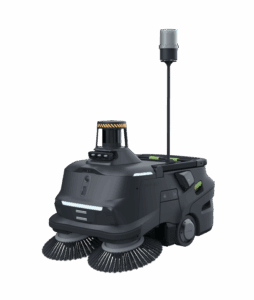
A covered car park collects a different mix of debris from an indoor warehouse. Leaves and paper blow in from entrances, tyres carry in grit, and the route may cross ramps or areas with changing light. The PUDU MT1 Max is a dry sweeper designed for suitable indoor, outdoor and semi-outdoor routes where those conditions matter. Its 3D LiDAR, adaptive sweeping and visual warnings distinguish it from the standard MT1.
What the MT1 Max does
- Sweeps loose litter and grit. Its 700 mm sweeping path and 35 L waste container suit recurring collection of material such as paper scraps, leaves and suitable bottles. The robot collects dry debris through its sweeping system.
- Adjusts how it approaches debris. PUDU describes a system that can reduce power for lighter material to limit scattering, increase power for heavier material, and change its approach angle to guide debris between the brushes.
- Runs full-route or selective cleaning. Covered mode sweeps an assigned area. Spot mode patrols a zone and collects recognised litter where it finds it.
- Uses 3D sensing on changing routes. The robot combines 3D LiDAR, visual positioning and other sensors. Audible and visual warnings help people notice it. Plan routes and operating windows around the facility’s traffic rules.
- Automates parts of daily upkeep. The MT1 Max has automatic filter cleaning. With the compatible Auto-Empty Station and waste box, it can unload into a larger site receptacle and return to its route.
Where it works and how it helps
- Covered and multilevel car parks. Assign recurring dry sweeps to approved bays and perimeter lanes during quieter windows. Test ramps, speed bumps and drainage crossings before mapping the final route.
- Logistics parks and covered loading approaches. Clear windblown litter and tracked-in grit from suitable routes between a dock approach and enclosed work areas. Choose operating periods that match vehicle movements.
- Commercial campuses and large venues. Patrol suitable paved approaches and covered walkways where litter reappears throughout the day. Identify a sheltered place for docking, waste handling and parking between runs.
The onboard system has the sweeping assembly, a 35 L waste container, 3D navigation sensors, filter-cleaning hardware and audible and visual warning systems. The Auto-Empty Station and compatible waste box are optional paired accessories. Ask Autofina to itemise the charging setup, optional rain-sensing configuration, spare filters and brushes, and any lift or gate integration.
Pro tip. Use the real parking or loading route for the demo, including the roughest approved surface, the sharpest turn and the steepest ramp. The MT1 Max has an IP54 rating, and PUDU advises against cleaning in extreme weather. Define when the machine should stop and where it should park during heavy rain.
| Specification | PUDU MT1 Max |
|---|---|
| Cleaning modes | Autonomous dry sweeping, covered-area cleaning and AI-assisted selective spot cleaning. |
| Dimensions and weight | 840 × 600 × 675 mm (L × W × H), 85 kg. Verify overhead clearance with the warning light installed. |
| Sweeping width and bin | 700 mm with side brush, 35 L waste container. |
| Published cleaning rate | Up to 2,200 m²/h in covered mode and up to 7,000 m²/h in selective spot mode. |
| Battery and runtime | 60 Ah, 5–10 hours depending on mode, with 8 hours listed for standard mode. |
| Charging and cruise speed | Less than 3.5 hours charging. Adjustable 0.2–1.2 m/s cruise speed. |
| Navigation and alerts | 3D LiDAR SLAM, visual SLAM and marker support. Elevated warning light, projection light and audible alerts. |
| Site conditions | IP54. Verify route clearance, ramp gradient, surface conditions and operating weather limits during the survey. |
| Maintenance and options | Automatic filter cleaning. Optional Auto-Empty Station with compatible waste box. Confirm rain-sensing and integration options in the quote. |
8] PUDU CC1: Four-in-One Commercial Floor Cleaning for Scheduled Routes
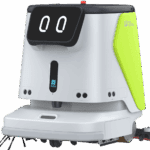
The PUDU CC1 is a versatile option for facilities that need regular dry and wet cleaning on predictable indoor routes. A mall, for example, can schedule wet scrubbing on a suitable hard-floor corridor before opening and use dry cleaning on other assigned routes. The CC1’s value is the range of tasks it can perform with one machine.
What the CC1 does
- Sweeps and vacuums. Use the appropriate setup to collect loose dust, hair and particulate debris. Confirm the vacuum configuration and surface compatibility when a route includes carpet.
- Scrubs and recovers dirty water. A powered cleaning mechanism loosens soil on compatible hard flooring. The squeegee recovers used water into a separate tank.
- Dust-mops for routine upkeep. Assign a lighter dry-cleaning run when the floor needs dust pickup between scheduled scrubs.
- Follows mapped routes. Visual and laser positioning help it navigate assigned zones. A compatible dock or workstation can support automatic charging and water handling, depending on configuration.
Where it works and how it helps
- Malls, campuses and IT parks. Schedule long indoor corridors and open areas around building hours. Test how much of the route the CC1 completes while doors, furniture and pedestrian traffic are in their usual positions.
- Hotels and convention venues. Assign hard-floor scrubbing in lobbies and public circulation areas between busier periods. Check the cleaning setup and route separately if the venue also needs carpet vacuuming.
- Hospitals and industrial facilities. Evaluate approved public corridors, entrances and other suitable circulation areas. Housekeeping procedures should specify which floors, chemicals and cleaning windows are authorised.
The CC1 has onboard floor-cleaning and water-recovery equipment, including separate clean-water and wastewater tanks. Ask for the exact model revision, supplied brushes and pads, vacuum consumables, charger, workstation and installation in writing. A quote for scheduled floor cleaning with staff handling water can differ from a quote for automatic refill and drainage.
Pro tip. Select the main task before sizing the machine. If your facility mostly needs wet scrubbing, measure the scrubbing run and record the timing of tank stops. The longest published runtime across all modes gives a different answer from the runtime on a water-intensive route.
| Specification | PUDU CC1 |
|---|---|
| Cleaning modes | Autonomous sweeping, vacuuming, dust-mopping and wet scrubbing with water recovery. |
| Dimensions and weight | Autofina lists 663 × 568 × 682 mm and approx. 75 kg. PUDU’s portfolio brochure lists 629 × 552 × 695 mm. Verify the quoted unit before checking clearance. |
| Cleaning widths | Autofina lists 400 mm scrubbing and 500 mm sweeping widths. |
| Published cleaning rate | 700–1,000 m²/h. Actual output depends on the selected mode, floor and route. |
| Water tanks | 15 L clean water and 15 L wastewater in the Autofina listing. Confirm the tank and dry collection configuration supplied. |
| Runtime and charging | Up to about 9 hours in silent mopping. Autofina lists up to 3 hours charging in its overview and up to 4 hours in its specification panel. Confirm both for the quoted unit and mode. |
| Navigation | Visual and laser SLAM for mapped indoor routes. Check doorway clearance and thresholds with the quoted machine. |
| Docking and upkeep | Confirm the charger or workstation, automatic water refill and drainage, and cleaning attachments in the quote. |
| Best-fit sites | Malls, offices, campuses, hotels and approved circulation routes in hospitals and factories. |
9] PUDU CC1 Pro: Four-in-One Cleaning With AI Spot Scrubbing and Reporting
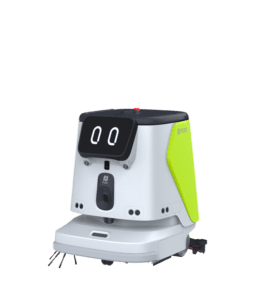
The PUDU CC1 Pro is suited to facilities that want scheduled floor cleaning and a way to respond to stains between runs. Its front-facing detection can identify certain wet stains during a patrol. A rear camera checks the floor after a pass and can trigger local re-cleaning when it detects a remaining mark. For a facility manager, the practical benefit is knowing where stains recur and which areas may still need attention.
What the CC1 Pro does
- Sweeps, vacuums, dust-mops and scrubs. Use scheduled passes for routine upkeep. On suitable dry routes, the machine can detect a floor transition and switch from sweep-and-vacuum to vacuum-only on carpet.
- Targets detected wet marks. During an AI spot-scrubbing patrol, it can respond to common recognised messes such as beverage spills. It can also adjust cleaning intensity when it detects a stubborn mark.
- Checks the result behind the machine. The rear AI camera can identify remaining visible stains and trigger a touch-up. Cleaning heatmaps help staff locate recurring or persistent marks for follow-up.
- Tracks tasks and equipment status. PUDU’s dashboard provides task completion and maintenance information. It can help supervisors identify which routes or components need attention.
- Supports automatic servicing with the appropriate station. The optional workstation can handle charging, water refill and drainage. PUDU also describes roller and squeegee self-cleaning with the workstation series. pudurobotics.com
Where it works and how it helps
- Malls and commercial buildings. Schedule routine cleaning on common routes and evaluate spot scrubbing near entrances or suitable food-service zones where visible marks recur.
- Hotels and event venues. Assign hard-floor and carpet tasks by zone. Inspect the results after an event turnover to see whether the robot’s spot cleaning and reporting reduce follow-up work.
- Hospitals and pharma facilities. Consider approved corridors and other validated routes. Task records can support a facility’s own documentation. Where a site requires a validated process or hygiene checks, review the robot, chemistry and records against those procedures.
The onboard system includes the cleaning mechanisms, separate clean-water and wastewater tanks, cameras, 10.1-inch display and navigation hardware. Ask Autofina to itemise the optional workstation, floor-specific brushes or pads, starter dust bags and other consumables, and any lift or e-gate integration. PUDU lists IEC 63327 certification for the CC1 Pro.
Pro tip. Ask for two demo runs. Use a full-area cleaning pass to measure scheduled productivity and a spot-scrubbing patrol to evaluate stain detection and re-cleaning. Review the heatmap alongside a visual inspection of the floor.
| Specification | PUDU CC1 Pro |
|---|---|
| Cleaning modes | Autonomous sweeping, vacuuming, dust-mopping and scrubbing. AI spot scrubbing and local re-cleaning supported. |
| Dimensions, weight and display | 629 × 552 × 695 mm (L × W × H), 75 kg, 10.1-inch LCD. |
| Clearance and working width | 700 mm minimum path clearance and 500 mm cleaning width with side brush. |
| Published cleaning rates | 700–1,000 m²/h in full-area cleaning and 1,500–3,000 m²/h in selective AI spot scrubbing. |
| Tank and debris capacities | 15 L clean water and 15 L wastewater. PUDU’s model page lists a 2.5 L dustbin and 6 L dust bag. Confirm the supplied dry collection setup. |
| Published runtime by mode | 5 h scrubbing, 5 h sweeping and vacuuming, 4 h carpet vacuuming, 9 h silent mopping. |
| Battery, charging and speed | 50 Ah battery, about 3 h charging, adjustable 0.2–1.2 m/s cruise speed. |
| Navigation and cleaning feedback | LiDAR and visual fusion positioning, rear AI camera, cleaning heatmaps, task dashboard and maintenance alerts. |
| Connectivity and options | 4G, Wi-Fi, Bluetooth and PUDU Link. Optional workstation and compatible lift or gate integration. |
| Certification and best-fit sites | PUDU lists IEC 63327 certification. Suited to malls, hotels, large offices and approved healthcare or industrial circulation routes. |
How to Choose the Best Commercial Cleaning Robot for Your Facility
- Identify the job that takes the most staff time. Start with MT1 for recurring dry debris, MT1 Max for suitable parking or semi-outdoor routes, and MT1 Vac for carpet or fine-dust vacuuming. Consider BG1 or BG1 Pro where a broad hard-floor route needs sweeping and wet scrubbing together. Shortlist ET1, CC1 or CC1 Pro for mixed floor-care tasks, or SH1 where a person needs to steer the machine.
- Measure the usable route. Record the cleanable floor area, tightest turn, narrowest doorway, lowest overhead clearance and any slope or threshold. Include the trip to the charger, workstation or waste-emptying station.
- Work backwards from the cleaning window. If a store has two hours before opening, the robot needs to finish the assigned work within those two hours. Calculate this from a representative site trial, including turns, pauses and servicing.
- Decide how much daily servicing to automate. A team that can refill tanks and empty waste each shift may need a different package from a facility that wants the robot to return to a station for those tasks.
- Compare the installed cost and ongoing support. Ask for the robot, dock, installation, training, consumables, spare parts, warranty and annual maintenance to be itemised. Include any lift or gate integration separately.
| Model | Main job | Best-fit sites | Published coverage and working width | Water or debris capacity | Size and clearance | Runtime and charging | What sets it apart |
|---|---|---|---|---|---|---|---|
| ET1 | Autonomous sweep, scrub, vacuum and dust-mop. | Stores, hotels, offices and compact furnished routes. | 300–720 m²/h. 300 mm scrub or dust-mop, 390 mm sweep or vacuum. | 8 L clean water, 7.2 L wastewater, 2.5 L dust box. | 500 × 380 × 580 mm, approx. 45 kg. Min. passage 500 mm wide and 600 mm high. | 2.5–4 h runtime, approx. 3 h charging. | Compact footprint, adaptive scrubbing and optional 8-in-1 dock with hot-water capability. |
| BG1 | Autonomous front sweeping and rear scrubbing in one pass. | Supermarkets, malls and broad hard-floor warehouse or factory routes. | Up to 2,000 m²/h full-area or 6,000 m²/h spot. 550 mm scrub, up to 708 mm with side brushes. | 75 L clean water, 60 L wastewater, 5 L debris bin, approx. 7 L total detergent capacity. | 1,195 × 760 × 1,303 mm with squeegee, approx. 344 kg. Min. path 850 mm. | Up to 7.5 h. Approx. 3 h charging at higher AC input or 4.5 h at lower input. | Extendable edge scrubber, dual-agent dosing and LiDAR plus 3D visual positioning. Optional workstation. |
| BG1 Pro | Autonomous front sweeping and rear scrubbing with 3D LiDAR. | Large hard-floor sites with changing staging areas or complex routes. | Up to 2,000 m²/h full-area or 6,000 m²/h spot. 550 mm scrub, up to 708 mm with side brushes. | 75 L clean water, 60 L wastewater, 5 L debris bin, approx. 7 L total detergent capacity. | 1,195 × 760 × 1,303 mm with squeegee, approx. 344 kg. Min. path 850 mm. | Up to 7.5 h. Approx. 3 h charging at higher AC input or 4.5 h at lower input. | 3D LiDAR, 3D visual positioning and enhanced processing. Published max. cruise speed 1.2 m/s, compared with 1.0 m/s for BG1. |
| SH1 | Operator-guided cordless hard-floor scrubbing and water recovery. | Restaurants, cafés, showrooms and small or furnished hard-floor zones. | 1,100–1,600 m²/h published productivity. 440 mm working width, 490 mm squeegee. | 4 L solution and 4 L recovery on PUDU’s main product page. Confirm quoted configuration. | 490 × 530 × 1,200 mm, 17 kg per PUDU’s model page. Operator clearance depends on the route. | 70 min Standard, 90–100 min Eco across PUDU listings. Approx. 2.5 h charging per PUDU’s store. | Staff steer it to small or irregular jobs and can repeat passes as needed. |
| MT1 | Autonomous dry sweeping for dust and loose litter. | Warehouses, industrial dry routes and large covered venues. | Up to 1,800 m²/h standard or 6,000 m²/h spot. 700 mm sweep width. | 35 L debris bin and filtered dust control. | 840 × 600 × 490 mm, 65 kg per PUDU’s model page. Min. path 750 mm. | 4–8 h runtime, less than 3 h charging. | Large dry-debris bin and optional Auto-Empty Station with compatible waste box. |
| MT1 Vac | Autonomous vacuuming, sweeping and dry dust-mopping. | Offices, hotels and venues with suitable carpet and hard floors. | Up to 1,400 m²/h. 550 mm vacuum path, 700 mm sweep path. | Two 7 L dust bags and a separate 6 L litter bin per PUDU’s model page. | 840 × 600 × 490 mm, 75 kg per PUDU’s model page. Min. passage 750 mm wide and 520 mm high. | 3–6.5 h runtime, including 4 h in standard hard-floor sweep and vacuum. Less than 3.5 h charging. | Dual-fan vacuum, automatic floor recognition, H11 filtration and optional H13. |
| MT1 Max | Autonomous heavy-duty dry sweeping with 3D perception. | Parking facilities, suitable loading approaches and semi-outdoor routes. | Up to 2,200 m²/h full-area or 7,000 m²/h spot. 700 mm sweep width. | 35 L waste container and automatic filter cleaning. | 840 × 600 × 675 mm, 85 kg per PUDU’s model page. Check route and warning-light clearance. | 5–10 h runtime, 8 h standard, less than 3.5 h charging. | 3D LiDAR, IP54, visual and audible alerts, optional auto-emptying. |
| CC1 | Autonomous sweep, vacuum, dust-mop and scrub. | Malls, campuses and facilities with predictable indoor cleaning routes. | 700–1,000 m²/h. Autofina lists 400 mm scrub and 500 mm sweep widths. | 15 L clean water and 15 L wastewater per Autofina. | Autofina lists 663 × 568 × 682 mm and approx. 75 kg. Dimensions differ in PUDU’s portfolio brochure. Verify the quoted unit. | Up to about 9 h in silent mopping. Autofina lists up to 3 h and up to 4 h charging in different parts of the model page. | Four cleaning modes for scheduled floor care. Docking and water handling depend on the configuration. |
| CC1 Pro | Autonomous four-in-one cleaning with AI spot scrubbing and re-cleaning. | Malls, hotels, offices and approved healthcare or industrial routes that benefit from reporting. | 700–1,000 m²/h full-area or 1,500–3,000 m²/h spot. 500 mm width with side brush. | 15 L clean water, 15 L wastewater. Model page lists 2.5 L dustbin and 6 L dust bag. | 629 × 552 × 695 mm, 75 kg. Min. path 700 mm. | 5 h scrub or sweep and vacuum, 4 h carpet vacuum, 9 h silent mop. About 3 h charging. | Rear AI camera, stain heatmaps, adaptive cleaning and optional workstation. |
Frequently Asked Questions
1] Which commercial cleaning robot is best for a warehouse in India?
Start with the MT1 for recurring dry dust and loose debris. Consider MT1 Max for approved parking, loading approaches or semi-outdoor routes. If the warehouse also needs frequent wet scrubbing on the same hard-floor route, compare BG1 and BG1 Pro. Test the actual debris, aisle widths and traffic pattern before selecting one.
2] Which PUDU robot is best for carpet?
The MT1 Vac is the starting point for recurring dry carpet vacuuming across larger commercial routes. Consider CC1 Pro where the facility needs carpet vacuuming and wet scrubbing on separate suitable surfaces. Demonstrate both on the actual carpet, including seams, mats and transitions.
3] What is the difference between BG1 and BG1 Pro?
Both have the same published cleaning capacities, tank sizes and minimum path clearance. The BG1 Pro adds 3D LiDAR, enhanced processing and a higher published maximum cruise speed. Compare completed route time and staff interventions on the same site route to see whether the Pro configuration makes a practical difference.
4] What is the difference between CC1 and CC1 Pro?
Both cover four cleaning tasks. The CC1 fits routine scheduled cleaning. The CC1 Pro adds AI spot scrubbing, rear-camera monitoring, local re-cleaning and heatmaps. These features are worth evaluating when visible stains recur between scheduled passes or when a supervisor needs more detailed cleaning feedback.
5] Do commercial cleaning robots need a water supply and drain?
A dry sweeper or vacuum can do its primary job without a water connection. A scrubber-dryer needs clean water and a way to dispose of wastewater. Staff can service onboard tanks manually on applicable models. If you select a workstation that automates refill and drainage, confirm the site connections and installation requirements in the quote.
6] Can one commercial cleaning robot cover an entire facility?
It depends on the cleanable area, number of floors, coverage achieved on your routes, cleaning frequency and time available per shift. Divide the area by the measured cleaning rate, then account for travel between zones, charging and servicing. If the building needs multiple zones cleaned at the same time, evaluate capacity for each zone during that window.
Find the Right PUDU Cleaning Robot With Autofina Robotics
Start with one floor, one recurring cleaning problem and one representative route. Share your facility type, approximate cleanable area, floor surfaces, typical debris or stains, and available cleaning hours. Autofina Robotics can help you shortlist PUDU models, plan a site demo and quote the robot and supporting equipment for your facility.
Request a Live Demo
Tell us about your facility and cleaning challenges. We provide Pan India support and installations. Our team will propose routes, coverage estimates, and ROI.
Email: [email protected]
Phone: +91 98192 22944