



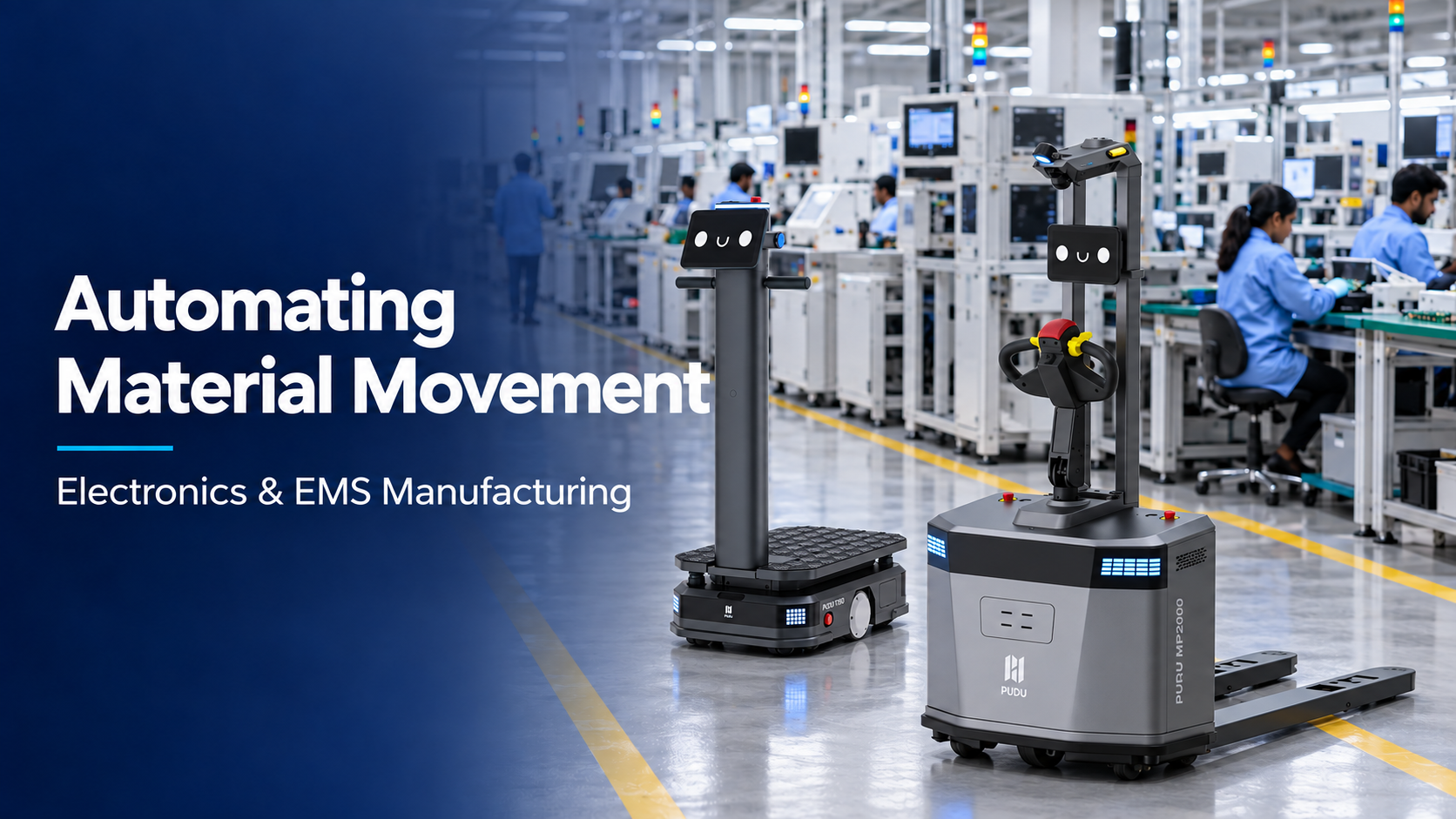
Material Handling Automation in Electronics Manufacturing in India
Electronics manufacturing depends on materials reaching the right place at the right time. From components in the warehouse to finished products ready for dispatch, every stage requires organised material movement.
Material handling automation in electronics manufacturing helps reduce repetitive transport work and delays between processes. Autonomous mobile robots (AMRs) can move suitable loads between departments, allowing employees to focus on production and quality.
This blog explains how electronics and EMS plants can automate material movement across warehouse, kitting, SMT, assembly, testing, and finished-goods areas—and what to consider before getting started.
Why Material Movement Matters in Electronics Manufacturing
An electronics production line can have advanced assembly machines and inspection systems yet still wait for a component reel, a prepared kit, or a batch of circuit boards. Keeping production moving depends on materials reaching the right location when they are needed.
Material handling automation in electronics manufacturing addresses the transport connecting these processes. Components move from the warehouse to kitting, prepared kits reach surface mount technology (SMT) lines, and work-in-progress continues through assembly, testing, and packing. Each transfer needs a clear destination, suitable handling, and confirmation that the next process is ready.
For Electronics Manufacturing Services (EMS) companies managing multiple customer orders and product variants, these movements can become difficult to coordinate. Urgent replenishment requests compete with routine deliveries, while employees spend time collecting trolleys and transporting materials between departments.
Autonomous mobile robots (AMRs) can take over suitable, repetitive transport routes. Depending on the configuration, they can carry materials, move compatible carts, or exchange loads with automated equipment. Their effectiveness depends on how well the pickup, delivery, and loading arrangements fit the production workflow.
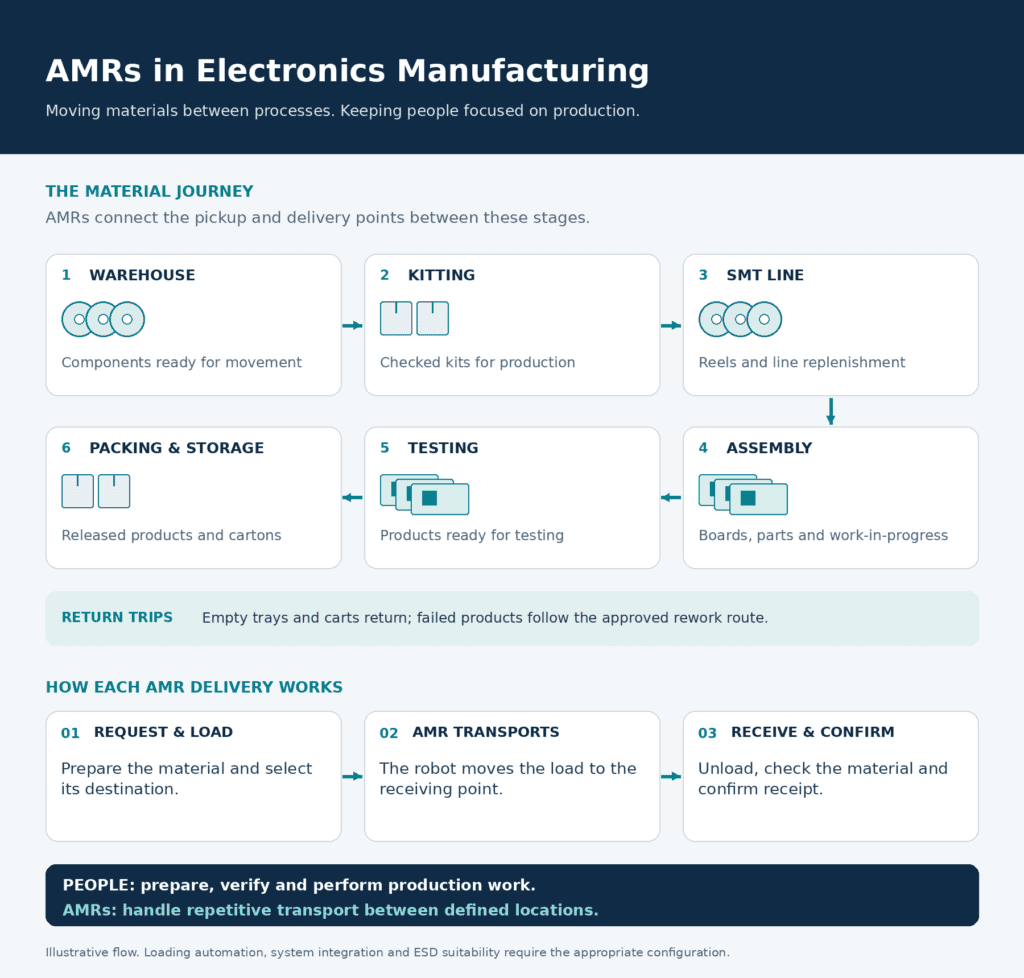
This guide follows the material journey from warehouse → kitting → SMT → assembly → testing → finished goods, explaining where AMRs fit and what an Indian electronics manufacturer should assess before deployment.
Map the Material Flow Before Selecting Automation
The first step is to understand how materials currently move through the plant. A route that looks straightforward on a floor plan may involve waiting for material release, locating an empty trolley, checking a kit, or finding space at the receiving station.
Observe the complete transfer—from the initial request to confirmed receipt. This helps identify whether the delay comes from transport, material preparation, or the receiving process.
Follow the Materials Through Each Production Stage
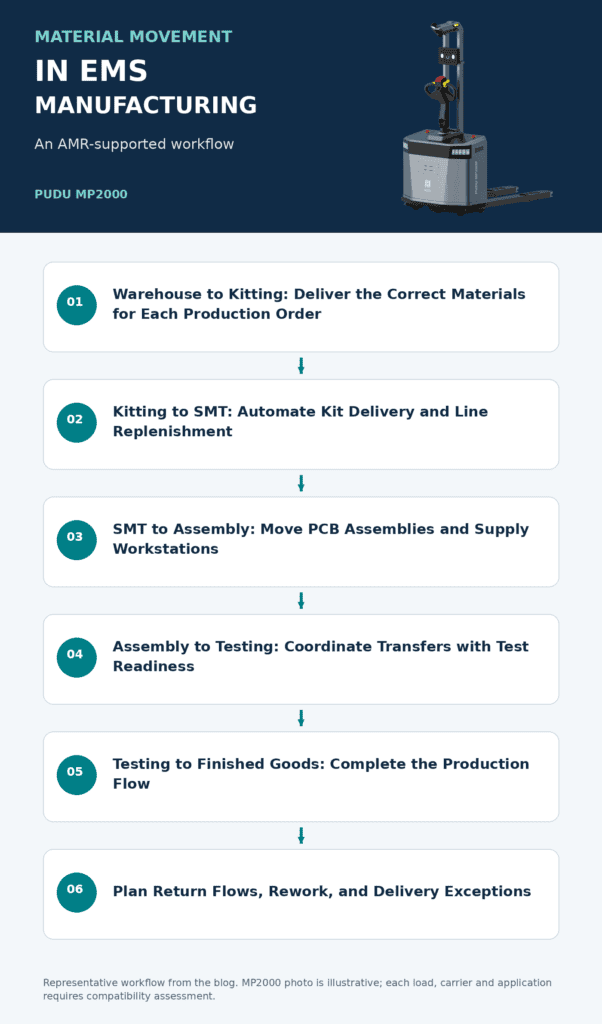
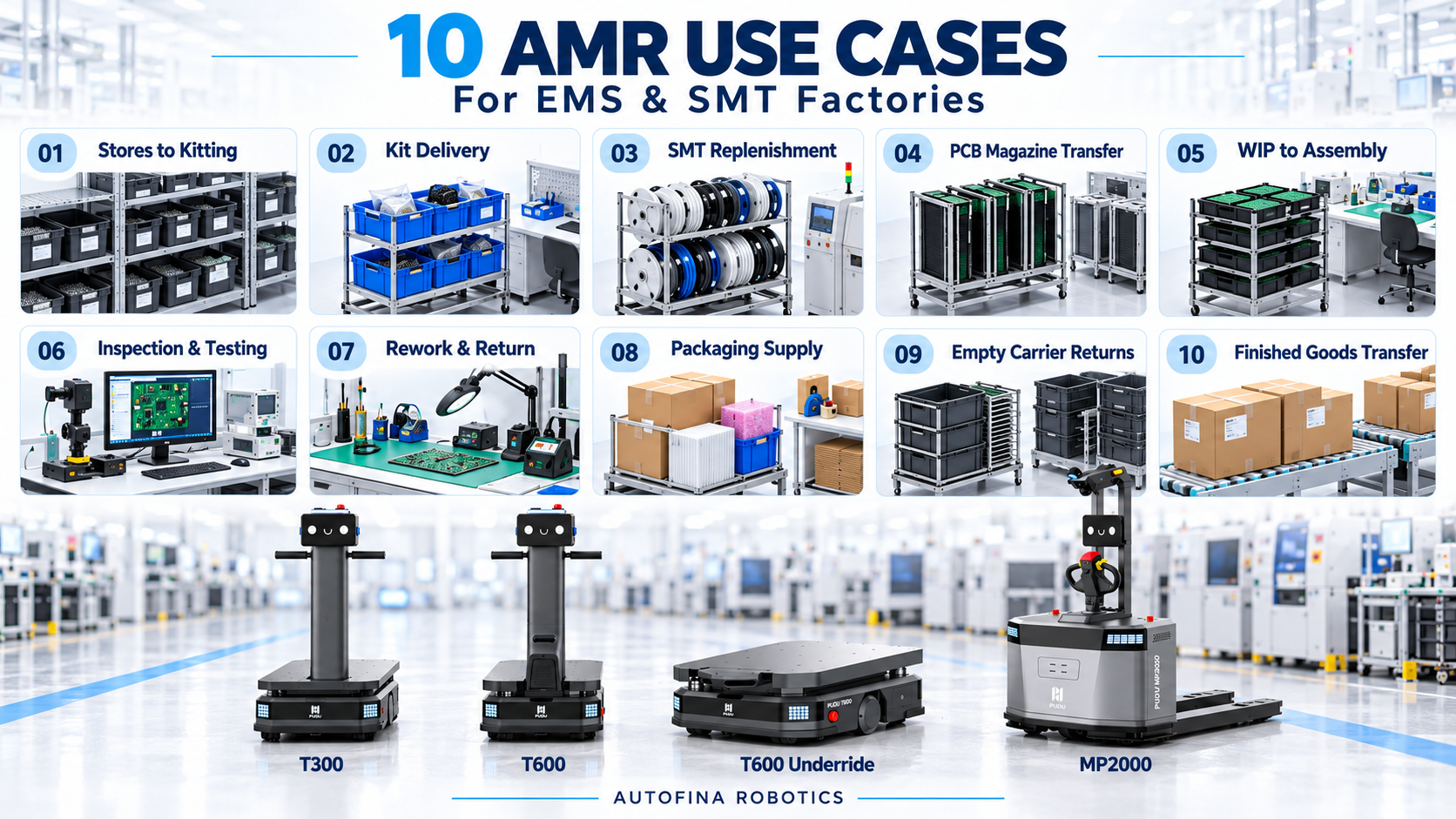
A representative electronics manufacturing workflow includes the following movements:
| Stage | Typical materials | Movement to evaluate |
|---|---|---|
| Warehouse | Component reels, bare PCBs, mechanical parts | Released materials from stores to kitting |
| Kitting | Verified materials grouped for a production order | Prepared kits to the assigned line |
| SMT | Component reels, feeder carts, PCB magazines | Line replenishment and transfers to downstream processes |
| Assembly | PCB assemblies, housings, cables, fasteners | Workstation supply and work-in-progress movement |
| Testing | Assembled products and tested units | Transfers to testing, rework, or the next approved process |
| Finished goods | Released products and packed cartons | Packing to storage or dispatch staging |
The actual sequence depends on the product. Some plants include coating, ageing, additional inspection, or multiple testing stages. These steps should appear in the material-flow map, together with return routes for unused components and empty carriers.
Record the Workload Behind Each Route
For every proposed route, record:
- Load: Material type, weight, dimensions, and carrier.
- Demand: Transfers per shift and peak request periods.
- Timing: Travel time, pickup waiting time, and unloading time.
- Responsibility: Who prepares, loads, receives, and verifies the material.
- Destination: Available receiving space and delivery deadline.
- Exceptions: Incomplete kits, occupied locations, or changes to production priorities.
These observations create a practical basis for selecting automation. A frequent transfer between two well-defined locations may be a suitable first application. A route regularly delayed by incomplete kits needs improvements in material preparation as well.
The aim is to establish a repeatable process that a robot can serve reliably.
Decide What to Automate: Transport, Cart Handling, or Equipment Transfer
Before choosing an AMR, define how materials will get onto and off the robot. Autonomous travel is one part of the workflow; loading, unloading, and delivery confirmation also need to be planned.
There are three common arrangements to consider.
Operator-Assisted Material Transport
An operator places materials on the robot or its approved carrier and starts the delivery task. The robot travels to the destination, where another operator unloads and confirms receipt.
This arrangement can be a practical starting point when people already prepare and receive materials at both ends. It reduces the need for an employee to accompany each load across the plant.
However, receiving staff must be available. If the robot waits too long for unloading, its capacity to serve other requests falls.
Automated Cart Pickup and Drop-Off
A suitably configured AMR collects a prepared cart, transports it, and releases it at a designated location. The mechanism may involve lifting or coupling, depending on the robot and carrier design.
This approach can support repeated movement of component kits, work-in-progress, and returnable carriers. Compatibility must be checked against the cart’s dimensions, weight, structure, coupling arrangement, and loaded stability.
Existing trolleys may need modification or replacement. The pickup and delivery areas also need enough space for reliable positioning and manoeuvring.
Integrated Transfer with Conveyors or Equipment
An AMR fitted with a compatible transfer module can exchange loads with a conveyor or production station. The systems coordinate readiness, positioning, transfer, and completion through the appropriate control interface.
This requires agreement on transfer height, load dimensions, alignment, sensors, and equipment signals. The workflow must also define what happens if the receiving station is occupied or a transfer is incomplete.
| Arrangement | Loading and unloading | Main planning requirement |
|---|---|---|
| Operator-assisted transport | Performed by people | Staff availability and completion confirmation |
| Automated cart handling | Compatible cart is collected and released | Carrier compatibility and docking space |
| Integrated equipment transfer | Load exchanged through automated interfaces | Mechanical alignment and coordinated controls |
The best choice follows the application. A short, fixed connection between adjacent machines may suit a conveyor. Flexible deliveries across several departments may suit an AMR. If delays arise because materials are not prepared on time, that process should be addressed before transport is automated.
Warehouse to Kitting: Deliver the Correct Materials for Each Production Order
Warehouse-to-kitting movement connects stored inventory with production preparation. In an EMS plant, this can involve component reels, bare printed circuit boards (PCBs), connectors, and other parts required for a specific production order.
The transport task should begin once the materials are ready for movement. Sending a robot before picking and verification are complete creates waiting at the warehouse.
Prepare and Identify the Load
Warehouse personnel or an automated storage system retrieve the required materials. The applicable checks confirm their identity, quantity, and release status before they are placed in suitable containers or carriers.
Associate the load with a clear identifier, such as a kit, trolley, or production-order reference. This allows the receiving team to connect the delivery with the work being prepared.
Where barcode scanning or software integration is used, the identifier can also link the physical load with its transport record. The level of traceability depends on the systems and verification steps implemented.
Create the Transport Request
Once the load is ready, an operator or connected system requests delivery to the assigned kitting station.
A typical workflow is:
Materials picked and checked → load identified → transport requested → pickup completed → delivery received and confirmed.
For an initial deployment, an operator may select a predefined destination. With suitable integration, a warehouse or manufacturing system can generate the request using the relevant order and location information.
The AMR then carries the load—or moves a compatible prepared trolley—to the designated receiving point.
Confirm Receipt and Manage Exceptions
At kitting, the receiving team verifies the delivery and confirms completion through the agreed process. The robot can then accept another task or collect an available return carrier.
Define how exceptions will be handled before starting regular operation. Materials awaiting inspection should remain under the plant’s release controls. An incomplete kit should be clearly identified, and a destination change should follow an authorised update.
Illustrative example: Warehouse staff prepare a component trolley for a scheduled production order. Once it is checked and ready, an AMR transfers it to the assigned kitting bay. The receiving operator confirms arrival while the warehouse team continues preparing the next load.
The improvement comes from separating transport from material preparation while keeping responsibility for identification and receipt clear.
Kitting to SMT: Automate Kit Delivery and Line Replenishment
Once a kit is prepared, it needs to reach the correct surface mount technology (SMT) line in time for production. During the run, additional component reels and other materials may also be required. These deliveries must be coordinated with both the production schedule and actual consumption.
Deliver Prepared Kits to the Assigned Line
A kit should be identified against its production order and checked before a transport request is created. An AMR can then carry the materials or move a compatible trolley to the designated receiving point.
At the line, an operator or integrated verification system confirms that the delivered kit matches the scheduled job. Transport completion and material acceptance should be clearly defined, especially when several lines manufacture different products.
Replenish Materials Before They Run Out
SMT line replenishment can begin with an operator request or, where supported, a signal from a connected production system. The request needs enough lead time for material preparation, pickup, travel, and receipt.
The workflow should account for:
- Routine replenishment during production.
- Prepared kits for an upcoming changeover.
- Urgent requests that need higher priority.
- Available space at the receiving location.
Delivering reels or feeder carts to a line does not automatically include installing them in the SMT equipment. That remains a separate operation unless specifically automated.
Illustrative example: A line operator requests a replacement component reel before the current supply is exhausted. Stores prepare and verify the material, and an AMR delivers it to the line’s receiving point. The operator checks the reel before use, while the delivery is recorded as complete.
SMT to Assembly: Move PCB Assemblies and Supply Workstations
After SMT and the required process checks, PCB assemblies move towards their next operation. Depending on the product, this may involve further component insertion, coating, mechanical assembly, or another inspection stage.
Work-in-progress transport automation helps organise these transfers between departments. The route should follow the approved production sequence for each product.
Use Suitable Carriers for PCB Assemblies
Boards need carriers that support and separate them appropriately during movement. Depending on the application, these may be PCB magazines, compartmented trays, or purpose-designed racks.
Before introducing an AMR, check that:
- The carrier holds the boards securely.
- Loading and unloading do not expose components to avoidable contact.
- The loaded carrier remains stable during starts, stops, and turns.
- The complete handling arrangement meets the applicable ESD requirements.
Robot speed and route settings should be validated with the actual load and floor conditions.
Coordinate Delivery with Assembly Readiness
The receiving station needs space for the incoming batch. Moving materials faster will not improve the workflow if they accumulate around assembly benches.
Define a receiving position or buffer, confirm availability, and identify the batch at handoff. Where production systems are integrated, the destination can be assigned using the relevant order or routing information.
AMRs can also supply assembly areas with housings, cables, connectors, and fasteners, using suitable containers and separate material identification.
Illustrative example: A released batch of PCB assemblies is placed in a compatible carrier. Once the assigned assembly cell has space, an AMR transfers the batch to its receiving point. Empty carriers are collected through a planned return task.
Assembly to Testing: Coordinate Transfers with Test Readiness
Assembled products may require electrical, functional, or other product-specific tests before progressing. Material movement should match the availability and capacity of these testing areas.
Sending every completed batch immediately can create congestion. A defined receiving buffer and a clear request process help control the flow.
Send Each Batch to the Correct Test Location
When a batch is ready, an operator or connected manufacturing system creates a transport request. The request should identify the load, its destination, and any priority or handling requirements.
Depending on the traceability process, identification may be maintained at tray, batch, or individual-unit level. An AMR task record alone does not establish product-level traceability; the material identifiers must be linked through the appropriate checks or system integration.
At delivery, the receiving team or equipment interface confirms the handoff.
Route Products According to Their Test Status
After testing, the quality system or an authorised operator determines the next destination. Passed products may move to another production stage or packing. Failed units may require diagnosis, rework, and retesting.
The transport workflow should preserve this distinction:
| Product status | Possible next movement |
|---|---|
| Passed and released | Next approved process or packing |
| Failed | Designated diagnosis or rework area |
| Awaiting a decision | Controlled holding location |
| Reworked | Required inspection or retesting station |
The robot carries out the assigned transfer; it does not decide whether a product has passed.
Illustrative example: A completed assembly tray is delivered to an available test buffer. After testing and release, a new task sends the accepted units onward, while failed units remain identified for a separate rework movement.
Testing to Finished Goods: Complete the Production Flow
Once products have completed the required checks and are released, they can move towards packing and finished-goods storage. This final part of the workflow may involve different load sizes and carriers from those used earlier in production.
AMR selection should therefore account for both the product and its packaging.
Connect Product Release with Packing
Transport requests should follow the plant’s release process. Products awaiting approval need to remain clearly separated from those authorised for packing or onward movement.
An AMR can deliver released units in suitable trays or carriers to an assigned packing location. Packing stations may also need regular supplies of cartons, inserts, labels, and other materials, which can be included as separate replenishment tasks.
Move Packed Goods to the Correct Location
After packing, cartons can be transported to a defined storage or dispatch-staging position. Check the total load dimensions, weight, stability, and receiving arrangement before choosing the handling configuration.
| Movement | Main requirement |
|---|---|
| Released products to packing | Product identification and protective handling |
| Packaging supplies to packing | Timely replenishment and suitable containers |
| Packed cartons to storage | Stable loading and correct destination |
| Palletised goods to staging | Equipment compatible with the pallet and load |
Delivery to dispatch staging and loading a truck are separate applications. Vehicle loading requires its own equipment and site assessment.
Illustrative example: A packing team completes and identifies a carton batch. An AMR transfers it to the assigned finished-goods location, where receipt is confirmed. This allows packing personnel to continue working without accompanying the load across the plant.
Plan Return Flows, Rework, and Delivery Exceptions
Material movement in an EMS plant includes frequent return journeys. Empty PCB magazines need to reach the next loading point, unused components must return through the approved process, and failed products may travel back for rework.
Including these movements in the automation plan helps prevent shortages of carriers and unnecessary accumulation around workstations.
Organise Return Movements
Define collection points and responsibilities for:
- Empty trays, magazines, and trolleys.
- Unused component reels after changeovers.
- Products awaiting rework or retesting.
- Reusable packaging and approved returnable containers.
Unused materials may need quantity reconciliation, identification checks, and storage-status updates before returning to stock. Transport automation should fit around these controls.
Where practical, a robot can collect an available return load after completing a delivery. This depends on carrier compatibility, task priority, and the readiness of both locations.
Define What Happens When a Task Cannot Continue
Each exception needs an agreed response and a responsible person or team.
| Situation | Response to define |
|---|---|
| Material is not ready at pickup | Hold or reschedule the request and notify the preparation team |
| Receiving position is occupied | Wait at an approved location or use an authorised alternative |
| Load identification does not match | Pause the handoff and request verification |
| A route is blocked | Apply the configured waiting, alternative-route, or escalation process |
| Production priority changes | Update the task through an authorised control |
| Communication is interrupted | Follow the tested recovery procedure for that system |
These behaviours should be checked during the pilot. A useful deployment test includes routine deliveries, peak demand, occupied destinations, and recovery from interrupted tasks.
Clear exception handling helps operators understand when to intervene and how to resume material movement without losing track of the load.
Protect Electronic Materials During Transport
Material handling automation in electronics manufacturing must preserve the condition, identity, and release status of each load. Reaching the destination is only one part of a successful transfer.
Verify the Complete ESD Handling Arrangement
Electrostatic discharge (ESD) can damage sensitive electronic components. Where ESD controls apply, assess the robot, carrier, containers, contact surfaces, and transfer points as a complete arrangement.
A robot’s ability to navigate a factory does not establish its suitability for an ESD-protected area. The proposed configuration should be reviewed and validated against the plant’s ESD control requirements before use.
Secure Boards and Assemblies Against Movement
Use carriers that prevent boards from sliding, contacting one another, or placing pressure on exposed components. Validate the loaded arrangement across the actual route, including floor joints, turns, acceleration, and stopping.
Protective handling should also extend to pickup and unloading. A stable journey cannot compensate for a poorly designed handoff.
Maintain Material Controls and Traceability
For moisture-sensitive components, movement must remain within the applicable storage and exposure controls. Time spent waiting at pickup, in transit, and at the receiving buffer may need to be accounted for under the plant’s process.
Material identification should remain attached to the load throughout the journey. Where digital traceability is required, connect the transport event with the relevant material, batch, or production-order record.
Quality-held and rejected materials also need clearly controlled destinations to prevent unintended use.
Match Cleanliness to the Process
Cleanliness requirements vary between electronics assembly areas and specialised manufacturing environments. Assess the actual process before specifying robot or carrier requirements.
Document these handling conditions during the site study so that material protection forms part of the deployment acceptance criteria.
Connect Material Requests with Factory Systems
An AMR needs a clear instruction: what to collect, where to deliver it, and when the movement is required. A plant can begin with operator-requested deliveries and introduce system integration as the workflow develops.
The starting point is to define how a production requirement becomes a transport task.
Begin with a Clear Request and Confirmation Process
For a simple deployment, an operator can request a predefined delivery through a supported interface. Materials are prepared at the pickup location, and the receiving team confirms arrival after unloading.
As demand increases, connected systems can generate requests using warehouse activity, production status, or equipment signals. Each request should include the information needed to complete and track the transfer.
| Information | Purpose |
|---|---|
| Task ID | Identifies the transport request |
| Pickup and destination | Specifies where the load must move |
| Load or carrier ID | Connects the task with the physical material |
| Priority and required delivery time | Supports task scheduling |
| Pickup readiness | Confirms the material is available |
| Delivery confirmation | Records completion of the handoff |
Define Each System’s Responsibility
An Enterprise Resource Planning system (ERP) manages business information such as production orders and material requirements. A Warehouse Management System (WMS) manages stock locations and warehouse transactions. A Manufacturing Execution System (MES) tracks production activity and process status.
Fleet management software assigns transport tasks to robots and coordinates their operation. Equipment interfaces may provide signals confirming that a conveyor or station is ready to exchange a load.
A connected workflow could follow this sequence:
Production request → material prepared → AMR task assigned → pickup confirmed → delivery confirmed → relevant records updated.
The exact responsibility for each step should be agreed during integration. A completed robot mission, for example, should not automatically mark material as consumed unless the manufacturing process explicitly requires that transaction.
Plan for Connectivity and Recovery
Confirm the selected system’s Wi-Fi coverage, hosting requirements, access permissions, and behaviour during communication interruptions. Internet access and local network connectivity are separate requirements and should be assessed for the proposed configuration.
The integration should also handle duplicate requests, cancellations, and incomplete confirmations. These details help prevent the same load being requested twice or a delivery being recorded before the receiving team has accepted it.
Deploy AMRs in an Existing Indian EMS Plant
Introducing AMRs into an operating electronics plant requires coordination between production, warehouse, quality, maintenance, and IT teams. The deployment must fit around existing equipment, material controls, and production commitments.
A phased approach allows the team to validate one application before extending automation to other routes.
Select a Suitable First Route
Start with a movement that happens regularly, has defined pickup and delivery points, and can be measured. Warehouse-to-kitting delivery or a repeated WIP transfer may provide a manageable starting point.
Record the current workload across representative shifts. Include peak demand, waiting time, loading effort, and any production delays associated with the route.
Check the Site with the Actual Load
Assess the complete robot-and-load arrangement. A robot may fit through an aisle while its loaded trolley needs more turning space.
The site review should cover:
- Loaded dimensions, turning clearance, and docking space.
- Floor joints, transitions, ramps, and thresholds.
- Pedestrian traffic and interaction with other vehicles.
- Pickup, receiving, and waiting locations.
- Doors or lifts requiring integration.
- Network coverage and charging locations.
- Material protection and ESD requirements where applicable.
Use the actual carrier and representative loads during trials. Confirm that loading, travel, and unloading can all be completed reliably.
Introduce the Workflow Around Production
Agree installation and testing windows with the plant team. Assign responsibility for preparing loads, confirming receipt, responding to alerts, and recovering interrupted tasks.
Training should cover routine operation as well as common exceptions. Operators need to know how to request a delivery, cancel an incorrect request, report a problem, and use the approved recovery procedure.
Maintenance teams should understand inspection requirements, charging arrangements, service escalation, and access to replacement parts.
Expand After Validation
Review performance under normal and peak operating conditions before adding routes or robots. If the pilot shows excessive waiting at pickup or unloading, resolve that issue first.
For an Indian EMS facility operating multiple shifts, the assessment should also confirm support availability, maintenance ownership, and charging coverage across the intended operating hours. Expansion should follow demonstrated demand and measured performance.
Measure Capacity, Savings, and Pilot Performance
The business case for material handling automation in electronics manufacturing begins with the current process. Measure how much work the route requires and identify which part an AMR can realistically take over.
Robot trip counts are useful, but they do not explain whether materials arrived on time or whether employees spent less time on transport.
Establish the Baseline
Consider this illustrative calculation:
120 transfers per shift × 4 minutes of hands-on transport per transfer = 480 minutes, or 8 person-hours per shift.
This represents the combined transport workload. It does not necessarily mean one employee can be removed from the process. The work may be distributed across several people, and loading, verification, or unloading may remain manual.
If the measured hands-on time falls to 1.5 minutes per transfer after deployment, the same workload would require 3 person-hours. The difference—5 person-hours per shift—represents capacity released for other activities under those assumptions.
Separate the Types of Benefit
Evaluate benefits in three categories:
| Benefit | What to measure |
|---|---|
| Employee capacity released | Reduction in time spent accompanying or moving loads |
| Cash savings | Actual reduction in overtime, external labour, or other expenditure |
| Production improvement | Measured reduction in material-related waiting or increase in usable output |
Avoid counting the same benefit twice. Employee time reassigned to production is not automatically a payroll saving. Additional output has financial value only where the plant can use or sell that capacity.
Include the Complete Project Cost
The cost assessment should include the robot, carriers or attachments, integration, site preparation, commissioning, training, and recurring support. Battery replacement, maintenance, software charges, and energy costs should be included where applicable.
For a simple cash-payback calculation:
Payback period = total initial project cost ÷ annual net cash benefit.
Use consistent assumptions and show which figures come from measurements, quotations, or estimates.
Agree Pilot Acceptance Criteria
Set targets before the pilot begins.
| Metric | What it shows |
|---|---|
| On-time delivery rate | Whether production deadlines are met |
| Request-to-delivery time | Responsiveness of the complete workflow |
| Transfers completed per shift | Coverage of normal and peak demand |
| Manual interventions | Reliability and remaining operator effort |
| Pickup and unloading delays | Bottlenecks around the robot |
| Material condition and identification | Quality of the handling process |
| Availability across shifts | Coverage after charging and maintenance |
A useful pilot demonstrates that the complete process works repeatedly with representative loads, traffic, and production demand.
Select the Right AMR and Implementation Partner
AMR selection should follow the material-flow study. Payload capacity is one consideration, alongside load dimensions, carrier compatibility, handoff method, route conditions, and delivery frequency.
A suitable robot must meet the requirements of the complete transfer.
These considerations guide material handling automation in electronics manufacturing.
Match the Configuration to the Application
| Requirement | What to confirm |
|---|---|
| Material and payload | Total transported weight, dimensions, and load stability |
| Carrier | Compatibility with trays, racks, trolleys, or pallets |
| Loading method | Operator-assisted, automated cart handling, or equipment transfer |
| Route | Loaded clearance, turning space, floor conditions, and traffic |
| Throughput | Ability to meet peak requests, including waiting and return travel |
| Material protection | Applicable ESD, cleanliness, and handling requirements |
| Charging | Coverage of the intended shift pattern |
| Integration | Supported interfaces and responsibility for implementation |
Ask for a demonstration using representative loads and carriers. An unloaded demonstration confirms much less about the intended production application.
For PUDU industrial delivery solutions, including the T300, the proposed configuration should be checked against the actual material, carrier, route, and handoff requirements. The assessment should establish which functions are included and which require accessories or additional integration.
Evaluate the Deployment Scope
A proposal should explain who is responsible for carrier modifications, mapping, equipment interfaces, network preparation, commissioning, and training.
It should also define acceptance criteria and the process for resolving issues identified during trials. This gives the plant and supplier a shared understanding of what constitutes a working deployment.
Assess Support After Commissioning
Discuss service availability, preventive maintenance, spare parts, software support, and operator training. Clarify how changes to production routes, carriers, or layouts will be assessed.
Ongoing support should form part of the implementation plan for material handling automation in electronics manufacturing.
Frequently Asked Questions
Which Material Movements Should an EMS Plant Automate First?
Start material handling automation in electronics manufacturing with frequent, measurable transfers between defined locations. The strongest candidates have prepared loads, suitable carriers, and clear receiving arrangements. Warehouse-to-kitting deliveries, line replenishment, and repeated WIP transfers are useful routes to assess.
Can AMRs Transport Component Reels and PCB Magazines?
Yes, when the robot and carrier configuration are suitable for the load. Check restraint, stability, handling conditions, and applicable ESD requirements. The proposed arrangement should be tested with representative materials before regular production use.
Can Existing Factory Trolleys Be Used?
Sometimes. Compatibility depends on the robot’s handling mechanism and the trolley’s dimensions, structure, weight, wheels, and coupling or lifting arrangement. Some trolleys can be adapted; others may need replacement. Confirm this through a physical assessment.
Does an AMR Automatically Load and Unload Materials?
This depends on the configuration. A basic transport workflow may require people at both ends. Automated cart collection or conveyor transfer requires compatible hardware, defined docking locations, and the appropriate controls.
What ESD Checks Are Required?
The plant’s ESD team should assess the complete handling arrangement against its control requirements. This includes the robot, carrier, containers, contact surfaces, and transfer points. A general industrial AMR specification alone does not establish ESD suitability.
Is MES Integration Necessary to Begin?
Not always. A plant can start with supported operator-requested deliveries between predefined locations. MES or WMS integration becomes useful when transport requests and confirmations need to follow production or inventory events automatically.
How Many AMRs Will the Plant Need?
Fleet size depends on peak delivery demand and the complete task cycle: pickup, loading, travel, unloading, return movement, and charging. Measure these activities and include realistic traffic and waiting conditions. Payload capacity alone cannot determine the number of robots required.
How Should an AMR Pilot Be Evaluated?
Evaluate a pilot for material handling automation in electronics manufacturing against an agreed baseline using on-time deliveries, response time, completed transfers, manual interventions, material condition, and shift coverage. Include exception handling and peak demand so the results reflect the intended operating conditions.
Conclusion: Start with One Validated Route
Material handlng automation in electronics manufacturing can help connect warehouse, kitting, SMT, assembly, testing, and finished-goods operations through organised, repeatable transfers.
Successful deployment begins with understanding the load and the workflow. Each route needs prepared materials, suitable carriers, clear pickup and delivery points, and defined responsibilities for verification and exceptions.
Start with one route that can be measured. Establish the current workload, test the proposed arrangement under production conditions, and review the results before expanding. This gives the plant a practical foundation for wider AMR adoption.
Planning material movement automation for your electronics or EMS plant?
Tell us about your facility and cleaning challenges. We provide Pan India support and installations. Our team at Autofina Robotics will propose routes, coverage estimates, and ROI.
Email: [email protected]
Phone: +91 98192 22944
Pingback: AGV vs AMR for Electronics Manufacturing: Which Should Indian Manufacturers Buy?