



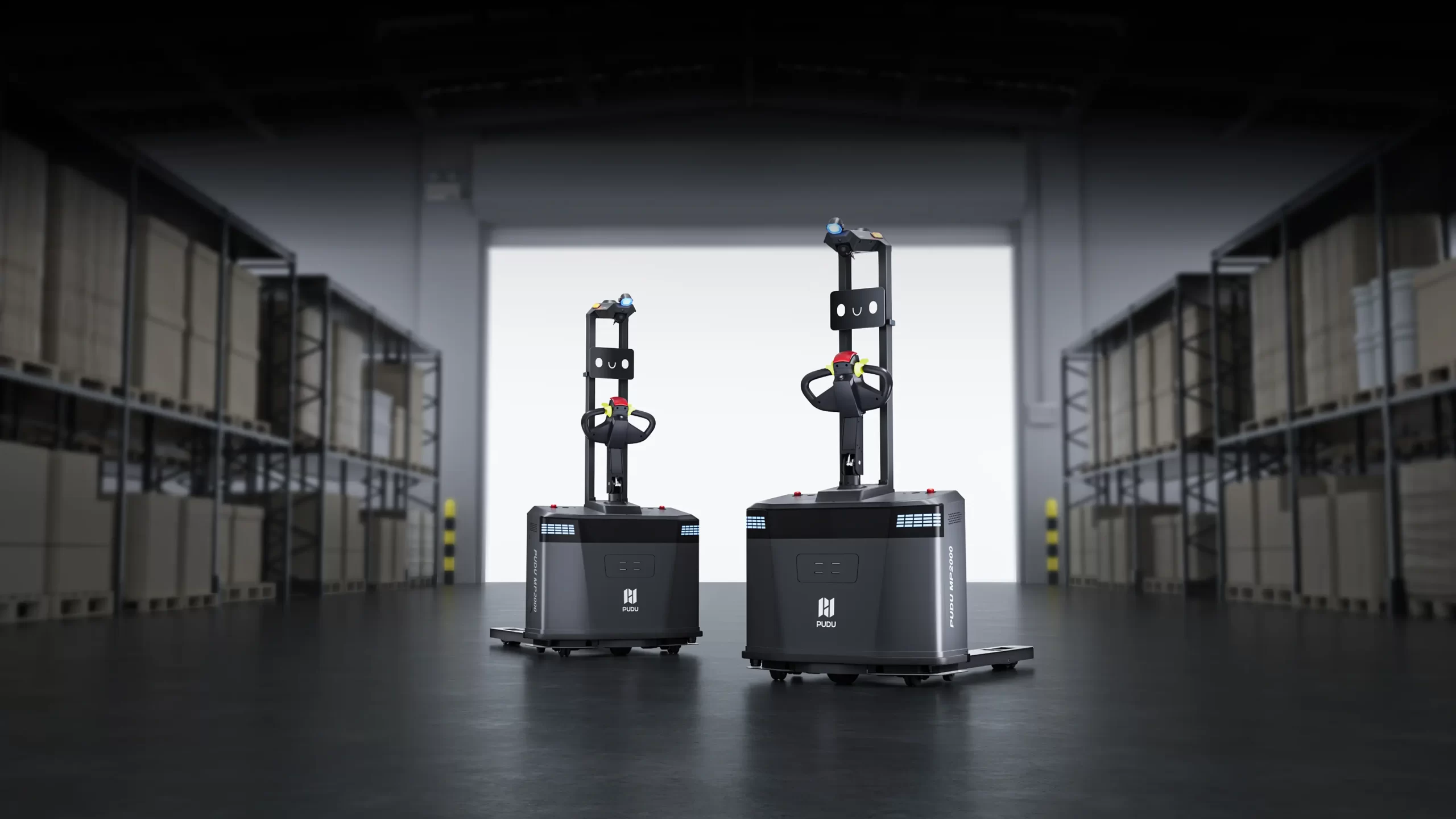
PUDU MP2000: AI Pallet Handling Robot for Industrial Logistics
PUDU Robotics has expanded its industrial automation portfolio with the newly launched PUDU MP2000, an AI-native autonomous pallet handling robot designed specifically for manufacturing facilities, warehouses, and logistics operations.
Unlike conventional delivery robots that primarily transport materials from one location to another, the MP2000 is built to automate a much larger part of the pallet-handling process. With a 2,000 kg payload capacity, AI-based pallet recognition, adaptive fork alignment, autonomous pickup and placement, intelligent load assessment, advanced navigation, and fleet coordination, it is designed to handle real industrial material-flow requirements with minimal manual intervention.
The MP2000 can recognise pallets, adjust to pallets that are not perfectly positioned, insert its forks, lift and transport heavy loads, navigate through narrow industrial spaces, identify storage locations, and autonomously place pallets at their destination.
In this blog, we take a closer look at the PUDU MP2000 pallet handling robot, its major functions and technologies, how it differs from PUDU’s conventional industrial delivery robots, and where it can add the most value across manufacturing, warehousing, and logistics environments.
Pallet Movement Is More Than Point-to-Point Delivery
Industrial material movement is often viewed as a simple transportation task: pick up a load at one location and deliver it to another. In reality, pallet handling involves several additional steps before and after transportation. The pallet must first be identified, approached correctly, aligned with the forks, lifted safely, transported through the facility, and then accurately placed at its destination.
Traditional autonomous delivery robots are mainly designed to move materials once the load has already been placed on the robot or prepared for transportation. Pallet handling is more complex because the robot must interact directly with the load itself.
The PUDU MP2000 pallet handling robot has been developed to automate much more of this process. With a maximum payload capacity of 2,000 kg, the MP2000 combines autonomous navigation with AI-powered pallet recognition, adaptive fork alignment, intelligent load assessment, autonomous pickup and placement, and storage-location detection.
Instead of automating only the journey between two locations, MP2000 is designed to automate the wider pallet-handling cycle, including:
- Identifying the correct pallet or load carrier
- Detecting its actual position
- Aligning the robot and forks with the pallet
- Compensating for pallet displacement or angular misalignment
- Inserting the forks and lifting the load
- Assessing the clearance required for the pallet being carried
- Navigating autonomously through the facility
- Identifying the correct destination or storage position
- Placing the pallet at the required location
This makes MP2000 more than a conventional industrial delivery robot. It is designed as an AI-native autonomous pallet handling system for manufacturing facilities, warehouses, logistics centres, and other industrial environments where heavy pallet movement forms an important part of daily operations.
Meet the PUDU MP2000
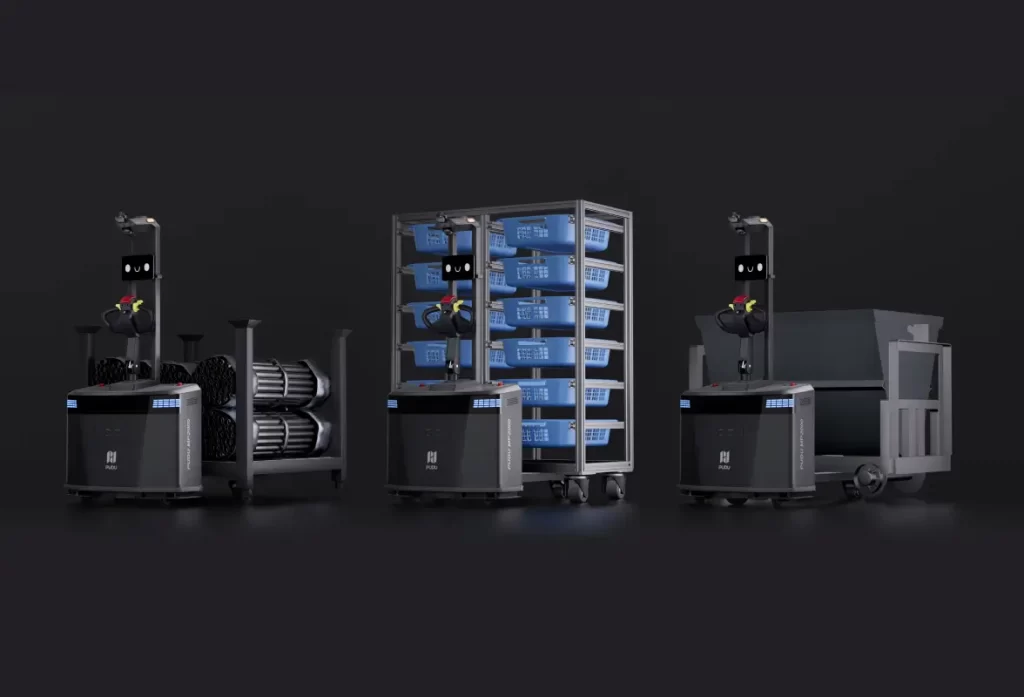
The PUDU MP2000 is an AI-native autonomous pallet handling robot designed specifically for heavy-duty industrial material movement. It combines a 2,000 kg maximum payload capacity with autonomous pallet recognition, fork alignment, load handling, navigation, and storage-location detection.
Unlike conventional delivery AMRs, the MP2000 is not limited to transporting a load that has already been placed on the robot. It is designed to participate directly in the pallet-handling process by recognising the pallet, approaching it correctly, inserting its forks, lifting the load, transporting it, and placing it at the required destination.
Key MP2000 Capabilities
The MP2000 combines several technologies within one autonomous platform:
- AI load-carrier recognition
- AI storage-location detection
- Adaptive fork alignment
- Autonomous pallet pickup and placement
- Intelligent load and clearance assessment
- 3D LiDAR-SLAM and VSLAM navigation
- Multi-layer safety perception
- Distributed fleet orchestration
- IoT and workflow integration
- Autonomous and manual operating modes
These functions allow the robot to handle more of the material-flow process without requiring workers to manually position every pallet or constantly supervise each pickup and drop-off.
Two MP2000 Configurations
PUDU offers the MP2000 in two fork configurations to support different pallet and load-carrier requirements:
- MP2000 Standard – MPID01-M: 620 mm fork outer width
- MP2000 Narrow Fork – MPID01-N: 550 mm fork outer width
Both versions support a maximum load of 2,000 kg and are designed for autonomous pallet transport and floor-level pallet handling.
The robot can also operate for up to 12 hours when unloaded and up to 6 hours at maximum load, making it suitable for repeated material-transfer tasks across warehouses, manufacturing facilities, and logistics operations.
Overall, the MP2000 is best understood not simply as a heavy-duty delivery robot, but as an autonomous pallet-handling platform capable of recognising, engaging, transporting, and placing palletised loads as part of a larger industrial workflow.
More Than Delivery: Recognise, Pick, Move and Place
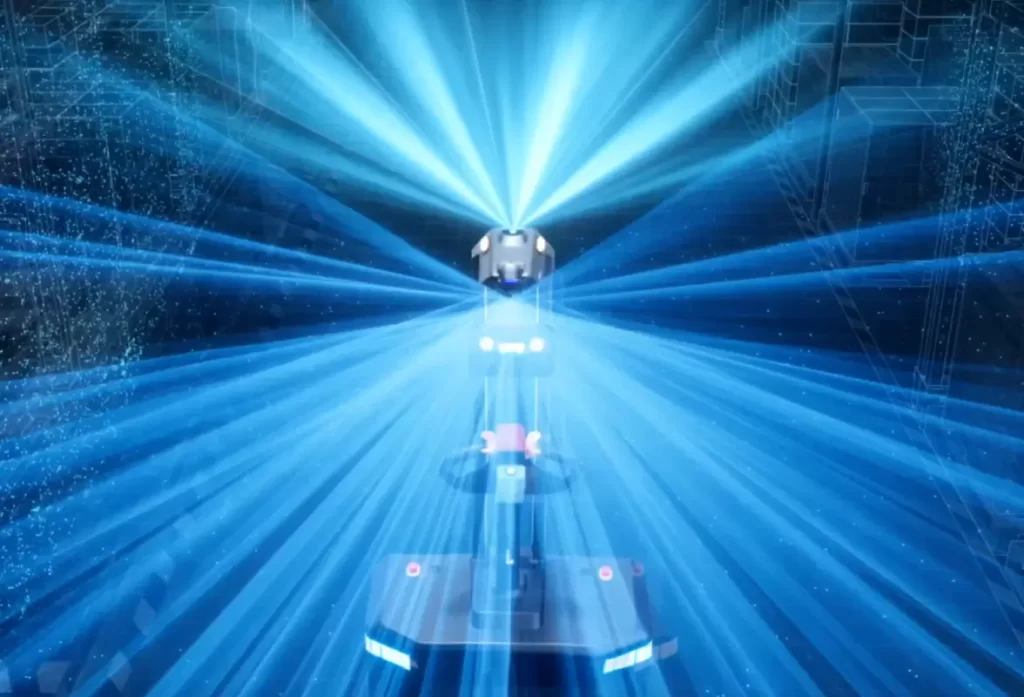
One of the biggest differences between the PUDU MP2000 pallet handling robot and a conventional industrial delivery robot is what happens before and after transportation.
A standard AMR typically moves a load once that load has already been placed on the robot, trolley, rack, or carrier. The MP2000 is designed to go a step further by interacting directly with the pallet itself.
AI Load-Carrier Recognition
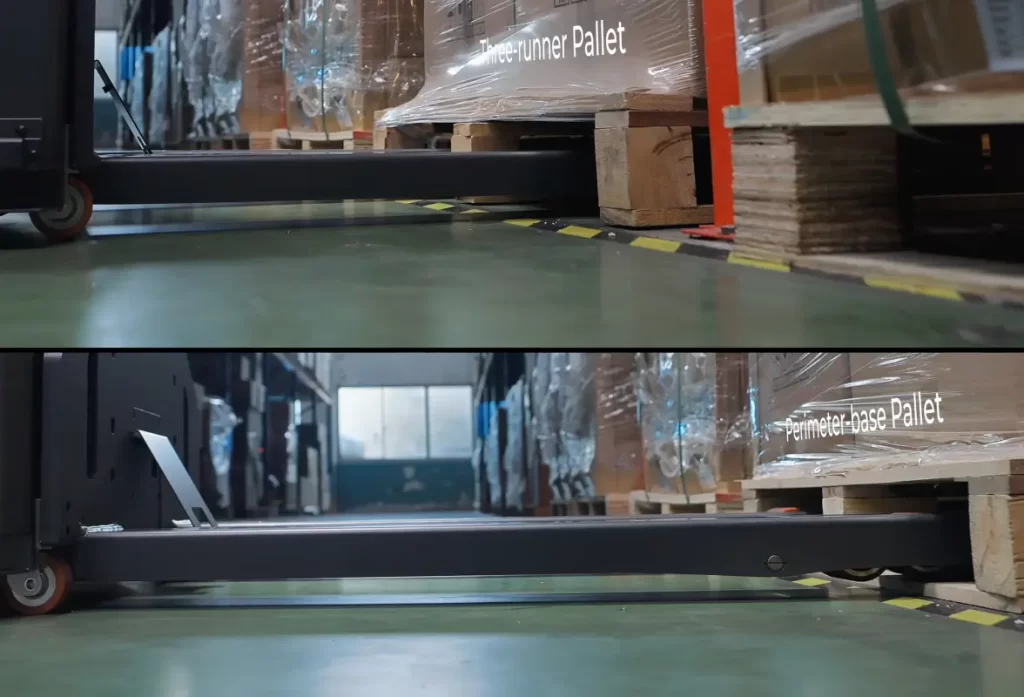
The MP2000 can recognise different pallet and load-carrier formats, including:
- Three-runner pallets
- Perimeter-base pallets
- Non-standard load carriers that can be learned by the system
This gives the robot greater flexibility in environments where pallet types are not always completely uniform.
AI Storage Detection
The robot can also identify the condition and position of storage locations before completing a pickup or placement task.
This includes:
- Detecting whether a storage location is occupied
- Identifying the pallet position
- Selecting the correct pickup or drop-off target
- Planning the approach to the storage position
This reduces the need for operators to manually confirm each pallet location before every task.
Autonomous Pallet Pickup
Once the target pallet has been identified, MP2000 can approach the load, align itself with the pallet openings, insert the forks, and lift the pallet for transport.
The process can include:
- Detecting the pallet
- Identifying its real position
- Correcting the robot’s approach
- Aligning the forks
- Inserting the forks
- Lifting the load
Autonomous Pallet Placement
At the destination, the robot can perform the reverse process by identifying the required storage or drop-off position, approaching it correctly, and placing the pallet at the designated location.
This means the MP2000 is designed to automate a much broader material-handling cycle:
- Recognise
- Align
- Pick
- Lift
- Transport
- Position
- Place
The key difference is that the MP2000 does not simply transport a pallet between two locations. It is designed to automate the physical handling required to collect and place that pallet as part of the same autonomous workflow.
For manufacturing plants, warehouses, and logistics facilities, this makes the MP2000 particularly relevant for repetitive pallet-transfer processes where both transportation and load handling need to be automated.
When the Pallet Is Not Perfectly Positioned
Industrial environments are rarely perfectly controlled. Pallets may be placed slightly off-centre, left at an angle, or positioned differently from one task to the next. If an autonomous pallet robot required every load to be placed with exact precision, the automation would quickly become impractical.
The PUDU MP2000 pallet handling robot is designed to handle these real-world variations through adaptive pallet detection and fork alignment.
Up to 15 cm Positional Offset
MP2000 can adapt to pallets positioned up to 15 cm away from their expected location.
This means the robot does not depend on perfectly repeatable pallet placement before every pickup. If a pallet has been placed slightly to one side, the system can detect the actual position and adjust its approach accordingly.
Up to 15° Angular Misalignment
The system can also compensate when a pallet is rotated or angled by up to 15°.
This is useful in environments where pallets are placed manually by forklift operators or workers and may not always be perfectly square to the intended pickup direction.
Automatic Fork Alignment
Once the pallet’s real position has been detected, the robot adjusts its approach and aligns the forks with the pallet openings before beginning the pickup.
This process helps reduce the need for workers to:
- Reposition pallets before collection
- Manually straighten misaligned loads
- Precisely place every pallet within fixed markings
- Continuously supervise autonomous pickup operations
Approx. 20-Second Fork Insertion
PUDU states that MP2000 can complete fork insertion in approximately 20 seconds.
This helps create a faster and more repeatable pallet-handling cycle, especially in facilities where the same pickup and drop-off processes are repeated many times throughout a shift.
In practical terms, the MP2000 follows a simple adaptive workflow:
- Detect the pallet’s actual position
- Identify any offset or angle
- Adjust the robot’s approach
- Align the forks
- Insert and engage the pallet
- Lift the load
This ability to adapt to imperfect pallet placement is one of the features that makes MP2000 more suitable for real industrial environments, where pallet positions are not always identical from one operation to the next.
Intelligent Movement With the Load, Not Just the Robot
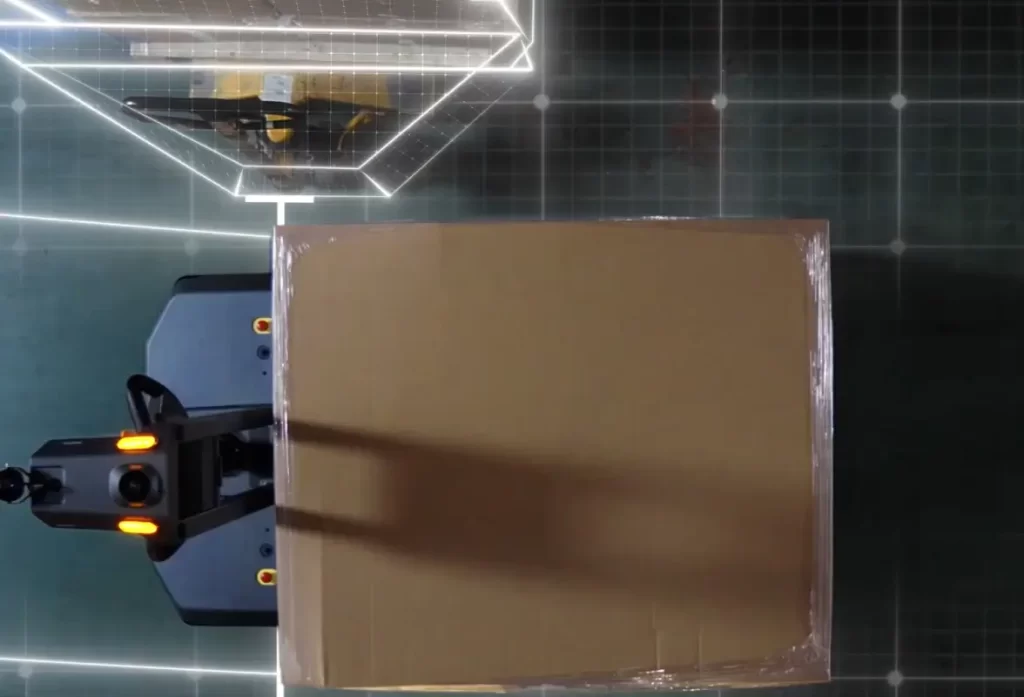
Moving an unloaded autonomous robot through a warehouse is one challenge. Moving the same robot while carrying a large pallet is another.
Once a pallet is lifted, the dimensions of the robot alone are no longer enough to determine whether a route is safe. The load may extend beyond the robot body, and different pallets may require different amounts of clearance depending on their size and shape.
The PUDU MP2000 pallet handling robot is designed to account for this through intelligent load and clearance assessment.
Load Dimension and Contour Detection
MP2000 can detect the dimensions and contours of the load it is carrying.
This allows the system to consider not only the robot chassis, but also the actual pallet and material being transported.
That is important because a safe route for the unloaded robot may not necessarily be safe once a wider or differently shaped load is being carried.
Intelligent Clearance Assessment
After detecting the load dimensions, MP2000 can assess the clearance required to move through the facility.
The route-planning process therefore considers questions such as:
- Is there enough width for the current load?
- Can the robot safely pass between nearby objects?
- Does the carried pallet extend beyond the normal robot footprint?
- Is a different route required because of the load size?
This makes the navigation process more suitable for facilities where pallet dimensions and load profiles may vary.
3D LiDAR-SLAM and VSLAM Navigation
MP2000 uses a combination of:
- 3D LiDAR-SLAM
- VSLAM
to support positioning, mapping, and autonomous navigation.
These technologies help the robot understand its surroundings and move through industrial environments where people, equipment, storage areas, and material positions may change throughout the day.
Handling Real Industrial Floor Conditions
The robot is also designed to handle common variations found in industrial facilities.
Published specifications include:
- Thresholds up to 10 mm
- Gaps up to 35 mm
- Gradeability up to 3° at full load
- Gradeability up to 8° when unloaded
These capabilities are important because factory and warehouse floors are not always completely flat or uniform.
The key difference is that MP2000 does not simply ask whether the robot itself can move through a route.
It considers whether the robot and the load together can move through that route safely.
That makes the MP2000 better suited to real-world pallet handling, where load size, positioning, and surrounding clearance can change from one task to the next.
Moving 2,000 kg Through Surprisingly Tight Spaces
Heavy-duty pallet handling usually demands space. Larger loads require wider turning areas, greater approach clearance, and enough room for the robot to align with the pallet safely.
The PUDU MP2000 pallet handling robot has been designed to handle substantial industrial loads while still operating in comparatively compact warehouse and factory layouts.
2,000 kg Maximum Payload
Both MP2000 configurations support a maximum load of 2,000 kg.
This makes the robot suitable for moving heavy palletised materials across:
- Manufacturing plants
- Warehouses
- Logistics centres
- Distribution facilities
- Production and storage areas
The high payload capacity places MP2000 in a different category from conventional industrial delivery robots designed for lighter carts, bins, shelves, or smaller material loads.
90° Pallet Pickup in Narrow Aisles
One of the more important MP2000 capabilities is its ability to perform 90° pallet pickup in aisles as narrow as approximately 2 metres.
Published right-angle stacking aisle requirements include:
- ≤ 2,000 mm for a 1,200 × 1,000 mm pallet
- ≤ 1,960 mm for a 1,200 × 800 mm pallet
This allows facilities to automate pallet movement without necessarily creating very large dedicated robot aisles.
Pallet Spacing Down to 15 cm
MP2000 can also operate with pallet spacing down to approximately 15 cm.
For warehouses and storage areas, this is important because increasing the space between every pallet purely for automation can reduce storage density.
The MP2000 is designed to work within tighter pallet layouts while still identifying and handling the required load.
Loaded and Unloaded Travel Speed
The robot can travel at speeds of up to:
- 1.6 m/s when unloaded
- 1.2 m/s when loaded
Combined with its approximately 20-second fork insertion, this supports faster and more repeatable pallet-transfer cycles.
Designed for Efficient Material Flow
The real advantage is not simply the robot’s top speed or maximum payload.
The combination of:
- Heavy-load handling
- Narrow-aisle operation
- Compact pallet spacing
- Adaptive pallet alignment
- Autonomous pickup and placement
allows MP2000 to support material movement in facilities where both throughput and space utilisation are important.
For industrial operations, this means pallet automation can be introduced without necessarily sacrificing valuable warehouse or production-floor space.
One Robot Is Useful. A Coordinated Fleet Changes Material Flow
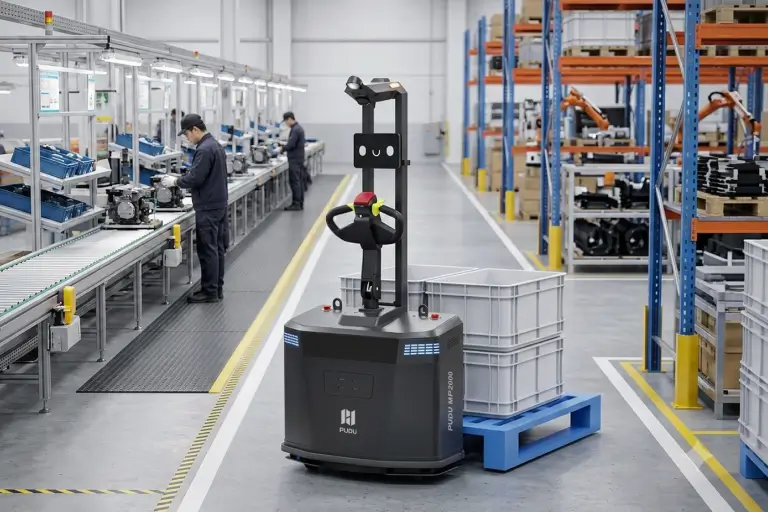
A single autonomous pallet handling robot can automate an individual material-transfer route. In larger factories, warehouses, and logistics facilities, however, several pallet movements may need to happen at the same time across different production lines, storage zones, and transfer points.
The PUDU MP2000 pallet handling robot is designed to support this type of larger-scale operation through distributed fleet orchestration. Multiple MP2000 units can work within the same facility while coordinating routes, tasks, and shared operating areas.
Robot-to-Robot Coordination
When several robots operate within the same environment, simply giving each robot an individual route is not enough. Their movements must be coordinated so that they do not unnecessarily block one another or create congestion around commonly used areas.
MP2000 fleet operation can support coordination of:
- Robot routes
- Shared pathways
- Pickup and drop-off zones
- Task movement
- Traffic between multiple robots
This allows the robots to work as part of the same material-flow system rather than operating as completely independent machines.
Intelligent Route Planning
As the number of autonomous robots increases, efficient routing becomes increasingly important.
Fleet coordination can help reduce:
- Route conflicts
- Robots blocking one another
- Unnecessary waiting time
- Congestion around common transfer points
- Inefficient movement through shared industrial areas
By continuously coordinating movement, the system can support smoother pallet flow across busy warehouses and manufacturing facilities.
Continued Fleet Coordination Offline
An important capability of the MP2000 fleet system is the ability to maintain coordinated operation even when external connectivity is unavailable.
This is particularly relevant in industrial environments, where core material-handling operations should not necessarily stop because of temporary cloud or external network interruptions.
Scaling From One Route to an Autonomous Material-Flow Network
The value of fleet coordination becomes clearer as pallet automation expands.
A single MP2000 may automate one repetitive transfer route. Multiple units can support interconnected workflows such as:
- Raw-material movement
- Line-side material supply
- Work-in-progress transfer
- Warehouse-to-production movement
- Movement between different storage zones
- Pallet transfer within distribution centres
This allows MP2000 to move beyond individual point-to-point tasks and become part of a wider autonomous material-flow network.
The objective is not simply to deploy more robots. It is to allow multiple robots to work together efficiently so that pallet movement across the facility becomes more coordinated, scalable, and consistent.
Safety Around People, Pallets and Equipment
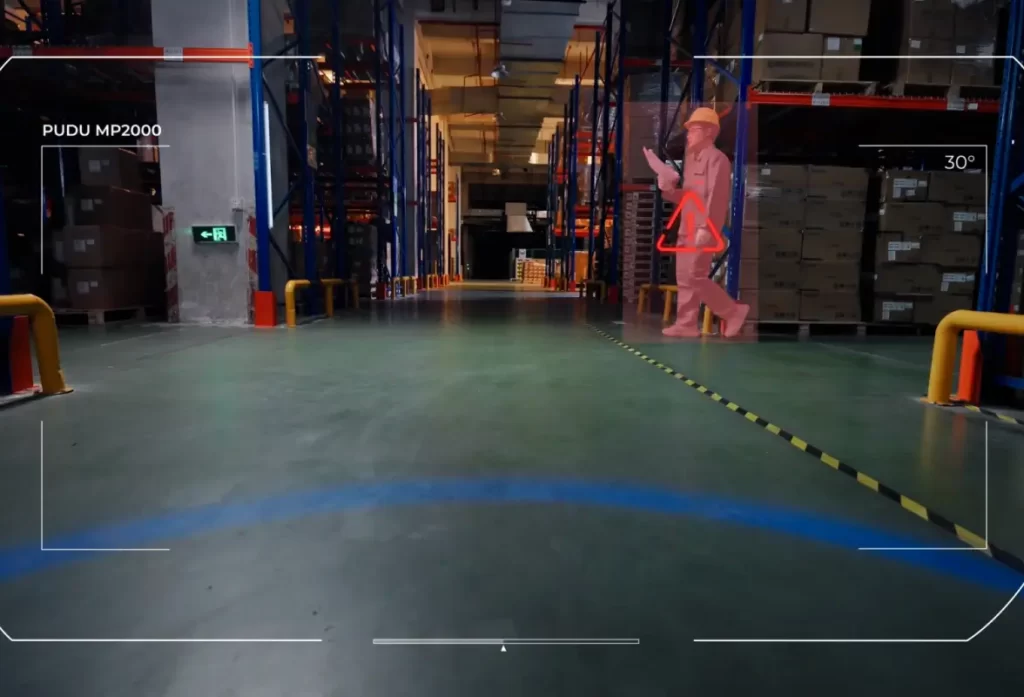
For an autonomous pallet handling robot, safety is just as important as payload capacity or navigation accuracy. The MP2000 is designed to operate in active industrial environments where workers, forklifts, pallet stacks, machinery, and other mobile equipment may all share the same space.
To manage these conditions, the PUDU MP2000 pallet handling robot uses a multi-layer perception system that combines several sensing technologies to continuously monitor its surroundings and respond to changing conditions.
360° Environmental Perception
MP2000 uses a combination of:
- 3D LiDAR
- Depth cameras
- Additional onboard sensing systems
Together, these provide the robot with broad environmental awareness around the vehicle rather than relying on a single forward-facing sensor.
This helps the system monitor people, obstacles, equipment, and changes in the operating environment while the robot is moving with or without a load.
Dynamic Obstacle Response
In active industrial facilities, obstacles are not always stationary. Workers may walk across the robot’s route, forklifts may enter shared areas, and other equipment may move unexpectedly.
When MP2000 detects a dynamic obstacle, the system can respond by:
- Adjusting its movement
- Avoiding the obstacle when appropriate
- Slowing down
- Stopping when necessary
This allows the robot to operate more safely in shared human-robot environments.
Static Obstacle Rerouting
If the robot encounters a stationary obstacle blocking its planned path, MP2000 can evaluate the surrounding environment and determine whether an alternative route is available.
Instead of simply remaining stopped until someone moves the obstruction, the robot can autonomously reroute when conditions allow.
This is particularly useful in warehouses and factories where temporary obstructions such as pallets, carts, or materials may appear throughout the day.
Safety With Heavy Loads
Handling a load of up to 2,000 kg requires the robot to consider more than its own dimensions. The pallet may extend beyond the robot body, which changes the space required for safe navigation.
MP2000 therefore combines its safety perception with load-aware clearance assessment, allowing it to consider the dimensions and contour of the carried load while planning movement.
This helps the robot account for:
- Wider pallet dimensions
- Different load profiles
- Restricted passages
- Nearby people and equipment
- Shared industrial pathways
The objective is to make autonomous pallet movement safer and more predictable in environments where heavy loads and people may operate in close proximity.
PUDU MP2000 vs Other PUDU Industrial Delivery Robots
PUDU already offers several industrial AMRs for internal material movement, including the T150, T300, and T600. However, the MP2000 serves a different purpose within this portfolio. While the T-Series primarily focuses on transporting materials, carts, racks, or loads between locations, the PUDU MP2000 is specifically designed around autonomous pallet handling.
The difference is therefore not simply payload capacity. MP2000 combines transport with direct interaction with the pallet itself, including pallet recognition, adaptive fork alignment, autonomous pickup, lifting, storage detection, and placement.
MP2000 vs PUDU T-Series
| Robot | Maximum Payload | Primary Role | Load Handling | Key Application |
|---|---|---|---|---|
| PUDU T150 | 150 kg | Light-payload industrial delivery | Standard and lifting configurations | Components, bins, parts, and light material movement |
| PUDU T300 | 300 kg | Industrial material delivery | Standard, lifting, shelf, and towing applications | Production-line and warehouse material transport |
| PUDU T600 | 600 kg | Heavy-payload industrial delivery | Lifting and rack-oriented material handling | Heavy internal logistics and rack transport |
| PUDU MP2000 | 2,000 kg | Autonomous pallet handling | Fork-based autonomous pallet pickup and placement | Heavy pallet movement across manufacturing, warehousing, and logistics |
PUDU lists maximum payloads of 150 kg for T150, 300 kg for T300, 600 kg for T600, and 2,000 kg for MP2000.
What Makes MP2000 Different?
The T-Series is particularly useful when the primary requirement is moving materials from one point to another. Depending on the model and configuration, these robots can carry loads, lift racks or carriers, tow equipment, and integrate with factory workflows.
MP2000 goes further into the pallet-handling process itself. Its capabilities include:
- AI pallet and load-carrier recognition
- Adaptive fork alignment
- Up to 15 cm pallet-position compensation
- Up to 15° angular-misalignment compensation
- Autonomous fork insertion
- AI storage-location detection
- Load-dimension and clearance assessment
- Autonomous pallet pickup and placement
- 2,000 kg maximum payload
This means MP2000 should not simply be considered a larger version of the T300 or T600.
The key distinction is:
T-Series robots primarily automate industrial material transportation, while MP2000 extends automation into the pallet pickup, handling, transport, and placement process itself.
That makes it particularly relevant for facilities looking to automate workflows that would traditionally require forklifts, pallet trucks, or dedicated pallet-handling equipment.
Where Does PUDU MP2000 Fit Best?
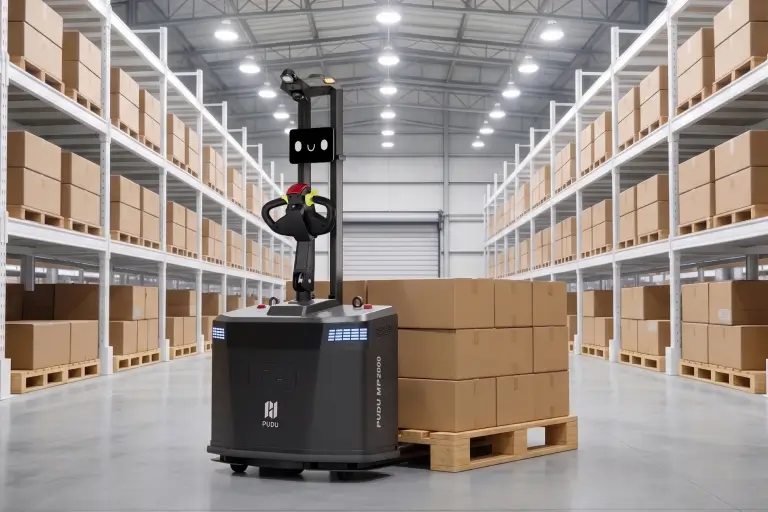
The PUDU MP2000 pallet handling robot is primarily designed for environments where heavy palletised goods need to move repeatedly between production, storage, and logistics areas.
Its combination of a 2,000 kg payload capacity, AI pallet recognition, narrow-aisle operation, autonomous pickup and placement, and fleet coordination makes it particularly relevant across manufacturing, warehousing, and logistics operations.
Manufacturing
Manufacturing facilities frequently require materials to move between warehouses, production lines, staging areas, and finished-goods zones.
MP2000 can support applications such as:
- Raw-material transfer
- Line-side material supply
- Work-in-progress movement
- Movement between production processes
- Finished-goods pallet transfer
- Repetitive internal logistics routes
Automating these movements can reduce the amount of repetitive pallet transportation that needs to be performed manually throughout a shift.
Warehousing
Warehouses represent one of the most natural applications for MP2000 because pallet movement forms a major part of daily operations.
Potential workflows include:
- Autonomous pallet pickup
- Transfer between storage zones
- Movement from receiving to storage
- Pallet staging
- Internal warehouse replenishment
- Transfer to dispatch areas
MP2000’s ability to perform 90° pallet pickup in aisles as narrow as approximately 2 metres and work with pallet spacing down to around 15 cm can also help facilities automate material handling without requiring unusually large dedicated robot lanes.
Logistics and Distribution Centres
Distribution centres often need to move large numbers of pallets between inbound areas, storage locations, sorting zones, and outbound staging areas.
MP2000 can support:
- Inbound pallet transfer
- Internal logistics movement
- Movement between warehouse zones
- Outbound staging
- Repetitive pallet-transfer routes
- Multi-robot material-flow operations
For larger facilities, multiple MP2000 units can also operate as a coordinated fleet, allowing pallet movement to scale beyond individual point-to-point tasks.
Overall, MP2000 is best suited to environments where the challenge is not simply moving goods, but consistently identifying, picking, transporting, and placing heavy palletised loads as part of a continuous industrial workflow.
PUDU MP2000 Technical Specifications
| PUDU MP2000 Technical Specifications | ||
|---|---|---|
| Specification | MP2000 Standard | MP2000 Narrow Fork |
| General Specifications | ||
| Product Type | AI-Native Pallet Handling Robot | |
| Model | MPID01-M | MPID01-N |
| Overall Dimensions |
1585 × 910 × 1870 mm 62.40 × 35.83 × 73.62 in |
1585 × 910 × 1870 mm 62.40 × 35.83 × 73.62 in |
| Maximum Load |
2,000 kg 4,409.25 lbs |
2,000 kg 4,409.25 lbs |
| Fork & Pallet Handling | ||
| Maximum Lift Height |
200 ± 5 mm 7.87 ± 0.20 in |
200 ± 5 mm 7.87 ± 0.20 in |
| Lowered Fork Height |
80 ± 5 mm 3.15 ± 0.20 in |
80 ± 5 mm 3.15 ± 0.20 in |
| Fork Outer Width |
620 mm 24.41 in |
550 mm 21.65 in |
| Fork Insertion Time | Approx. 20 seconds | |
| Compatible Standard Pallets | Three-runner pallets and perimeter-base pallets | |
| Non-Standard Load Carriers | AI learning supported for recognition of non-standard load carriers | |
| Pallet Position Offset Compensation | Up to 15 cm | |
| Pallet Angular Misalignment Compensation | Up to 15° | |
| Minimum Pallet Spacing | Down to approximately 15 cm | |
| Aisle & Space Requirements | ||
| 90° Pallet Pickup | Supported in aisles as narrow as approximately 2 m | |
|
Right-Angle Stacking Aisle Width 1200 × 1000 mm Pallet |
≤ 2,000 mm Pallet positioned 1200 mm along forks ≤ 78.74 in for 48 × 40 in pallet |
≤ 2,000 mm Pallet positioned 1200 mm along forks ≤ 78.74 in for 48 × 40 in pallet |
|
Right-Angle Stacking Aisle Width 1200 × 800 mm Pallet |
≤ 1,960 mm Pallet positioned 1200 mm along forks ≤ 77.17 in for 48 × 31.5 in pallet |
≤ 1,960 mm Pallet positioned 1200 mm along forks ≤ 77.17 in for 48 × 31.5 in pallet |
| Speed & Mobility | ||
| Maximum Speed – Unloaded | Up to 1.6 m/s | |
| Maximum Speed – Loaded | Up to 1.2 m/s | |
| Maximum Surmountable Threshold Height |
10 mm 0.39 in |
10 mm 0.39 in |
| Maximum Surmountable Gap |
35 mm 1.38 in |
35 mm 1.38 in |
| Gradeability – Full Load | 3° | 3° |
| Gradeability – Unloaded | 8° | 8° |
| Navigation & AI Intelligence | ||
| Navigation Method | 3D LiDAR-SLAM + VSLAM | 3D LiDAR-SLAM + VSLAM |
| AI Load-Carrier Recognition | Recognises supported standard pallets and can learn non-standard load carriers for precise fork engagement | |
| AI Storage Detection | Detects storage-location occupancy and pallet positions, selects the appropriate target, and plans pickup or drop-off | |
| Adaptive Pallet Alignment | Automatically compensates for manually positioned pallets within published offset and angular tolerances | |
| Intelligent Clearance Assessment | Detects load dimensions and contours and calculates the space required for safe passage in real time | |
| Safety & Perception | ||
| Safety System | Omni-Sense multi-layer safety perception | |
| Primary Safety Sensors | Depth cameras, 3D LiDAR, and additional onboard sensors | |
| Environmental Perception | 360° perception | |
| Dynamic Obstacle Response | Intelligent avoidance and stop | |
| Static Obstacle Response | Autonomous rerouting | |
| Battery & Charging | ||
| Battery Life – Unloaded | Up to 12 hours | Up to 12 hours |
| Battery Life – Maximum Load | Up to 6 hours | Up to 6 hours |
| Charging Time – 200–240 VAC Input | Approx. 2 hours | Approx. 2 hours |
| Charging Time – 100–120 VAC Input | Approx. 3.2 hours | Approx. 3.2 hours |
| Fleet & Operations | ||
| Fleet Orchestration | Distributed intelligent fleet orchestration | |
| Robot-to-Robot Communication | Supported for coordinated fleet operation | |
| Offline Fleet Operation | Supported; coordinated fleet operation can continue offline | |
| Operating Modes | Autonomous Mode and Manual Mode | |
| Integration & Task Control | ||
| PUDU Link Task Dispatch | Supported | |
| API Task Dispatch | Supported | |
| Voice Command Dispatch | Supported | |
| Task Button Dispatch | Supported | |
| Elevator Integration | Optional integration supported | |
| Automatic Door Integration | Optional integration supported | |
| Other IoT Device Integration | Supported | |
| Deployment | ||
| Deployment Approach | Plug-and-play, rapid deployment | |
| Site Mapping | Fast site mapping and configuration | |
| Site Modification Requirement | PUDU states that the robot does not require site modifications for standard deployment | |
| Core Applications | ||
| Manufacturing | Line-side material delivery | |
| Warehousing | Pallet handling | |
| Logistics | Distribution centre transfer | |
Is PUDU MP2000 Right for Your Operation?
The MP2000 is not intended to replace every type of industrial delivery robot or forklift application. Its strongest use case is where heavy palletised loads need to be repeatedly picked up, transported, and placed with minimal manual handling.
The robot is particularly worth considering when pallet movement has become a repetitive internal logistics process rather than an occasional task.
MP2000 May Be a Strong Fit When:
- Loads of up to 2,000 kg need to be moved autonomously
- Pallets must be picked up and placed without manual loading onto the robot
- Pallet positions are not always perfectly aligned
- Different pallet or load-carrier formats are used
- Narrow warehouse aisles need to be maintained
- Heavy materials move repeatedly between production and storage areas
- Multiple autonomous robots may eventually need to work together
- Material-flow tasks need to connect with existing facility systems or IoT devices
- A facility wants to reduce dependence on repetitive manual pallet-transport operations
Look Beyond Payload Capacity
Selecting an autonomous pallet handling solution should not be based on payload alone.
Before deployment, facilities should also evaluate:
- Pallet dimensions and construction
- Fork-entry dimensions
- Load centre and weight distribution
- Required pickup and drop-off positions
- Aisle width
- Turning space
- Floor condition
- Slopes, thresholds, and gaps
- Human and forklift traffic
- Required throughput
- Number of pallet movements per shift
- Existing warehouse or manufacturing systems requiring integration
This is particularly important when non-standard pallets or specialised load carriers are involved.
A proper site assessment allows the robot, pallet geometry, workflow, and facility layout to be evaluated together before finalising the automation solution.
Ultimately, MP2000 is most valuable where a facility wants to move beyond autonomous transportation and begin automating the physical pallet-handling process itself.
Conclusion: From Autonomous Delivery to Autonomous Pallet Handling
The PUDU MP2000 represents a significant expansion of PUDU’s industrial automation portfolio.
Rather than simply transporting a load between two destinations, MP2000 is designed to recognise pallets, compensate for imperfect placement, align and insert its forks, lift loads of up to 2,000 kg, assess clearance, navigate autonomously, and place the pallet at its destination. PUDU also combines these capabilities with intelligent fleet orchestration and multi-layer safety perception for operation in active industrial environments.
The result is a robot designed around the complete pallet-handling cycle:
Recognise → Align → Pick → Lift → Transport → Position → Place
For manufacturing plants, warehouses, and logistics centres looking to automate repetitive heavy-material movement, this distinction is important. MP2000 moves the conversation beyond autonomous delivery and toward autonomous material handling.
Explore PUDU MP2000 with Autofina Robotics
Every pallet-handling application is different. Pallet geometry, load weight, aisle width, pickup positions, traffic conditions, and required throughput all influence whether an autonomous solution will work effectively.
Contact Autofina Robotics to discuss your pallet-handling workflow, evaluate your facility requirements, and explore a PUDU MP2000 demonstration or site assessment.