AGV vs AMR for Electronics Manufacturing: Which Should Indian Manufacturers Buy?
An electronics production line can have advanced placement machines, automated inspection and reliable testing equipment, yet still wait for materials. Component reels need replenishment, verified kits must reach the assigned line, and PCB assemblies must move between processes without losing their identification or protection.
For an Indian Electronics Manufacturing Services (EMS) plant, these transfers can involve several production orders, changing priorities and shared aisles. Automating suitable movements can reduce the time employees spend accompanying loads across the factory.
However, choosing AGV vs AMR for electronics manufacturing requires more than comparing navigation technologies. The decision must account for the material, carrier, route, receiving arrangement and complete cost of deployment.
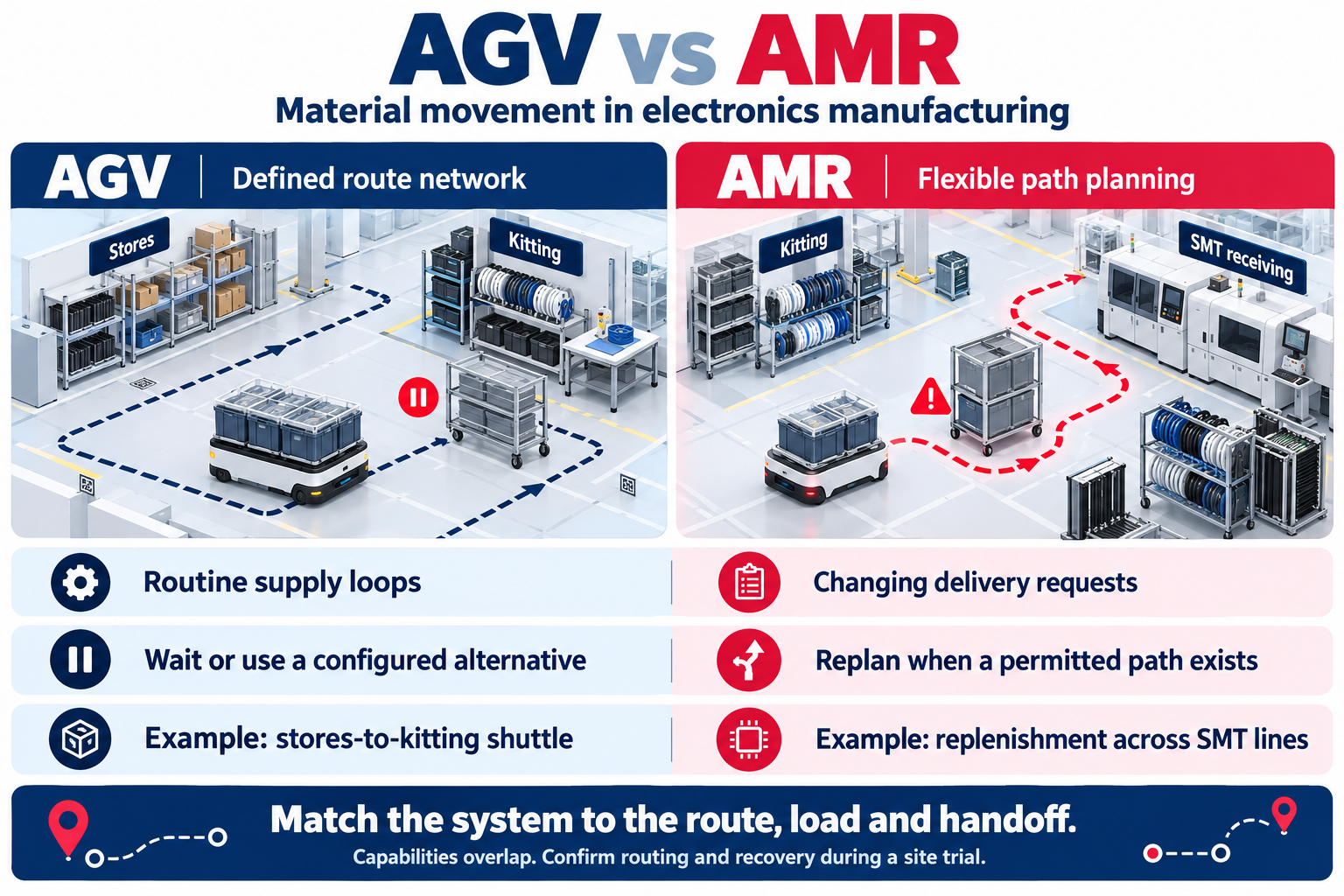
An Automated Guided Vehicle (AGV) may be a suitable option for a stable, repetitive transport route. An Autonomous Mobile Robot (AMR) may be better suited to changing destinations and flexible delivery requests. Modern systems can overlap in capability, so the proposed configuration must be assessed rather than relying on the category name alone.
For example, a regular movement between stores and a fixed preparation area presents a different requirement from urgent reel deliveries to several SMT lines. The first may prioritise repeatable route performance; the second may need flexible task assignment and destination selection.
The practical objective is to select a system that delivers the right material to the right receiving point, within the required time, while preserving the plant’s handling and verification controls.
AGV vs AMR: A Quick Comparison for Electronics Plants
The table below provides a starting point for comparing AGV vs AMR for electronics manufacturing. It describes typical differences and the questions an EMS buyer should investigate.
Neither category automatically guarantees better material flow. A robot that reaches its destination quickly can still spend excessive time waiting for loading or unloading.
The strongest comparison therefore measures the complete transfer—from a valid material request to confirmed receipt.
What Are AGV and AMR Robots?
AGVs and AMRs move materials without an onboard driver. The main difference is how they follow routes and respond when the path changes. Both can transport suitable loads between stores, production, inspection and dispatch areas.
AGV: Transport Along Defined Routes
An Automated Guided Vehicle (AGV) typically follows a predefined route or route network between designated stations. Guidance may use magnetic tape, markers, lasers or other navigation technology.
AGVs can suit repetitive movements where pickup points, destinations and traffic patterns remain predictable.
Example: An automotive component factory
A factory needs to move component trolleys from its supermarket storage area to three assembly stations throughout each shift. The stations remain in fixed positions, and the vehicle follows an established delivery circuit.
An AGV could suit this requirement. If a forklift blocks its path, its response depends on the installed system: it may wait or use another configured route.
AMR: Transport with Flexible Route Planning
An Autonomous Mobile Robot (AMR) uses onboard sensors and navigation software to locate itself within a mapped area and plan a path to its assigned destination.
When an obstacle appears, an AMR may navigate around it or choose another permitted path, provided sufficient safe space is available.
Example: An electronics manufacturing plant
A preparation area supplies component kits to several SMT lines. Delivery destinations change with production orders, while operators and material trolleys share the aisles.
An AMR could collect a released kit and take it to the requested line-side receiving point. If a trolley blocks one aisle, it may reach the destination through another approved aisle. If no suitable path is available, it must wait or trigger the agreed recovery process.
The Difference in Everyday Operation
| Situation | Typical AGV approach | Typical AMR approach |
|---|---|---|
| Routine delivery | Follows a defined route between stations. | Plans a path between configured locations. |
| An aisle is blocked | Waits or uses another configured route, depending on the system. | May plan an alternative path within its permitted operating area. |
| Production layout changes | Route or guidance changes may be required. | Map, destination or traffic-rule updates may be required. |
| Application to assess | Repeated component deliveries along a stable automotive assembly circuit, such as in a Pune component factory. | Kit deliveries to different SMT lines across shared factory aisles, such as in a Sriperumbudur electronics plant. |
These examples illustrate possible applications, not specific customer deployments. Modern AGV and AMR capabilities can overlap; confirm the proposed system’s behaviour during a site trial.
What Should an Indian Manufacturing Buyer Check?
Choose according to the actual workflow and demonstrated capabilities. Modern AGV and AMR systems can overlap, and neither label guarantees automatic loading, unloading or equipment integration.
During a site trial, ask the supplier to demonstrate three situations:
- Blocked aisle: Can the robot use another permitted route, or does it wait?
- Changed destination: How is a delivery reassigned to another production station?
- Occupied receiving point: How does the system manage waiting, notification and task completion?
For either technology, the complete solution must match the load, carrier, factory traffic and receiving process.
What Makes Electronics Material Handling Different?
Electronics manufacturing involves loads whose identity, condition and production status must remain controlled throughout movement. Transport planning needs to reflect these requirements.
Components Need Suitable Protection
Component reels, bare PCBs, populated boards and assembled products require different carriers.
A container suitable for packaged connectors may not be suitable for exposed PCB assemblies. A PCB magazine must support the boards appropriately, while reels and other items need restraint against shifting during travel.
Assessment should cover pickup, movement and unloading. Protecting the load during the journey is insufficient if the handoff exposes components to damage.
Kits Must Match the Production Order
An EMS plant may prepare materials for different customer programmes using similar bins or trolleys. The receiving team needs to identify the correct kit and associate it with the intended production order.
The robot should transport an identified load to an authorised location. Material verification must remain part of the process, whether performed by an operator or an integrated system.
A completed robot mission does not, by itself, confirm that the correct components were accepted.
Changeovers Affect Delivery Priorities
SMT lines may need prepared kits for the next job while continuing to consume materials for the current run.
The transport workflow must distinguish between routine replenishment, urgent requests and upcoming changeover materials. Otherwise, faster movement can simply create congestion at the line.
Returns and Quality Status Affect Routing
Material movement in electronics manufacturing continues after delivery. Empty carriers need collection, unused components require approved returns, and failed products may need rework or retesting.
For AGV vs AMR for electronics manufacturing, these return journeys are part of the workload. They should influence route planning, carrier design and fleet capacity rather than being treated as occasional extras.
AGVs or AMRs: Which Suit Electronics Manufacturing Routes Better?
Electronics factories move component reels, PCB carriers, fixtures, packed products and empty containers throughout each shift. The right automation approach depends on what moves, how often it moves and how the destination receives it.
When comparing AGV vs AMR for electronics manufacturing, assess each route separately. A scheduled stores-to-kitting shuttle has different requirements from urgent replenishment across several SMT lines.
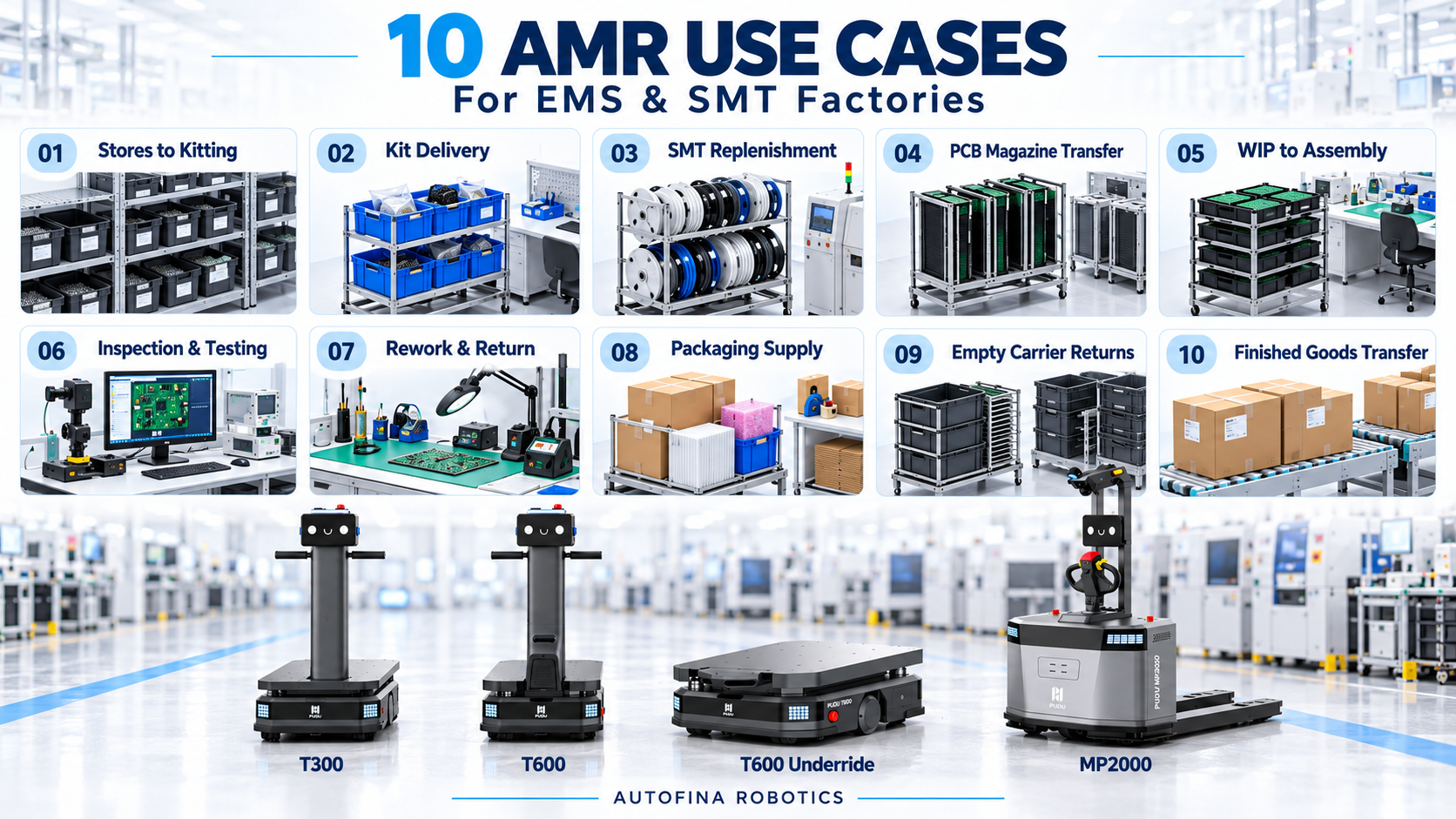
PUDU’s published deployments provide practical examples: T300 robots supporting Ennoconn’s EMS logistics and PuduBot 2 robots handling deliveries at a lithium-ion battery manufacturer in China. These are useful reference applications for Indian manufacturers evaluating similar workflows.
| Material movement | When an AGV approach may fit | When an AMR approach may fit | Essential check |
|---|---|---|---|
| Stores to kitting | Regular shuttle between established locations | Requests serve several preparation areas | Material readiness and order identification |
| Kitting to SMT | Repeatable deliveries to established stations | Line assignments or priorities change | Kit identity and receiving space |
| SMT replenishment | Predictable supply loops | Demand varies across several lines | Complete request-to-receipt time |
| Assembly to testing | Fixed production sequence | Products require different testing destinations | Product identity and test-buffer availability |
| Testing to packing | Consistent transfer of released products | Several authorised destinations | Quality status and release controls |
| Finished goods to staging | Repeated movement along defined routes | Multiple storage or staging destinations | Load stability and destination availability |
| Empty-carrier returns | Scheduled collection circuit | Collection depends on readiness and priority | Carrier availability and segregation |
Modern AGV and AMR capabilities overlap. Confirm the proposed system’s routing, dispatch and recovery behaviour rather than selecting by its label alone.
Stores to Kitting: Deliver Released Materials for the Next Order
Stores personnel pick component reels, bare PCBs, connectors and other parts against production requirements. A robot can then transport the identified, released load to its assigned preparation area.
A regular shuttle between fixed locations may suit an AGV arrangement. Several kitting bays with changing requests may benefit from an AMR arrangement.
For an Indian EMS plant: assess whether transport queues build after picking is complete. Automating this stage is most useful when prepared materials regularly wait for a person or trolley to become available.
The receiving team must still match the delivered material to the correct order. Picking accuracy and kit verification remain separate process responsibilities.
Kitting to SMT: Deliver the Correct Kit to the Assigned Line
A verified kit must reach the correct SMT receiving point before the scheduled job or changeover. The transport request should identify the kit, destination and required arrival time.
An AGV arrangement can serve repeatable deliveries between established stations. An AMR arrangement can support changing line assignments, subject to its dispatch and routing capabilities.
For a multi-line electronics factory : the important question is whether the next kit reaches an available receiving position before changeover begins. Separate spaces for incoming kits, current-job materials and returns help prevent mixing and congestion.
SMT Replenishment: Connect Delivery Timing with Production Demand
Replacement reels and other consumables must arrive before the available supply runs out. Measure the complete process: request, preparation, verification, pickup, travel and receipt.
PUDU describes T300 robots transporting solder paste, component reels and bare PCBs between the raw-material warehouse and SMT feeding area. The application uses a two-hour delivery cycle and automatic material-demand triggers. The two-hour figure describes the supply cycle, not an individual robot’s journey time.
For an Indian SMT plant, this illustrates how planned replenishment can work alongside demand-triggered requests. The required delivery window should follow the plant’s consumption and preparation times.
A robot delivering a reel to the line-side receiving point does not automatically install it in a feeder or load the SMT machine.
Assembly to Testing: Move Identified Products and Production Fixtures
PCB assemblies and other work-in-progress may travel in magazines, separated trays or engineered racks. Dispatch should depend on both product readiness and space at the next process.
Ennoconn: T300 robots connect assembly, functional circuit testing and ageing rooms through a delivery loop with priority-based scheduling. pudurobotics.com
Fixtures create another recurring transport requirement. At an unnamed lithium-ion battery manufacturer in China, PUDU reports that workers use PUDU Pager to summon T300 robots for fixture deliveries across production lines. PUDU reports a 50% improvement in material-turnover efficiency for this application.
For Indian electronics manufacturers, these examples support assessing fixture and test-related movement alongside component supply. The receiving buffer remains critical: faster transport cannot increase testing capacity when every receiving position is occupied.
Testing to Packing: Follow the Authorised Product Status
After testing, accepted products may move to packing, failed products to rework and undecided products to a controlled holding area.
The quality process determines the destination; the robot carries out the authorised movement.
An AGV arrangement may suit a consistent testing-to-packing route. An AMR arrangement may serve several approved destinations when task information identifies the product and its release status.
For electronics and automotive-electronics plants, the essential controls are clear identification, separate receiving positions and confirmation that the correct load reached the correct process.
Finished Goods to Staging: Match the Robot to the Packed Load
Packed cartons, PCB carriers and pallets need different handling arrangements. Selection must consider loaded dimensions, stability, pickup access and unloading.
PUDU describes T300 robots moving vacuum-packed PCBs and boxed PCBA units from the warehouse to the shipping area. This provides a reference for finished-product transport within an EMS facility.
For an Indian plant, evaluate carton or trolley movement separately from pallet transport. Palletised loads require equipment matched to the pallet and its handling interface. Delivery to dispatch staging also remains separate from loading a truck.
Returns and Support Deliveries: Keep the Complete Cycle Moving
Empty magazines, trays, bins and trolleys must return to preparation points. Unused reels need identification, quantity reconciliation and the plant’s approved return process before re-entering stock.
Scheduled collections may suit a defined return circuit. Readiness-triggered collections may suit an AMR workflow. Where the load and process allow it, an outbound delivery can be followed by a return collection.
A Chinese battery manufacturer deployed 32 PuduBot 2 robots for sample delivery, replenishment, inbound logistics and waste collection. PUDU reports more than 3,000 material batches handled daily and a 40% improvement in delivery efficiency. This demonstrates a broader support-logistics application; it does not establish that those robots collected empty PCB magazines.
A useful AGV vs AMR for electronics manufacturing assessment therefore includes forward deliveries, returns and support movements. For Autofina’s application review, the starting information should be the actual carriers, shift demand, receiving arrangements and current delays.
Will the Robot Keep Materials Moving During a Busy Shift?
For an electronics manufacturer, the practical question is whether materials reach production reliably when aisles, operators and receiving points are busy.
SMT lines rarely move. The more frequent challenges are parked trolleys, simultaneous replenishment requests, occupied delivery positions and empty carriers awaiting collection.
1. A Trolley Blocks the Aisle
Imagine a material trolley temporarily blocking the route between kitting and an SMT receiving point.
- An AGV may wait or use another configured route, depending on its routing capabilities.
- An AMR may plan another permitted path if sufficient space is available for its complete load.
If there is no suitable alternative, either system needs a clear waiting and notification process.
What to check during the demonstration: Block the normal route and observe whether the loaded robot reroutes, waits in an appropriate position or requests assistance.
2. Several Lines Request Materials Together
A robot must do more than reach a destination. The transport system needs to decide which request to serve first.
For example, a replacement-reel request may need priority over an empty-container collection. Robots sharing a narrow aisle also need coordinated access so they do not obstruct each other.
What to check: Test simultaneous requests from several lines, including an urgent delivery. Measure request-to-receipt time and observe how the remaining queue is handled.
3. The Receiving Position Is Occupied
A robot arriving on time does not complete the delivery if the operator cannot unload it or the receiving station is full.
Define whether the robot waits, alerts the responsible person or follows another approved instruction. Where equipment transfers are automated, the robot and station must exchange readiness and completion signals.
What to check: Leave the receiving position unavailable and demonstrate how the task is resolved without blocking the aisle.
4. The Carrier Needs More Space Than the Robot
A rack, trolley or overhanging load can require more clearance than the robot body.
Check loaded turns, docking approaches and unloading positions using the actual carrier. Repeat the trial with normal pedestrian and trolley traffic.
If staging positions or storage racks change later, review the affected routes and handoffs before resuming operation.
Where Does VDA 5050 Fit?
VDA 5050 is a standard communication interface between mobile robots and a central fleet-control system. It provides a common way to exchange transport orders and robot status, which can support coordination of compatible robots from different manufacturers.
For an EMS buyer, it becomes relevant when the plant wants to expand automation under a common control system. PUDU lists VDA 5050 support for its T600 series. The project should confirm the supported version, functions and compatibility with the proposed fleet controller.
VDA 5050 support alone does not establish automatic compatibility with every robot, conveyor or MES. Those connections still need an agreed integration scope and testing.
Which PUDU Robots Should an EMS Plant Assess?
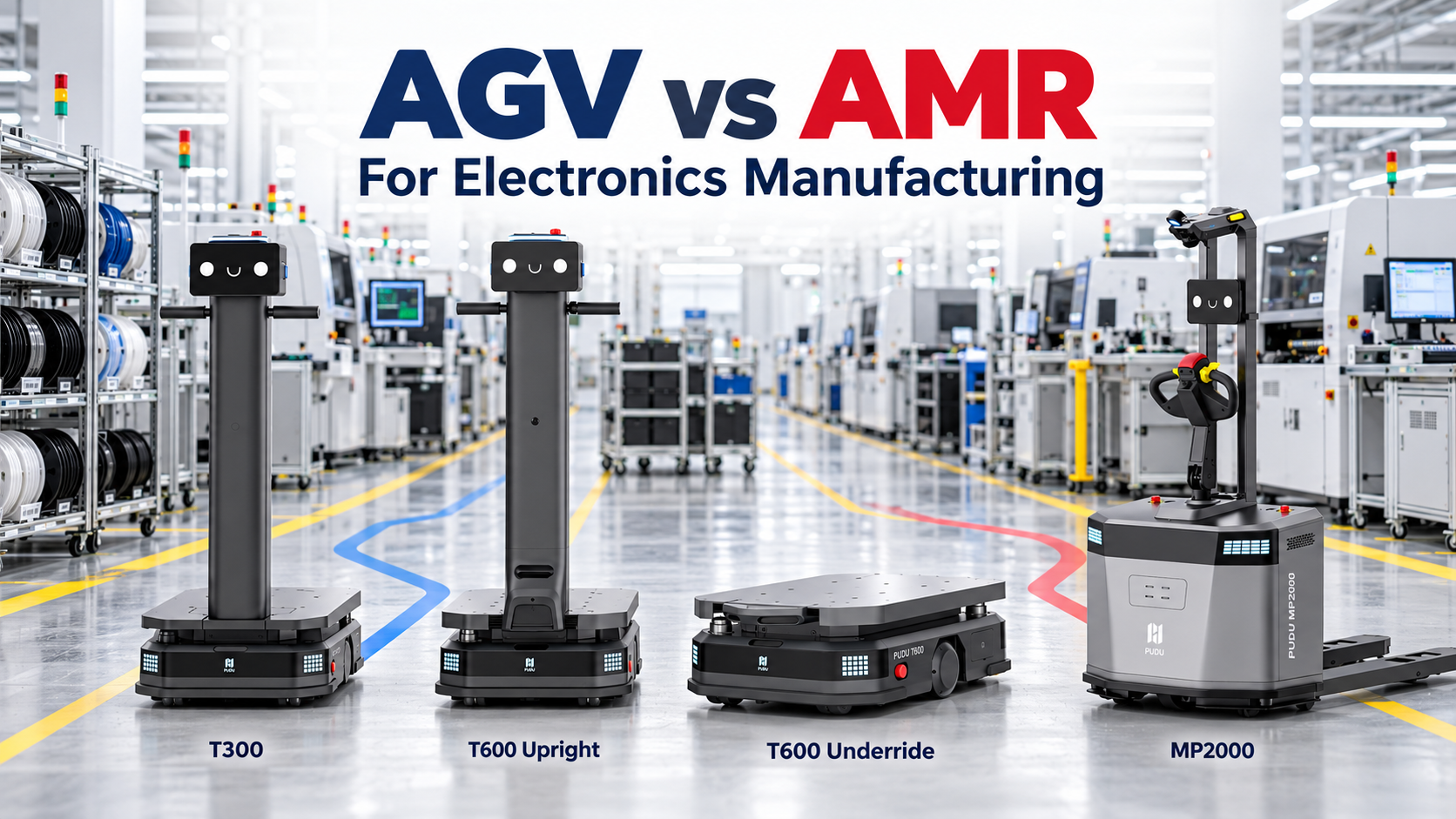
Select the robot around the material and handoff—not simply the highest payload. PUDU identifies the T300 and T600 as AMRs; avoid presenting them as separate conventional AGV models merely because they can perform repetitive delivery routes.
| PUDU configuration | EMS application to assess | How it would support the workflow |
|---|---|---|
| T300 with a suitable carrier | Prepared kits, protected containers and fixtures | Moves released loads from preparation to designated production or testing receiving points |
| T300 Roller | Standardised container transfers between equipped stations | Connects robot transport with an engineered roller handoff |
| T600 Upright | Heavier consolidated material loads | Provides transport capacity for compatible loads that exceed the smaller application’s requirements |
| T600 Underride | Compatible rack or carrier movement | Collects and moves carriers through an appropriately designed pickup interface |
| MP2000 | Palletised materials and finished goods | Handles compatible pallets between storage, preparation and dispatch staging |
The T300 supports several handling arrangements, including shelf, lifting and towing configurations. T600 selection should distinguish its upright and underride versions, while MP2000 addresses pallet handling. Each proposed arrangement needs validation with the plant’s actual carrier and load. pudurobotics.com
Assess kit delivery or replenishment first where transport delays are measurable. Include heavier carriers and upstream pallet movement when they form part of the same material-flow problem.
How Autofina Robotics Helps Streamline Material Movement
A useful deployment starts with the production requirement and continues through commissioning and operational support. Autofina’s proposal should make its responsibilities clear at each stage.
| Stage | Autofina’s role to define in the project scope | Deliverable for the plant |
|---|---|---|
| Understand the current process | Review routes, shift demand, transport delays and loading responsibilities | A prioritised application and baseline |
| Select the handling arrangement | Match the robot, carrier and receiving interface to the actual material | Proposed configuration and responsibilities |
| Define requests and integration | Agree operator calls, dispatch priorities, equipment signals and factory-system connections with the relevant vendors | An agreed workflow and interface scope |
| Trial the application | Test representative loads, busy traffic, occupied destinations and recovery scenarios | Recorded results against acceptance criteria |
| Commission and train | Configure agreed routes and destinations, validate handoffs and train authorised personnel | An operational workflow and handover records |
| Support and improve | Provide the contracted service scope and review delivery performance with the plant | Support arrangements and evidence for expansion |
The outcome to demonstrate is a complete material cycle: the right load collected, delivered, accepted and followed by the required return movement.
Share your route layout, carrier details and shift demand with Autofina Robotics to define a practical first application and measurable trial.
Build Material Flow That Keeps Production Moving
For an EMS facility, the AGV vs AMR for electronics manufacturing decision comes down to a practical outcome: getting the right materials to the right station within the required production window.
The strongest starting point is a recurring movement with a measurable problem—kits waiting for transport, delayed replenishment or empty carriers accumulating beside production. Match the robot to the load and receiving process, then prove the complete workflow during a representative trial before expanding.
Autofina Robotics helps manufacturers turn these requirements into a practical PUDU deployment, from material-flow assessment and robot selection to scoped integration, commissioning, operator training and ongoing service support.
Planning to automate material movement in your electronics facility? Share your route layout, carrier details and shift demand with Autofina Robotics to identify your first application.